

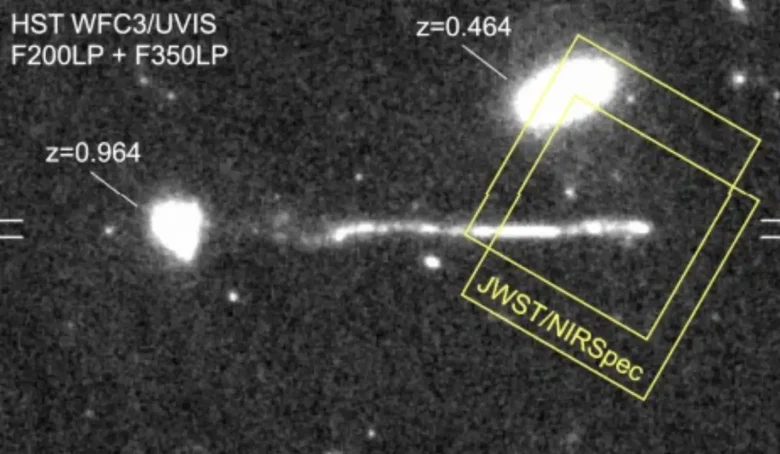
For the first time ever, astronomers have confirmed that a supermassive black hole has been thrown out of its home galaxy and is racing through space, leaving a glowing trail behind it. The object, known as RBH-1, sits about 7 billion light-years away and was confirmed using the James Webb Space Telescope (JWST). The discovery explains a strange, ruler-straight streak of light seen earlier by Hubble and settles years of debate over what caused it.
The black hole weighs millions of times more than the Sun and is moving at close to 1,000 kilometers per second. It likely got this violent push during a past galaxy merger, when two black holes joined and released energy unevenly. That imbalance acted like a cosmic kick, strong enough to eject one of them completely.
Astronomers first noticed the streak in 2023 while studying distant galaxies. The feature stretched for about 62 kiloparsecs and appeared to shoot straight out of one galaxy. Early ideas included a thin galaxy seen edge-on or the remains of a smaller system torn apart. None of those options explained why the light grew brighter at the far end or why stars were missing.
New data from Webb’s NIRSpec instrument changed everything. The telescope measured gas motions at the tip of the streak and found a sharp split in speeds. Gas on one side moved toward Earth, while gas on the other moved away. The shift happened over a very small distance, a clear sign of a fast-moving object slamming into surrounding gas.
This pattern matches a bow shock, the same shape water forms ahead of a fast boat. As the black hole plows forward, it heats and squeezes the gas in front of it. That gas cools and glows, creating the bright head of the trail. Behind it, the wake narrows and breaks into clumps as the flow slows down.
The glow does not come from stars or from the black hole feeding on material. Instead, the motion alone supplies the energy. Over tens of millions of years, the runaway has stirred and recycled huge amounts of gas, enough to form large numbers of stars along the way.
Astronomers say this finding matters because it confirms long-standing ideas about how black holes behave after mergers. It also offers a new way to spot similar runaways in future surveys. RBH-1 shows that even the biggest objects in the universe can get kicked out, and when they do, they leave tracks that are hard to miss.
Source: JWST Confirmation of a Runaway Supermassive Black Hole via its Supersonic Bow Shock
