
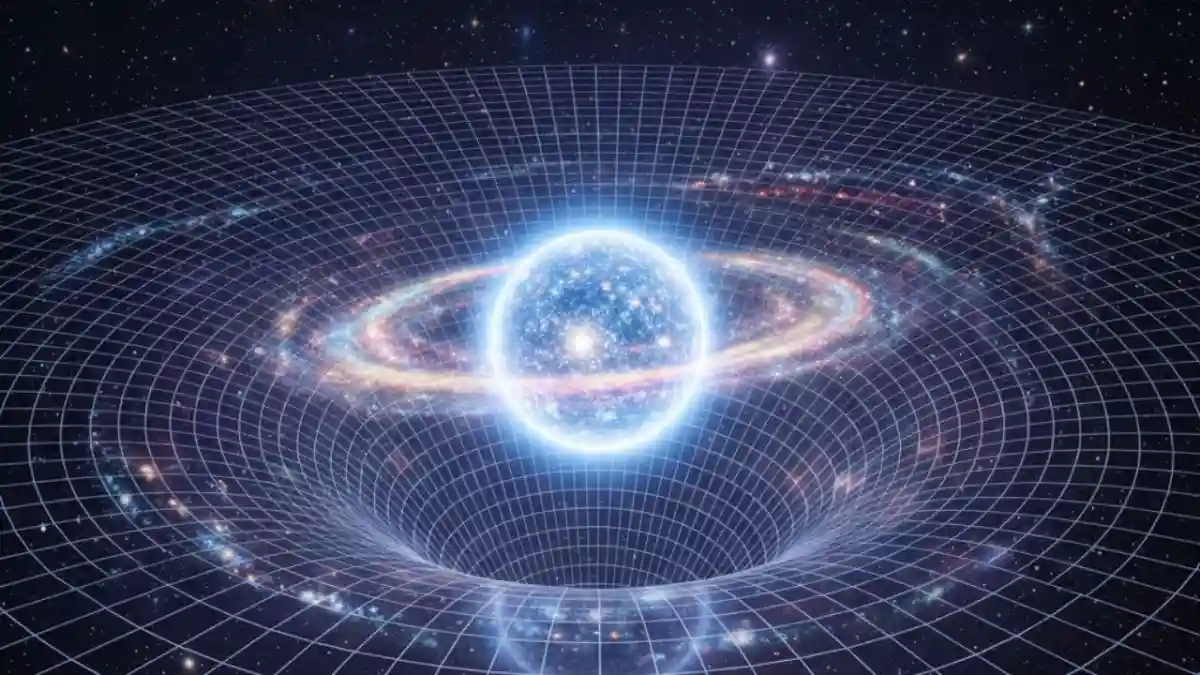
A physicist at the University of Ottawa is challenging one of modern astronomy’s biggest idea that invisible dark matter holds galaxies together. In a study published in September, Rajendra Gupta argues that galaxies may not need unseen mass at all. Instead, he suggests that the laws of physics themselves change over time as the universe expands, altering gravity and the speed of light in ways that mimic dark matter’s effects.
Gupta’s research builds on his “Covarying Coupling Constants plus Tired Light” model, or CCC+TL. It modifies the basic constants of nature rather than introducing new forms of matter or energy. By adjusting how the speed of light and gravity’s strength vary with cosmic age, his model reproduces the rotation speeds of galaxies from the SPARC database, a major collection of observations that record how fast stars orbit their galactic centers.
The model also explains supernova brightness and cosmic expansion without invoking dark energy. For decades, astronomers have used dark matter to explain why galaxies spin faster than visible stars and gas can support.
In standard physics, outer stars should orbit more slowly, yet their speeds stay nearly constant far beyond the galactic core. To account for this, researchers proposed halos of invisible dark matter surrounding galaxies. Despite extensive searches with detectors such as Xenon1T, no dark matter particles have ever been found.
The James Webb Space Telescope (JWST) has added new questions to the mystery. Webb has observed massive, well-formed galaxies appearing just a few hundred million years after the Big Bang. Standard dark matter models predict that galaxies at that time should be smaller and less organized. Gupta’s CCC+TL framework naturally produces large, early galaxies, as its variable constants allow faster structure formation and a longer cosmic timeline.
The model also offers a possible solution to the Hubble tension, the ongoing disagreement over the universe’s expansion rate. Measurements from nearby galaxies differ from those inferred from the early universe’s background radiation. Gupta’s equations suggest the universe could be about 27 billion years old, roughly twice the standard estimate, which would reconcile these differences by giving the cosmos more time to evolve.
His theory builds on an idea first proposed in 1937 by physicist Paul Dirac, who suggested that the strength of gravity might change over time. In Gupta’s version, both the gravitational constant and the speed of light vary according to a time-dependent factor represented as f(t) = exp[α(t – t₀)].
The value of α is small and negative, meaning gravity and light speed slowly weaken as the universe ages. These changes modify Einstein’s equations and alter how galaxies behave on large scales.
In this framework, there is no need for a cosmological constant or invisible energy. The new terms that emerge from α act like dark matter and dark energy. Near a galaxy’s dense center, the constants barely change, and ordinary matter dominates. Farther out, the variation becomes stronger, increasing the gravitational pull that keeps stars moving steadily even in low-density regions.
To test the model, Gupta analyzed several galaxies from the SPARC database, including NGC 3198, a classic spiral with a flat rotation curve. His equations reproduced the observed rotation speeds using only visible matter and the variable constants. Across seven galaxies of different shapes and sizes, he found consistent thresholds where α begins to rise, corresponding to the radius where the flat rotation pattern starts.
The model also scales up to larger structures such as galaxy clusters. When Gupta applied it to gravitational lensing data, which shows how clusters bend light from distant galaxies, the results matched observed patterns using the same parameters. At earlier cosmic times, the influence of α-matter fades, predicting steeper rotation curves in young galaxies, a trend already seen in recent JWST data.
Gupta combines the changing constants with a modified view of how light travels called tired light, where photons gradually lose energy as they move through space. This process increases redshift without requiring dark energy. Critics of tired light argue that it would blur distant images, but Gupta says his model avoids this by linking redshift to the changing speed of light instead of scattering.
If the theory holds up, it could remove both dark matter and dark energy from cosmology. Galaxies would form and remain stable because of evolving physical laws, not hidden substances. The model could also help explain gravitational lensing and the cosmic microwave background by introducing small, gradual variations in the constants across space and time.
Astronomers plan to test these ideas with future data. The European Space Agency’s Euclid telescope and Japan’s LiteBIRD mission could detect whether physical constants vary across cosmic distances. Gravitational wave detectors such as LISA may also find early-universe signals consistent with Gupta’s predictions.
While many scientists remain cautious, Gupta’s work reflects a growing curiosity among cosmologists about whether the universe’s constants are truly constant. If confirmed, his theory could mean that dark matter and dark energy are not separate substances at all but illusions created by the slow, natural drift of the universe’s fundamental laws.
Source: Testing CCC+TL Cosmology with Galaxy Rotation Curves

Leave a Reply