
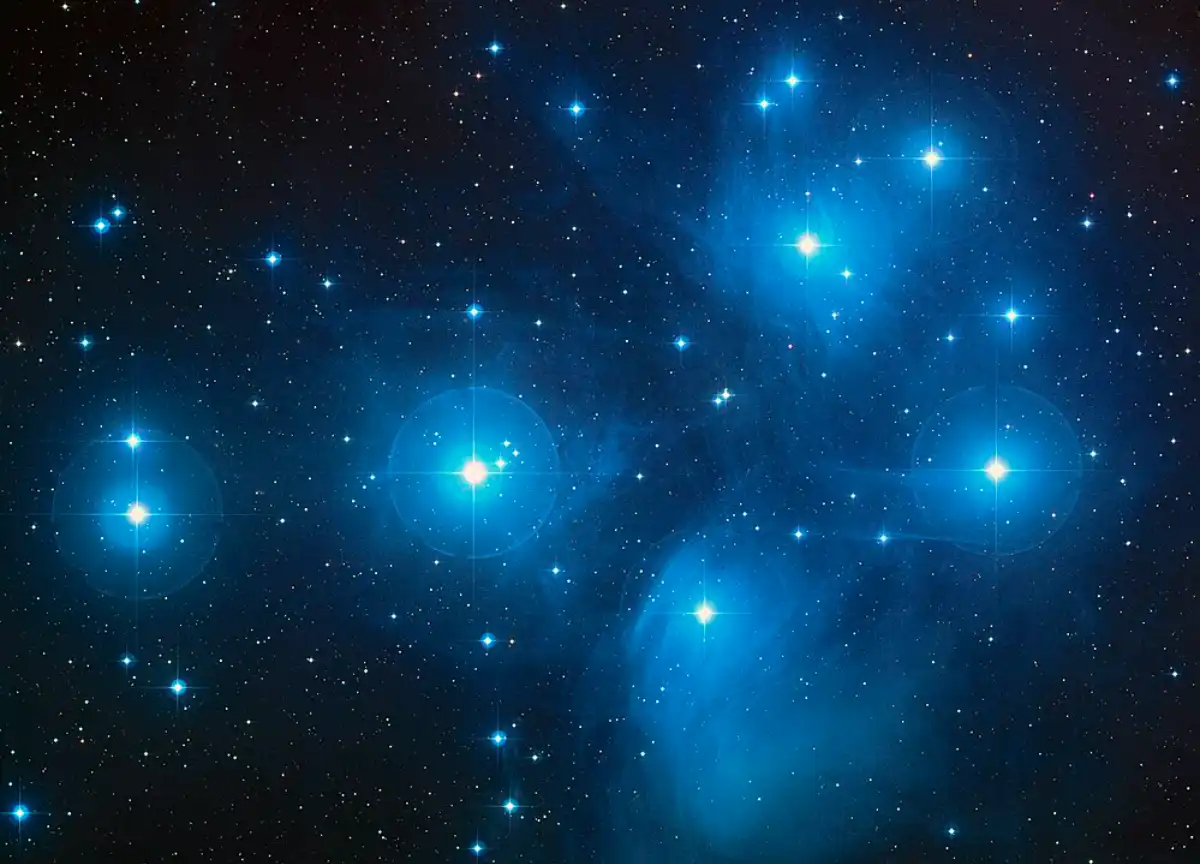
have reported that the Pleiades, the bright star cluster seen in the constellation Taurus, is only the compact core of a far larger family of stars that formed together about 125 million years ago. By using data from NASA’s TESS satellite and the European Space Agency’s Gaia spacecraft, researchers identified more than 3,000 related stars spread across nearly 2,000 light-years of space.
The Pleiades, often called the Seven Sisters, has been known for thousands of years. On a clear night, most people can see six or seven bright stars close together in the sky. Astronomers had already studied this central cluster in detail, which lies about 440 light-years from Earth. Until now, the focus remained on only this compact region.
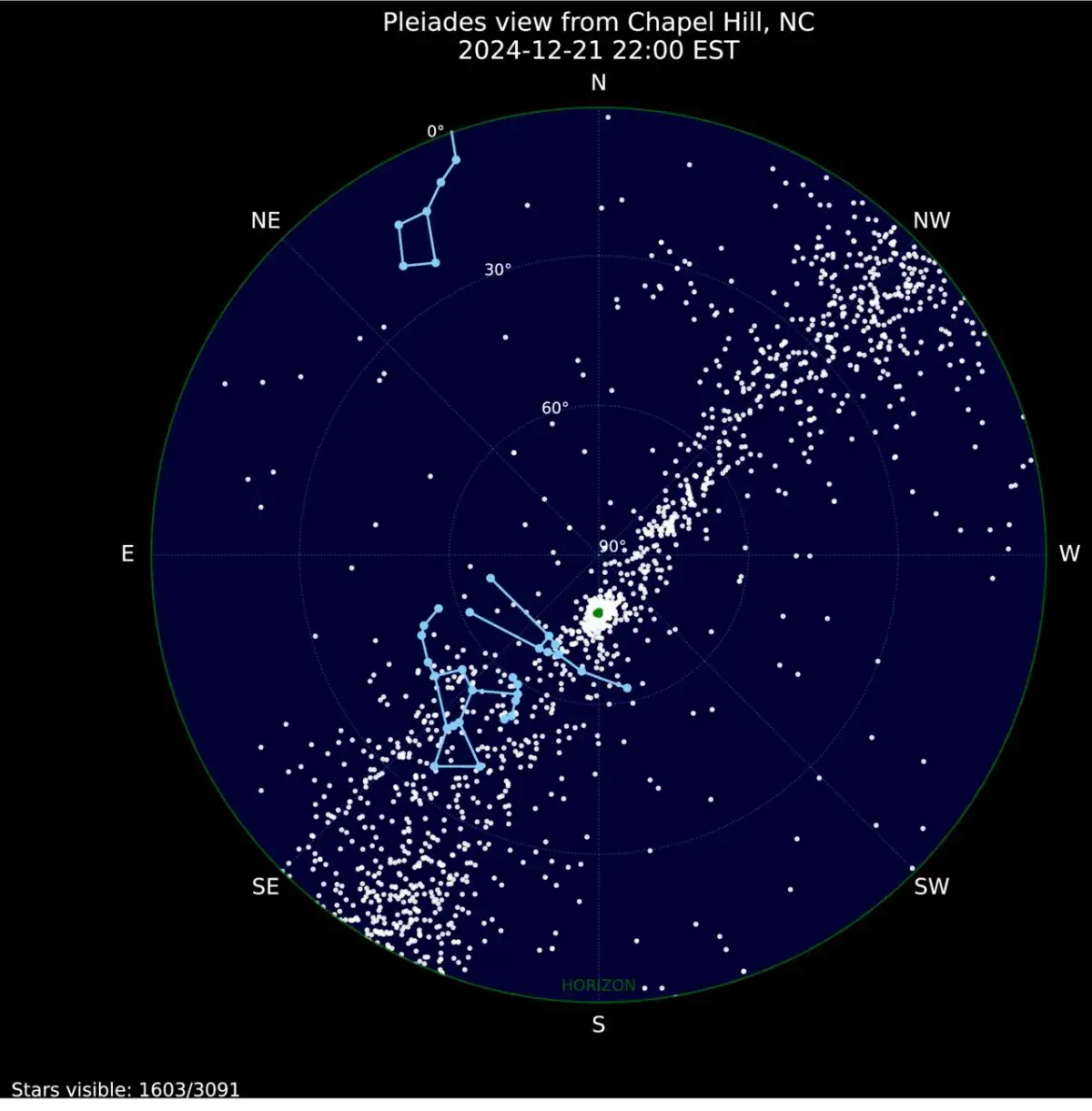
The new research shows that this visible group is just the middle of what scientists now call the Greater Pleiades Complex. Many related stars sit far from the bright core and do not form a tight cluster anymore. Some are hundreds of light-years away, while others lie more than a thousand light-years from the center.
To find these hidden members, scientists tracked how fast stars rotate. Young stars spin faster than older ones, and their spin causes small changes in brightness as dark spots move across their surfaces. TESS measures these tiny shifts in light. Gaia then provides exact positions, distances, and movements through space. By combining these two sets of information, the team found stars that move like the Pleiades and spin at the same youthful rate.
This method revealed long streams of stars that appear to have drifted from the original cluster over time. One stream, called UPK 303, can be traced back toward the Pleiades’ location at the time of its birth. Other groups, such as UPK 545, likely formed in the same large gas cloud but ended up far apart as the cluster slowly broke up.
Most stars form in groups, but gravity and the pull of the Milky Way usually tear these clusters apart within a few hundred million years. The Greater Pleiades Complex shows that even after a cluster spreads out, its members can still be identified by their shared motion and age. This changes how astronomers view the nearby region of space and suggests there may be many more hidden star families around us.
The Pleiades has long been used to study how young stars and planets develop. Adding thousands of stars of the same age gives scientists a much larger sample to compare. This can help improve models of how planets form and how stellar systems change over time.
The study focused on stars between about 50 and 200 million years old, when rotation is still easy to measure. Researchers now plan to use the same approach on other famous groups, including the Hyades and the Scorpius–Centaurus region. The current list includes about 3,100 strong candidates, but future data releases from Gaia and more observations from TESS may reveal many more.
The Sun is not part of this family, but it likely formed in a similar cluster long ago. Studies like this may one day help locate stars that were born alongside our own.
When you look up at the Pleiades on a clear winter night, you are only seeing the bright center. Around it, spread wide across the galaxy, lies a much larger family that began in the same cloud of gas and dust millions of years ago.
Source: Lost Sisters Found: TESS and Gaia Reveal a Dissolving Pleiades Complex

Leave a Reply