
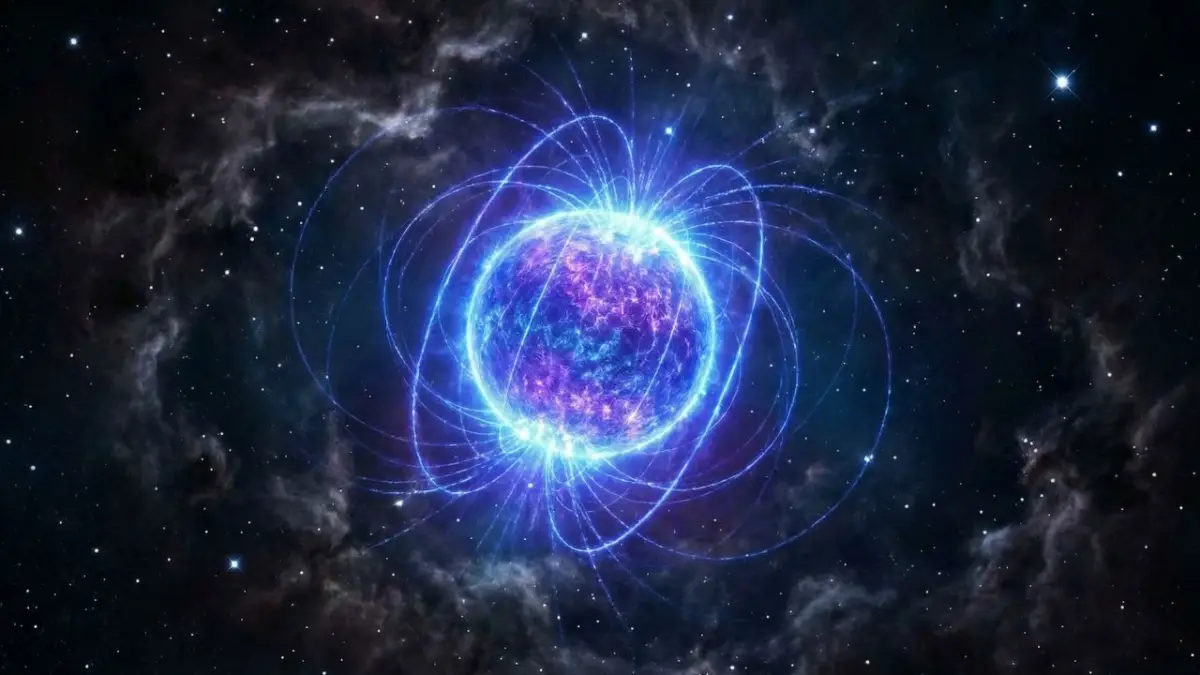
A new study suggests that fast-spinning neutron star remnants formed after violent mergers may mask or weaken the effects of dark matter hiding inside them. The work, led by Lorenzo Cipriani, looks at why some merged stars delay their collapse and how a small dark core might change their fate during the short but intense stage that follows a collision.
When two neutron stars crash together, the usual outcome is a black hole. But for a brief moment, the merged object can stay intact as a hypermassive neutron star. This short-lived stage lasts only milliseconds, yet it produces bright flashes across the electromagnetic spectrum and loud bursts of gravitational waves. The remnant survives because its outer layers spin far faster than its center, giving it extra support against gravity.
Many physics models allow dark matter to gather inside neutron stars over long timescales. If the dark component forms a compact core, it adds extra pull without adding much outward pressure. Earlier studies found that this extra weight makes a non-spinning star easier to collapse. Until now, researchers had not tested how this idea plays out in the rapidly rotating case that actually forms after a merger.
Cipriani’s team updated the RNS code, a standard tool for modelling spinning stars, so it could track two fluids at once: ordinary matter and a bosonic dark component. They used a realistic equation of state for nuclear matter and rotation patterns that match full merger simulations. The dark core rotated almost uniformly, while the regular matter spun up sharply outside the center and fell off near the edge.
Their models showed that adding a dark core equal to five percent of the total mass lowers the maximum mass the star can hold by about a third of a solar mass. That matches the softening seen in non-spinning stars. But as the total spin increases, the difference between stars with and without dark matter gets smaller. At extreme rotation rates, the two cases almost meet again, suggesting that rapid spin can partly counter the extra pull from the central core.
The team found two broad categories of remnants. Some flatten into a toroidal shape and reach higher masses. Others stay closer to round and support less mass. In the rounder models, the spin rate of the regular matter dips slightly a few kilometers from the center before rising again. The dark core reduces the enclosed mass just enough to let this dip form.
These small changes may matter for future gravitational-wave observatories such as the Einstein Telescope and Cosmic Explorer. These projects will hear the high-frequency ringing of merger remnants in far more detail. Even small adjustments to the frequency or lifetime of the signal could show up when thousands of events are measured.
Researchers still do not know whether neutron stars actually host dark cores. Most proposed dark matter models face tight limits from astronomy and collider experiments, though a narrow window remains. The new work suggests that rapid and uneven rotation complicates the picture. A dark core that weakens a calm neutron star may leave a smaller trace in the chaotic moments after a merger.
Future research will test other forms of dark matter and build full three-dimensional merger simulations. For now, the study hints that if we hope to use neutron star mergers to track dark matter, the spin of the remnant cannot be ignored.
Source: Differentially rotating neutron stars with dark matter cores

Leave a Reply