
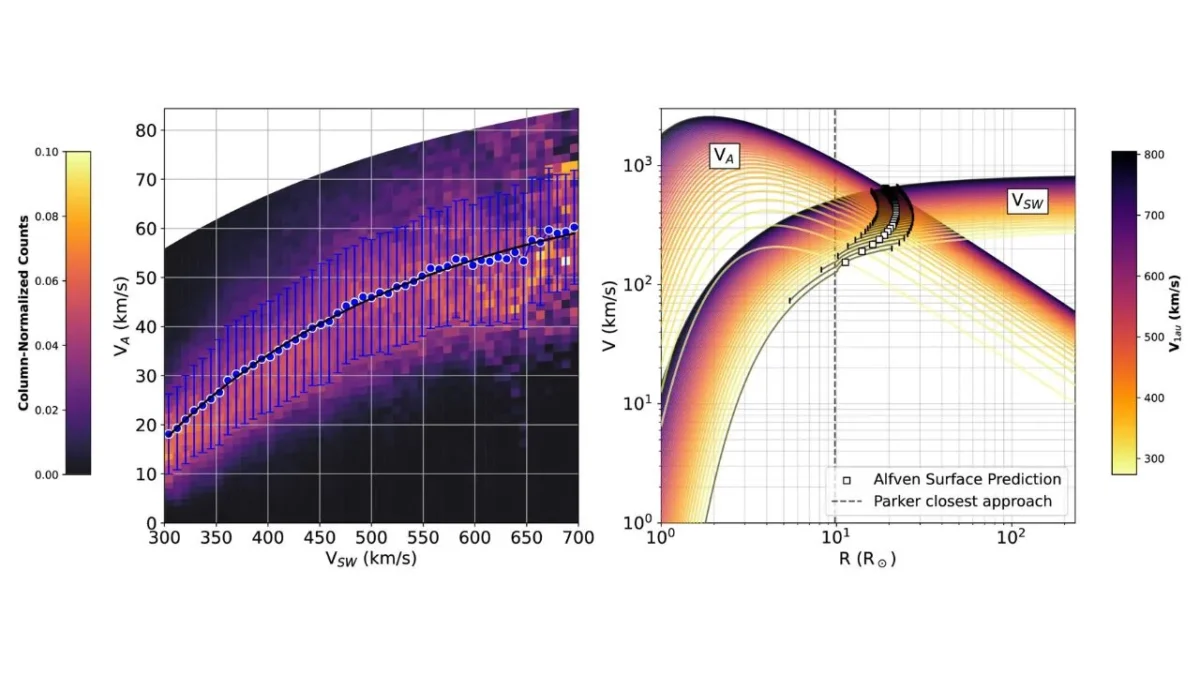
NASA’s Parker Solar Probe has crossed a hidden boundary around the Sun that shapes how solar wind escapes into space, and new research shows that this boundary expands, contracts, and grows more uneven as the Sun moves through its activity cycle. By combining close-range measurements from Parker with data from Europe’s Solar Orbiter and spacecraft near Earth, scientists tracked how this zone, known as the Alfvén surface, changed from the calm phase of solar cycle 25 to its recent peak.
Parker has flown closer to the Sun than any spacecraft before, reaching about 3.8 million miles above the surface. During several of these close passes, the probe moved inside the Alfvén surface, where the Sun’s magnetic field still controls the motion of charged particles. Above that boundary, the solar wind escapes freely and carries energy and rotation away from the star.
The study shows that the height of this surface is not fixed. Near the quiet period of 2019, it sat roughly 12 to 17 solar radii from the Sun. As solar activity climbed toward its peak in 2024, the boundary swelled outward to about 15 to 23 solar radii. This expansion matters because a higher boundary allows the Sun to lose spin more efficiently over time, shaping how stars age.
To map this shifting region, researchers blended observations from multiple spacecraft. Parker supplied direct crossings close to the Sun, Solar Orbiter filled in the middle distances, and satellites near Earth provided steady long-range measurements. By tracking wind speed, magnetic strength, and particle density, the team reconstructed the surface’s shape and confirmed their results against Parker’s direct encounters.
The maps also show that the boundary grows rougher during busy solar periods. Its shape becomes more uneven, with bumps and dips linked to solar storms and erupting regions on the Sun’s surface. During quieter times, the boundary appears smoother and closer in.
These findings carry practical value for space weather forecasting. Changes in this boundary affect how energetic particles travel through the solar system, which can influence satellites, astronauts, and missions to the Moon and Mars. The results also help scientists understand how stellar winds may affect planets around other stars.
Parker Solar Probe will continue its close passes for several more years as solar activity declines again. Along with future high-latitude views from Solar Orbiter, these observations will help build a clearer picture of how our star breathes, spins, and shapes the space around it.
