
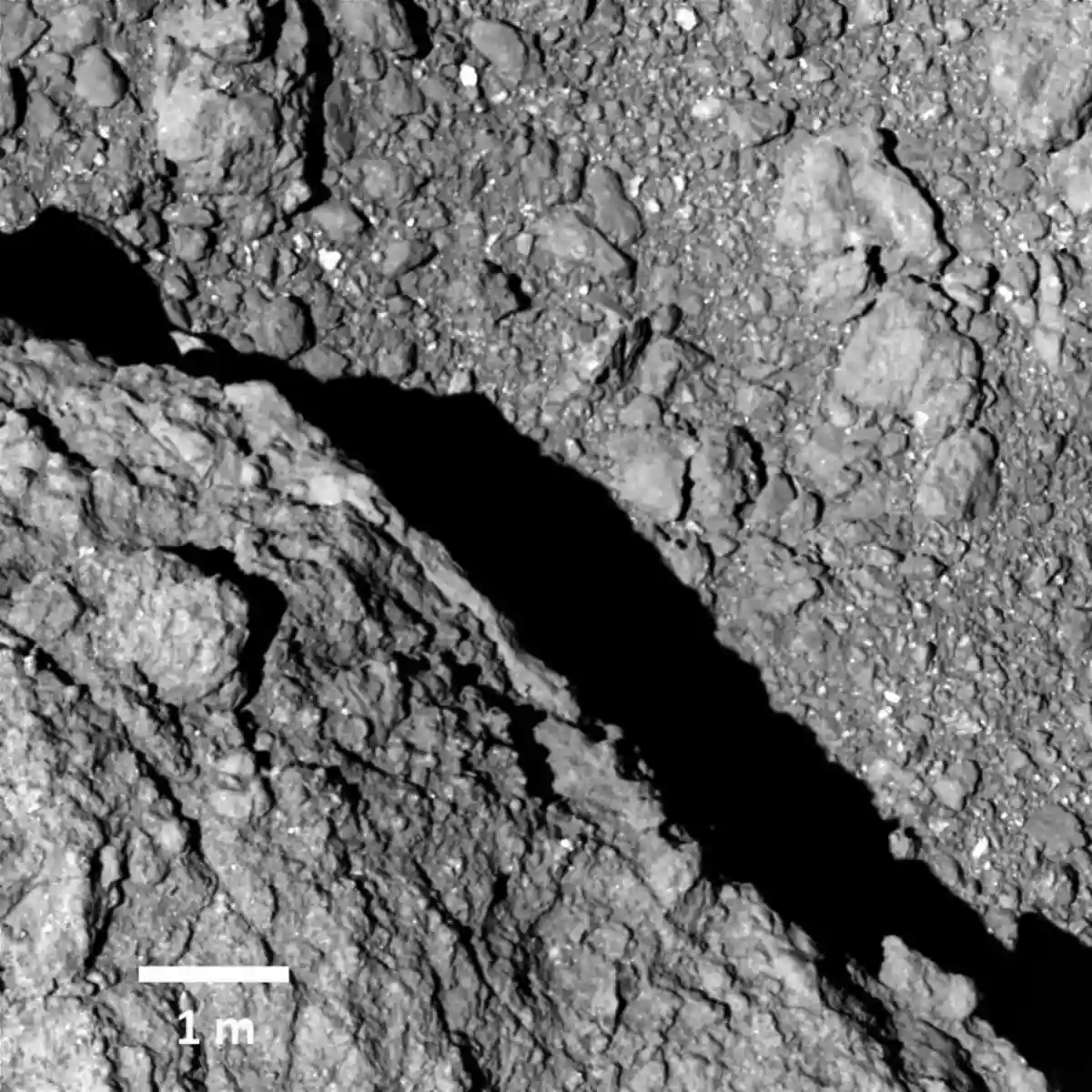
A new analysis of asteroid dust returned by Japan’s Hayabusa2 mission has revealed that tiny grains from the asteroid 162173 Ryugu still hold a record of magnetic fields from the early solar system. Researchers led by Masahiko Sato studied 28 samples and found that most preserve stable magnetic signals formed billions of years ago, offering a rare look at the environment where the first planets began to take shape.
Asteroids formed from leftover gas, dust, and rock when the solar system was young. Because they have remained mostly unchanged since then, they act like time capsules. When the Hayabusa2 spacecraft returned material from Ryugu in 2020, scientists hoped those grains could reveal details about the conditions that existed when planets were forming.
Earlier research produced confusing results. Different teams studied only a handful of grains and reached conflicting conclusions. Some reported a stable magnetic signal from the early solar system. Others argued the asteroid formed in a region with almost no magnetic activity. A third group suggested Earth’s magnetic field had contaminated the samples during handling.
The new study tackled that problem by analyzing four times more material. The team examined 28 grains and removed modern magnetic interference through a method called alternating field demagnetization. After cleaning the samples, 23 still held a stable magnetic signal while five did not.
The measurements show magnetic field strengths between about 16 and 174 microteslas. For comparison, Earth’s magnetic field averages around 50 microteslas. Several grains even contained signals pointing in different directions within the same piece of rock. That detail helped confirm the magnetism came from space, not from Earth.
The researchers believe these signals formed when the asteroid’s building blocks interacted with liquid water early in its history. Minerals known as framboidal magnetite can form when water reacts with rock. When those minerals cooled or hardened inside a magnetic field, they locked in the field’s direction and strength.
The team estimates this process happened between about 3 and 7 million years after the first solid material appeared in the solar system. That places the event very early in planetary history.
The findings may help scientists improve models of how planets formed.
“Our highly sensitive magnetic measurements on microsamples collected from the asteroid Ryugu provided sufficient magnetic data to finally clarify the differing interpretations obtained by previous research groups. Thereby, offering important clues for understanding the evolution of the early solar system,” said Dr. Sato

Leave a Reply