
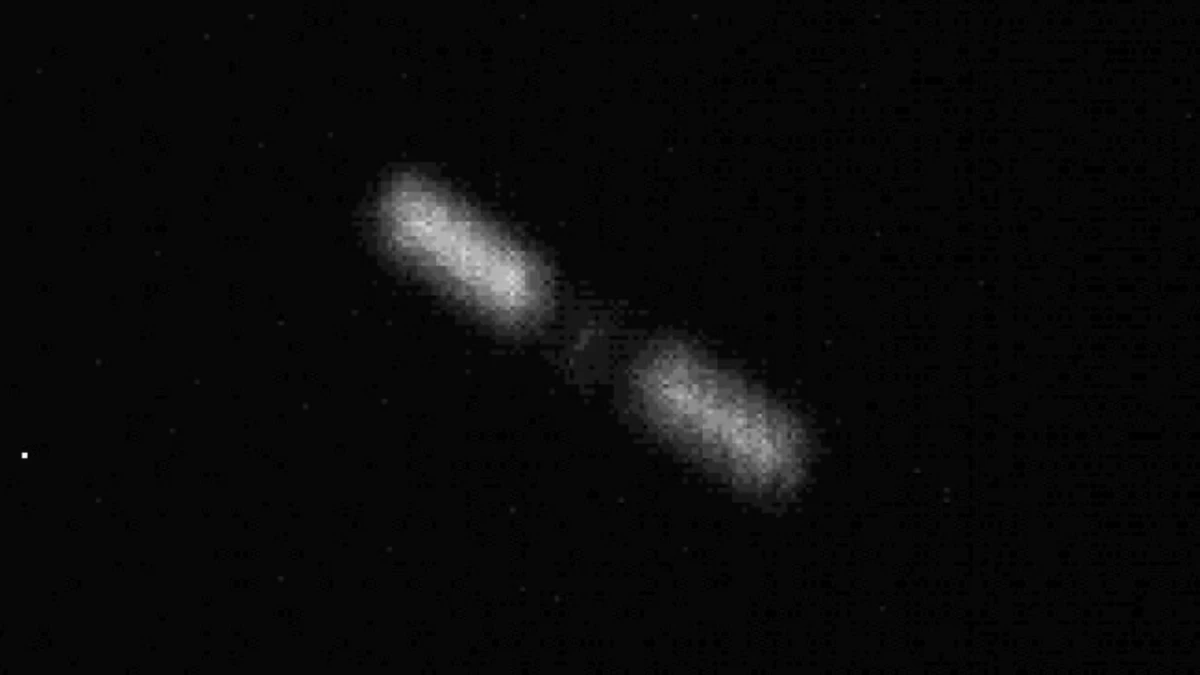
A HEO satellite monitoring campaign has captured new images of a damaged Starlink 34343 spacecraft following a suspected fragmentation event in orbit, confirming that the satellite remains largely intact but is now spinning rapidly and is no longer stable.
The company said it redirected its sensor constellation within a day of the incident to collect non-Earth imagery of the satellite. The images show the main body still holding together but rotating at a minimum of 16 degrees per second along one axis. Because the data only tracks motion on a single axis, the real spin rate could be higher.
Two months earlier, HEO had already captured clear images of the same satellite in a steady, operational state. That earlier dataset now serves as a direct comparison point, allowing analysts to assess how the satellite’s condition has changed after the event. This type of before-and-after record is rare and gives investigators a better starting point to determine what went wrong.
The exact cause of the fragmentation remains unclear. Such events can happen due to internal failures, leftover fuel reactions, or impacts with small debris. Even a minor breakup can create dozens of fragments, increasing the risk to nearby satellites in low Earth orbit, where thousands of spacecraft operate today.
What stands out here is how quickly imaging assets responded. Instead of relying only on ground-based tracking, HEO used space-based sensors to capture detailed visuals. That approach helps confirm whether a satellite is still intact, drifting, or breaking apart further.
The tumbling motion suggests the satellite has lost control of its orientation system. In normal operation, satellites maintain a fixed position using onboard systems to keep antennas and solar panels aligned. Once that control is lost, the spacecraft can spin uncontrollably, limiting communication and power generation.
HEO said it will continue monitoring the satellite with higher-resolution imaging in the coming days. These future observations may reveal visible damage, missing components, or debris nearby.
The incident adds to growing concerns about congestion in orbit. As networks like SpaceX Starlink expand, even isolated failures can have wider effects if debris spreads. Tracking and rapid imaging are becoming essential tools to keep space operations safe and predictable.

Leave a Reply