
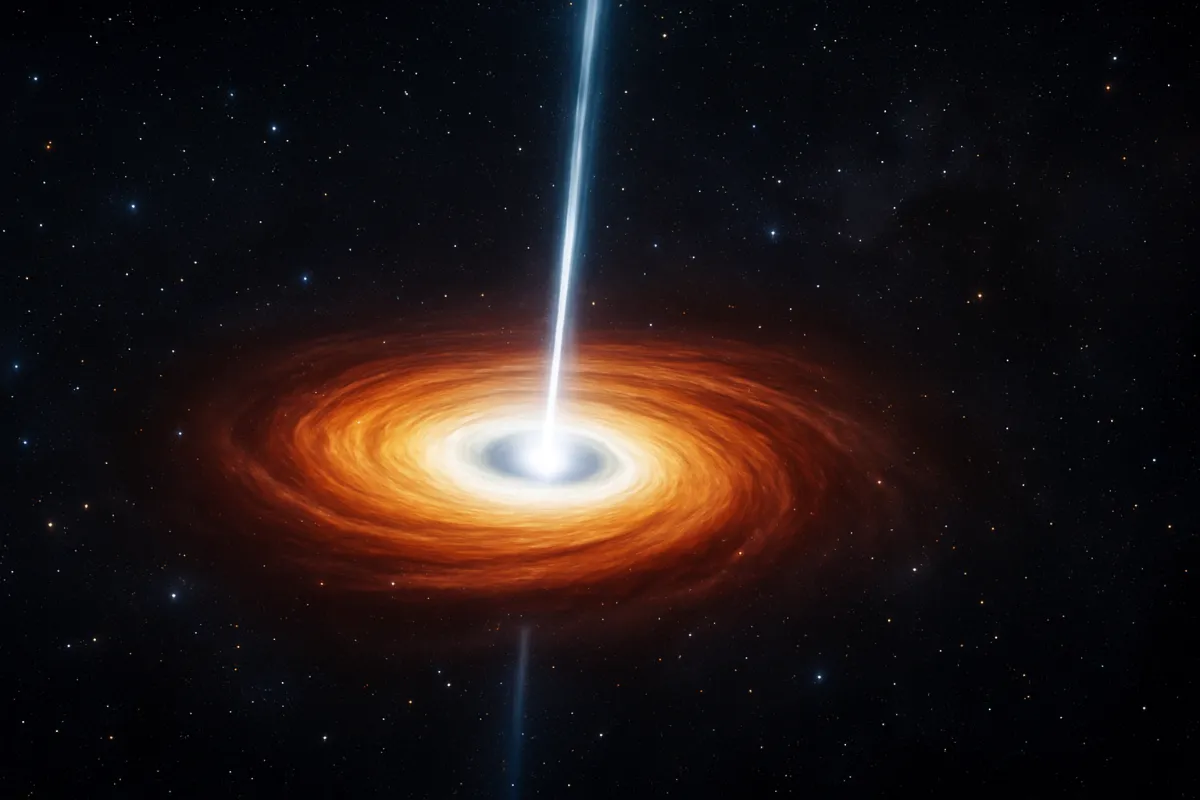
Astronomers have detected millimeter-wave light coming directly from the corona of a distant quasar, marking the first clear evidence of its origin. The quasar, RXJ1131-1231, lies about 6 billion light-years away in the constellation Crater.
The discovery was made using the Atacama Large Millimeter/submillimeter Array (ALMA) with the help of gravitational microlensing, which magnified subtle changes in brightness across the quasar’s four lensed images.
Quasars are powered by matter falling into supermassive black holes, with most of their light coming from the inner accretion disk and corona. While radio-loud quasars emit strongly at long wavelengths through jets, radio-quiet quasars like RXJ1131 have puzzled astronomers for years.
Observations in 2015 and 2020 revealed a clear shift in the brightness of one lensed image at 1.3 millimeters, consistent with microlensing caused by stars in the intervening galaxy.
The sharp dimming of image A compared with the others showed the source must be extremely compact—no larger than 50 astronomical units, about the size of the Kuiper Belt in our solar system. Models constrained the emission region to less than 2.4 × 10^-4 parsecs, or about 46 gravitational radii of the black hole, which itself has a mass of 200 million suns and spins close to the maximum rate.
This size places the emission firmly within the corona, a zone of hot plasma hovering near the black hole. The corona is known to produce X-rays by scattering photons, but at millimeter wavelengths it gives off synchrotron radiation from electrons spiraling in magnetic fields.
The measured relationship between millimeter and X-ray brightness follows the Güdel-Benz law, first seen in stellar coronae, confirming that the same physical processes apply.
Magnetic field strength in the corona was estimated at about 1.5 Gauss, similar to nearby quasars observed at other wavelengths. That suggests magnetic confinement plays a role in shaping both the plasma and its emission. The team ruled out larger sources such as dust clouds or jets, since those would extend far beyond the measured size.
The result is important because radio-quiet quasars represent the majority, yet their millimeter emission was not understood. Identifying the corona as the source clarifies how energy is distributed near black holes and shows that millimeter light can be used to study environments otherwise too small to image directly.
Gravitational lensing once again proved key. The quasar is magnified by a galaxy at redshift 0.295, while RXJ1131 itself is at redshift 0.658. The microlensing effect of individual stars in the lens galaxy allowed astronomers to probe scales far smaller than any telescope could resolve.
RXJ1131 has been studied for more than a decade, previously used to measure the expansion rate of the universe through time delays between its lensed images. Adding millimeter-wave monitoring extends its role as a natural laboratory for black hole physics. Future ALMA observations of other quasars may allow more coronal regions to be mapped using similar techniques.
Source: Millimeter emission from supermassive black hole coronae

Leave a Reply