

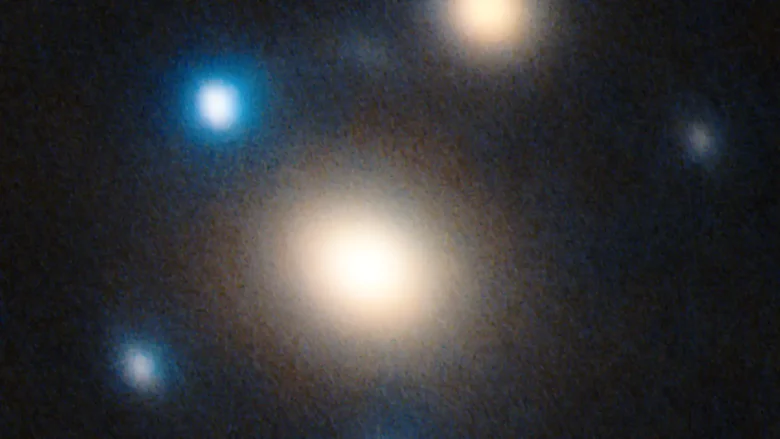
An international team of astronomers has discovered SN 2025wny (nicknamed SN Winny), the first strongly lensed superluminous supernova seen on galaxy scales, offering a rare new way to measure how fast the universe expands. The paper was published in Astronomy & Astrophysics. The explosion appears as four separate images because two foreground galaxies bend its light.
“The chance of finding a superluminous supernova perfectly aligned with a suitable gravitational lens is lower than one in a million,” said Sherry Suyu, associate professor of observational cosmology at TUM and fellow at the Max Planck Institute for Astrophysics.
Sky surveys first detected the transient in late August and early September 2025. Follow-up observations across Asia, Europe, and the United States confirmed the find and revealed a system that may help settle the long-running debate over the Hubble constant.
Researchers spotted the event through wide-field sky surveys and quickly turned ground-based telescopes toward it. The Lulin Observatory in Taiwan and the Maidanak Observatory in Uzbekistan confirmed the four-image structure after subtracting older sky images. Spectra from the Nordic Optical Telescope in Spain and the 88-inch telescope at the University of Hawaii pinned down the distance. Narrow absorption lines from the host galaxy matched those seen in superluminous supernovae closer to Earth.
Two galaxies sit directly between Earth and the explosion. Their gravity bends and splits the supernova’s light into four images that arrive at slightly different times. Because the image separations are small but measurable, astronomers expect delays of days to weeks. That range makes the system well suited for time-delay cosmology. Earlier galaxy-scale lensed supernovae showed delays shorter than one day, which limited precision.
By measuring these delays and mapping the mass of the lensing galaxies, scientists can calculate the Hubble constant using geometry rather than the usual distance ladder or early-universe models. Those two approaches currently disagree. A clean, independent measurement could help determine whether the tension reflects new physics or hidden errors in data.
The discovery came from the HOLISMOKES project, which built a catalog of strong lens candidates from large imaging surveys and cross-matched them with fresh transient alerts. Archival images from 2005 already showed four lensed views of the host galaxy at the same location, setting the stage for this event.
Teams now monitor SN 2025wny every night or two from telescopes in Taiwan, Uzbekistan, Mexico, and Germany. They expect full light curves within months. The Hubble and James Webb space telescopes have scheduled time to capture sharper images that will refine the lens model.
The Vera Rubin Observatory is now active, and it should find about ten useful lensed supernovae each year. Models suggest that about twenty well-measured systems could pin down the expansion rate to 1 percent accuracy. SN Winny may be the first clear step toward that goal.