

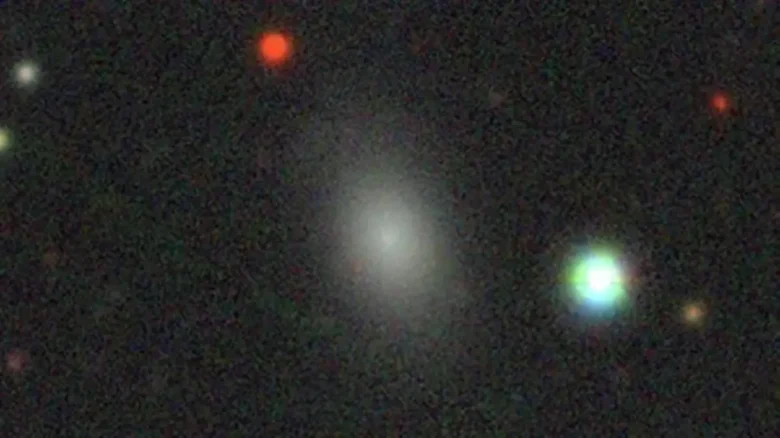
Astronomers have identified a small, faint galaxy drifting alone nearly 4 million light-years from the NGC 524 group in Pisces. The object, named dE01+09, appears to have been pushed out of its home environment long ago, making it one of the few known “runaway” dwarf galaxies. The discovery raises new questions about how galaxies interact and the long-term effects of those encounters.
Dwarf galaxies are common, but most live in crowded regions where larger neighbors can strip away their gas and stop star formation. dE01+09 is an early-type dwarf, meaning it no longer produces new stars and shows a smooth, featureless shape. Its red color and flat disk structure, measured by a Sérsic index of 1.1, match the traits of similar galaxies found in dense clusters, not in isolation.
Analysis suggests its stars are about 8.3 billion years old and contain few heavy elements, consistent with dwarfs in places like the Virgo cluster. But unlike those, dE01+09 is far from any group center. Astronomers say this makes it an unusual case: a galaxy shaped by environmental forces, yet now sitting well beyond its likely point of origin.
Researchers spotted it by combining data from major surveys, including the Sloan Digital Sky Survey (SDSS) and the Dark Energy Spectroscopic Instrument (DESI). They used a machine-learning model trained on 5,000 known early-type dwarfs to identify possible candidates. Spectroscopic data then confirmed that dE01+09 shows no signs of star formation.
The NGC 524 group itself lies about 111 million light-years away and is dominated by a lenticular galaxy of the same name. While the group contains several quiet members, dE01+09 is unusual because it sits three times beyond the group’s virial radius, the boundary where gravity normally holds galaxies together. That distance suggests it once orbited within the group before being expelled.
Astronomers think the galaxy was stripped of gas while still inside the group. Possible causes include ram-pressure stripping, where hot gas removes cold material, or gravitational tides from close encounters. A later interaction likely flung it outward at speeds around 300 kilometers per second, sending it into intergalactic space.
Similar cases have been found before. A dwarf near the M81 group shows signs of being ejected after a flyby, and computer simulations such as TNG50 predict that these “backsplash” galaxies should exist at the edges of groups and clusters. dE01+09 appears to match those predictions.
These findings matter because they complicate how astronomers classify galaxies. Objects that look isolated today may still bear the marks of past interactions. By studying more examples, scientists hope to understand how groups and clusters process their members and how those events affect galaxy evolution.
Future surveys are expected to uncover more of these outliers. With DESI mapping millions of galaxies in the search for dark energy, researchers say they will have better chances to identify faint dwarfs on the edges of groups.
Source: An isolated early-type dwarf galaxy that ran away from the group environment