

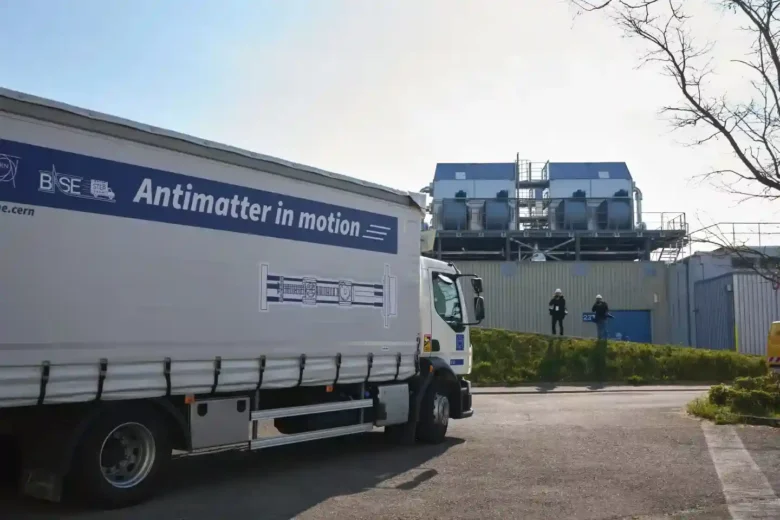
Physicists at CERN have successfully transported antimatter on a truck for the first time, completing a controlled test on March 24, 2026, at their Geneva campus. The team moved 92 antiprotons inside a custom-built portable trap, drove them over a 4-kilometre route, and returned with every particle intact. The test shows that antimatter can be safely moved outside its production site, opening a new path for precision experiments.
Antimatter is the mirror version of normal matter. When the two meet, they annihilate instantly. That makes storage and handling extremely demanding. Scientists can only produce and trap it at facilities like CERN, using machines such as the Antiproton Decelerator and ELENA, which slow particles enough to contain them using electromagnetic fields.
The transport was led by the BASE collaboration, a group focused on comparing matter and antimatter with extreme precision. Their work aims to answer a fundamental question: why the universe is made mostly of matter when both should have formed in equal amounts.
Until now, their measurements were limited by tiny magnetic disturbances inside CERN’s antimatter facility. Even extremely weak fluctuations interfere with high-precision experiments. Moving antimatter to quieter locations could remove that limitation.
To make this possible, the team built BASE-STEP, a one-tonne portable trap that combines a superconducting magnet, cryogenic cooling, vacuum systems, and backup power. It keeps antiprotons stable at temperatures colder than outer space and protects them from vibrations during transport.
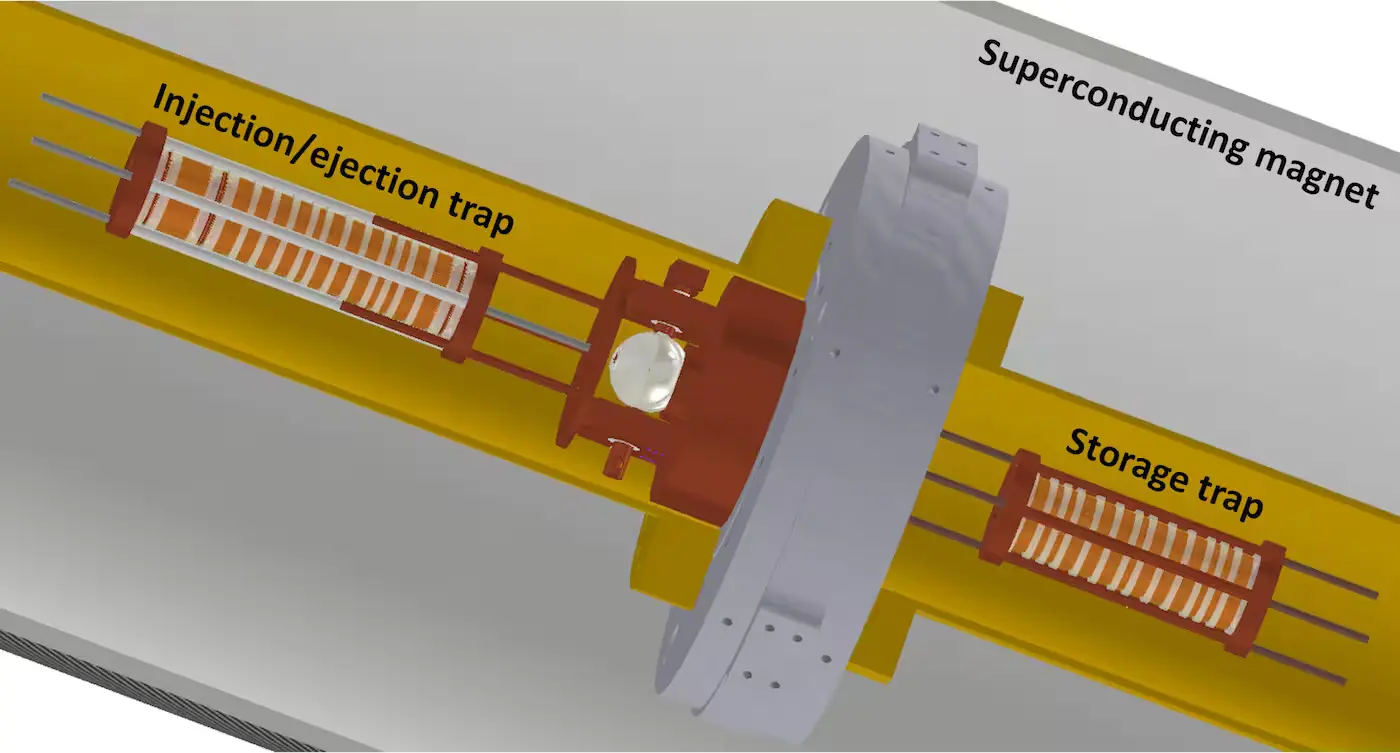
During the test, engineers loaded the trap onto a truck using a crane. A trained driver completed the route while scientists monitored the particles in real time. After reconnecting the system, the team confirmed that all 92 antiprotons survived the journey.
The next step is more ambitious. Researchers plan to transport antimatter to labs in Germany, including Heinrich Heine University Düsseldorf. That trip would take up to 12 hours and require continuous cooling below 8.2 Kelvin. The team is working on adding a mobile cryocooling system to extend travel time.
If successful, this approach could improve measurement accuracy by up to 1,000 times. That level of precision could reveal even tiny differences between matter and antimatter. Any mismatch would challenge current physics models and reshape our understanding of the universe.
