

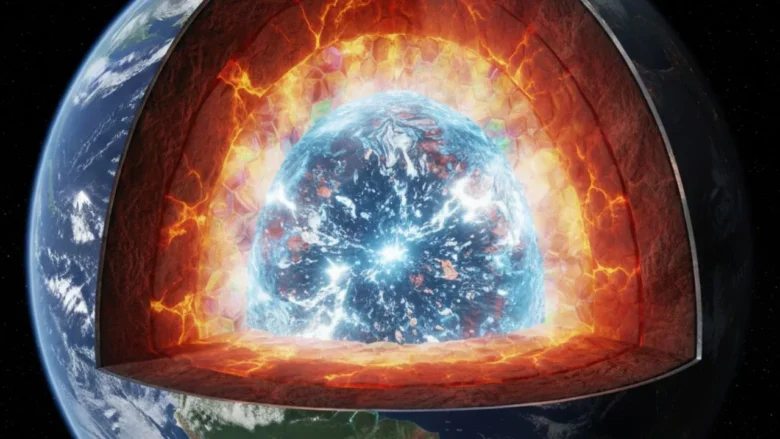
Researchers from the Guangzhou Institute of Geochemistry under the Chinese Academy of Sciences reported that Earth’s mantle acted as a vast water reservoir more than four billion years ago. Their findings, titled “Where did the water go when Earth’s early magma oceans crystallized? For the deepest mantle, the answer has been elusive,” was published in the journal Science.
The study suggests that the lower mantle absorbed far more water than researchers once believed. This water was stored inside a common mineral called bridgmanite.
Early Earth formed in extreme heat after countless collisions between rocky bodies. Much of the planet was once covered by a global ocean of molten rock. As this molten layer slowly cooled, solid minerals formed and sank, pulling certain elements with them. Water near the surface escaped into the air and later formed oceans, but water trapped deeper followed a different path.
To recreate these conditions, researchers used diamond anvil cells to squeeze mineral samples under pressures hundreds of thousands of times greater than at sea level. Powerful lasers heated the samples to temperatures similar to those inside the young Earth. Under these conditions, hydrated minerals transformed into bridgmanite and absorbed far more water than earlier models allowed.
Bridgmanite makes up most of the lower mantle, which stretches from about 660 to nearly 2,900 kilometers below the surface. The experiments show that this mineral can store vast amounts of water within its structure. Based on the results, scientists estimate the lower mantle could hold water equal to several modern oceans.
This hidden reserve may still shape the planet today. Seismic waves sometimes slow down as they pass through the mantle, which can hint at the presence of water. Volcanic rocks from places such as Hawaii also contain more water than expected, suggesting a deep source feeding eruptions over long periods of time.
The findings help explain why Earth remained wet while nearby worlds did not. Venus likely lost its water early, while Mars could not hold onto a steady cycle. On Earth, water stored deep inside may have returned to the surface again and again through volcanic activity, helping stabilize the climate.
Researchers say the results may also matter beyond our planet. Observations of distant rocky worlds already show signs of water-bearing minerals. If those planets formed in a similar way, they too may hide large water reserves far below their surfaces. The team plans further tests to refine the numbers and compare them with seismic data.