

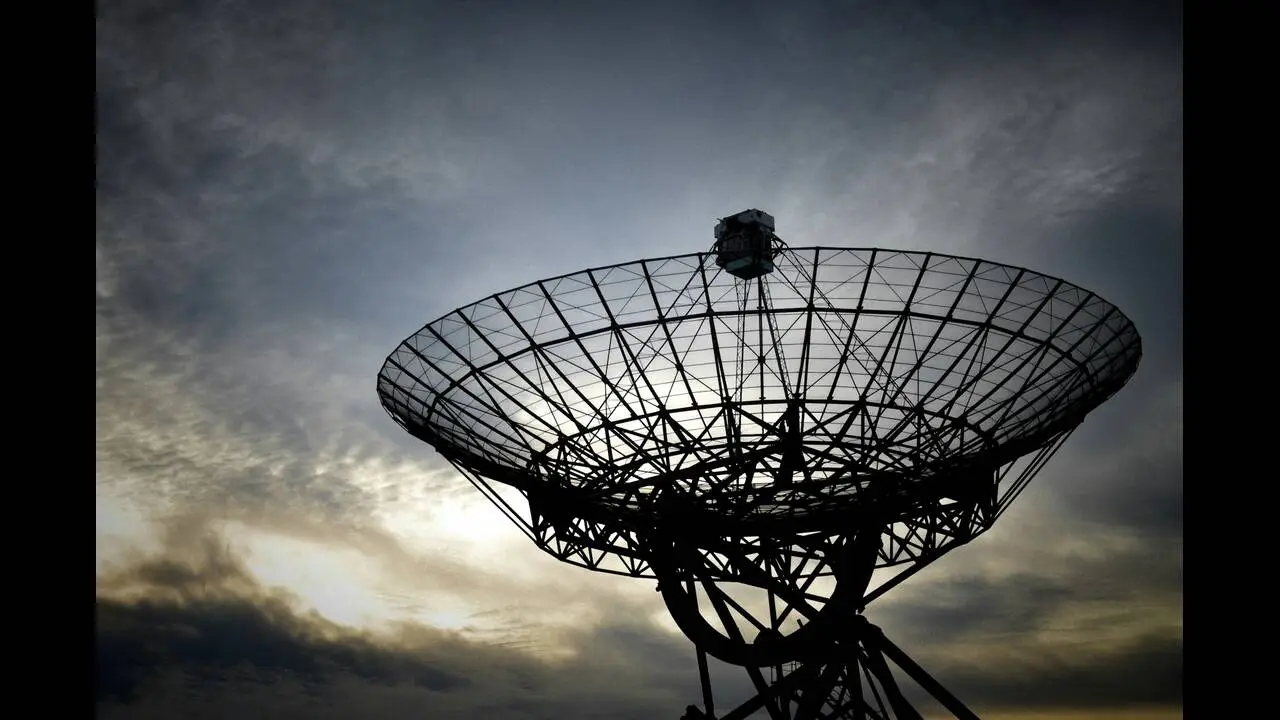
Researchers near Pune, India, have revealed 34 enormous cosmic structures powered by supermassive black holes. In a recent study, a team of astronomers based in India used data from the Giant Metrewave Radio Telescope (GMRT), located near Khodad village about 90 km north of Pune, to identify 34 new giant radio sources (GRSs).
These structures span millions of light-years, far larger than our Milky Way Galaxy, which is roughly 100,000 light-years across.
The discovery builds on observations taken between 2010 and 2012 during the TIFR GMRT Sky Survey (TGSS), which mapped nearly 90 percent of the sky at low radio frequencies. The findings help researchers better understand the late stages in the evolution of radio galaxies from supermassive black holes with masses between ten million and a billion times that of the Sun.
The team analyzed archived TGSS data taken by the GMRT at 150 MHz (not 150 Hz) from 2010 to 2012. By examining such low-frequency radio waves across about 90 percent of the sky, they could pick out the faint, extended emission of GRSs that might otherwise get missed. The telescope’s high sensitivity played a key role in detecting these rare and enormous sources.
The discovery came from a collaborative effort by two PhD students, Netai Bhukta from SKBU, India, and Souvik Manik from MCC, India, working alongside astronomers Sabyasachi Pal (MCC, India) and Sushanta K. Mondal (SKBU, India). Their work demonstrates how careful reanalysis of existing survey data can yield major new insights.
These giant radio sources represent one of the final known stages in the life cycle of radio galaxies. At their core lie supermassive black holes that launch powerful jets of particles and magnetic fields, producing vast lobes of radio emission. That these GRSs stretch up to millions of light-years makes them among the largest individual structures ever observed in the universe.
Some of the 34 GRSs also stand out because of their distance, being among the most remote ever recorded, raising questions about how such massive, extended structures could grow in the earlier universe. Two of the detected sources appear to challenge previous ideas about how GRSs interact with and are limited by their surrounding environment. Further study could reshape our understanding of how these rare objects form and evolve.
The team’s findings show that large-scale features hidden in older survey data can still surface when looked at with fresh eyes and better tools. As radio telescopes like GMRT continue to improve and new instruments such as the Square Kilometre Array (SKA) come online, researchers expect to find even more giant radio sources and learn how they fit into the cosmic story.