
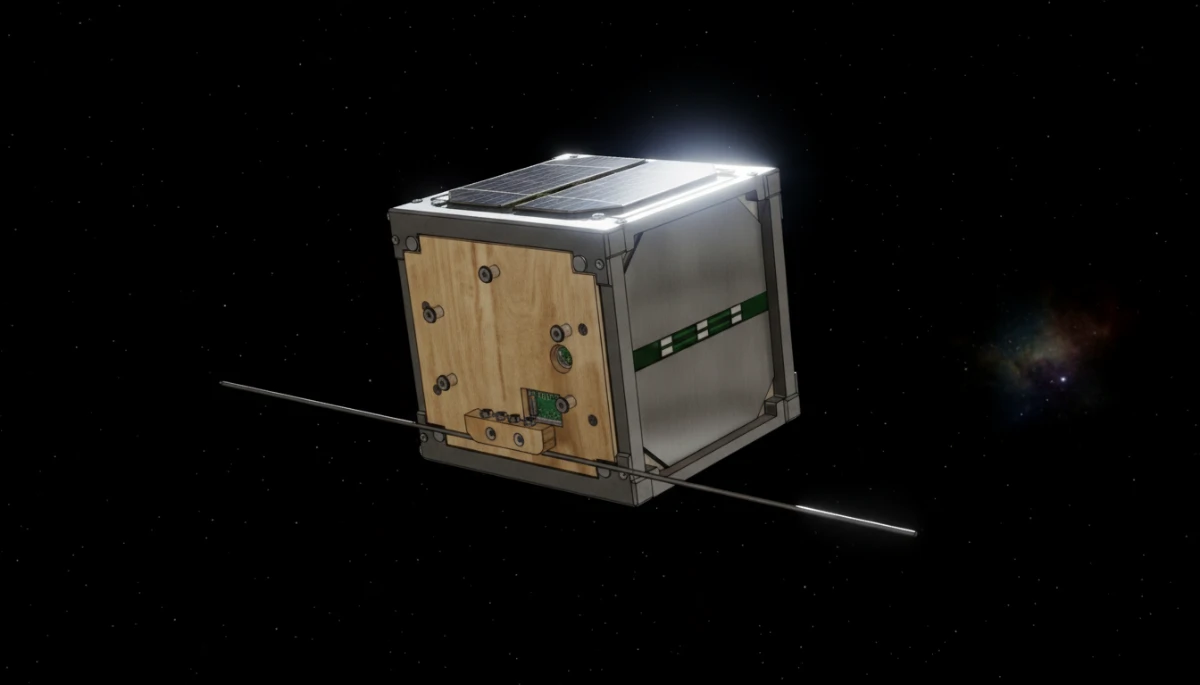
Japan will launch the world’s first wooden satellite later this year, aiming to cut down space pollution caused by metal spacecraft. The satellite, called LignoSat, was developed by researchers at Kyoto University in partnership with Sumitomo Forestry. Built with magnolia wood panels, the small spacecraft will test whether biodegradable materials can survive in orbit and reduce the aluminum particles released when satellites burn up during reentry.
The team designed LignoSat using honoki magnolia wood and traditional Japanese joinery instead of screws or adhesives. The satellite measures about 10 centimeters on each side. While it includes aluminum frames and steel shafts inside, its outer panels are wooden. Later this year, it will head to space, where it will face vacuum, radiation, and wide swings in temperature.
The idea may sound unusual, but earlier tests support it. Wood samples spent nearly a year outside the International Space Station. Researchers reported little visible damage after exposure. In orbit, the lack of oxygen and living organisms prevents rot. That environment may help wood last longer than many expect.
The project focuses on the growing problem of space debris. When metal satellites re-enter Earth’s atmosphere, they burn and release alumina particles. According to Japanese astronaut and aerospace engineer Takao Doi, these particles can remain in the upper atmosphere for years. Scientists are still studying their long-term environmental effects, but the number of satellites entering orbit continues to rise, increasing concern.
LignoSat will measure how its wooden panels change shape over time. Project lead Koji Murata has noted that wood remains stable along one grain direction but can crack or shift across another. The mission will track any warping or damage and send the data back to Earth.
The launch comes as governments and private companies deploy thousands of small satellites for communication and research. As more spacecraft return and burn up, even minor material choices could matter. If wood proves durable and safe, future satellites may rely more on biodegradable components.
Japan’s experiment will not solve space debris overnight. But it raises a practical question: if spacecraft must burn up anyway, why not build them from materials that leave less behind?

Leave a Reply