

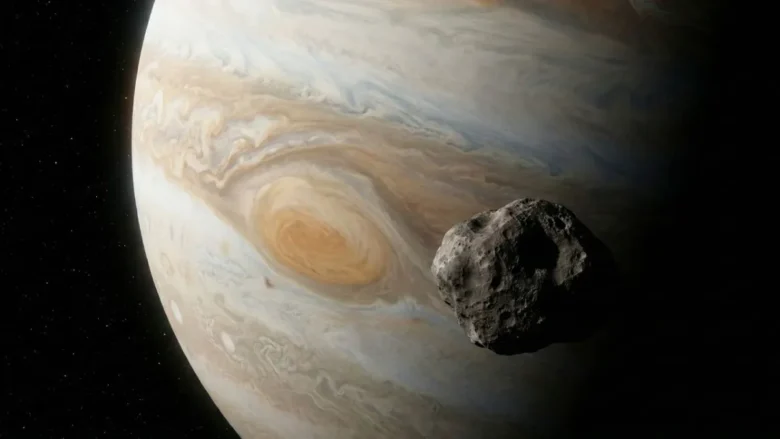
In the early solar system, most solid material formed fast. Iron-rich bodies appeared within the first million years. But a different group of rocky space material called chondrites formed two to three million years later. Scientists now think Jupiter, the largest planet, caused that delay by changing how gas and dust moved near the Sun and by shaping where rocks could form and survive.
Chondrites are some of the oldest and most basic space rocks. They contain small, round beads that formed when dust briefly melted and cooled in space. These rocks are common in meteorites that fall to Earth today. For a long time, researchers could not explain why these objects appeared later than other early bodies in the solar system.
A research team used computer models to study the young solar system. They placed a growing Jupiter about five times farther from the Sun than Earth, close to its current position. The models show that Jupiter gained most of its mass in less than a million years. As it grew, its strong gravity pushed aside gas and created a wide gap in the disk around the Sun.
This gap was not empty. It caused waves in the gas that formed dense rings closer to the Sun. These rings slowed down drifting dust and small rocks. Instead of falling into the Sun, the material collected in certain zones and stayed there for long periods.
At the same time, Jupiter’s presence sped up the loss of gas in the inner solar system. Without a large planet, the gas would last for several million years. With Jupiter in place, the inner region cleared much faster, changing how and where new bodies could form.
In the earliest stage, some solid worlds formed quickly. These early bodies are linked to iron meteorites found today. Later, growing rocky planets crashed into one another and released new dust into space. Normally, this dust would drift away, but the rings made by Jupiter trapped it instead.
Over time, enough material built up in these regions to form a second group of rocky bodies. These new planetesimals appeared between the orbits of Mercury and Mars, around two to three million years after the solar system began. These are believed to be the parent bodies of chondrite meteorites.
Jupiter also influenced the movement of young planets. In a thick gas disk, growing planets often spiral toward the Sun. The dense rings created by Jupiter slowed or even stopped this motion. When the gas disappeared soon after, it froze the inner planets in place.
This helped keep rocky planets, including Earth, in stable paths around the Sun instead of being pulled inward. The inner solar system we see today likely formed because Jupiter arrived early and changed the structure of the disk.
Modern telescopes have seen similar patterns around other young stars. Rings and gaps appear in these disks where large planets are forming. One well-known example shows clear banded structures around a very young star, suggesting the same process may be common across the galaxy.
The findings suggest Jupiter played a key role not just in shaping its own path but in deciding when and where rocky worlds and certain meteorites could form. Without that early influence, the inner solar system would likely look very different today.
Source: The late formation of chondrites as a consequence of Jupiter-induced gaps and rings