

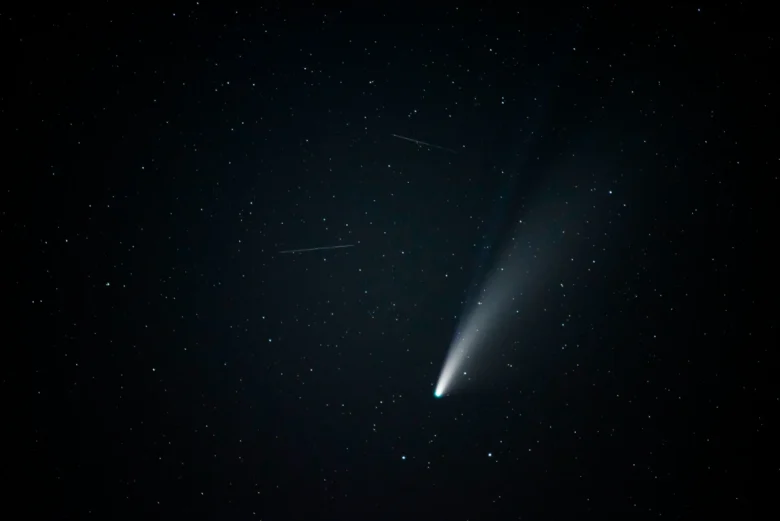
Astronomers are closely tracking a newly found comet that could become a rare and striking sight near the Sun in early April. The comet, named C/2026 A1 (MAPS), was discovered on January 13 by four amateur astronomers using a remote telescope in Chile’s Atacama Desert. Early observations show it is heading straight toward an extremely close pass by the Sun, where it will skim just 120,000 kilometers above the solar surface.
The comet is a part of the Kreutz family of sungrazing comets. These comets follow long, stretched paths that bring them dangerously close to the Sun. Most of them break apart before or during that encounter. A few survive long enough to brighten sharply, sometimes becoming visible in daylight. Some of the brightest comets ever recorded came from this same group.
The Kreutz family began with a giant comet that broke apart more than 2,000 years ago. Since then, its fragments have returned in waves, producing famous comets seen across history. The Great Comet of 1882 became brighter than the full Moon. In 1965, Comet Ikeya Seki reached similar fame after surviving a close solar pass and shining in daytime skies.
Comet 3I/ATLAS also followed a steep path toward the inner solar system and drew attention for its unusual orbit and brightness changes.
What makes comet MAPS stand out is how early it was spotted. At the time of discovery, it was farther from the Sun than any other known sungrazer detected at such a stage. That early detection hints that it may be larger than most of the small fragments usually seen. Recent observations show the comet steadily growing brighter, which suggests it is still holding together.
As the comet approaches the Sun, intense heat and gravity will put enormous stress on its icy core. It may break apart before reaching its closest point, known as perihelion. If it does survive, it could become visible near the Sun in early April and then move into the evening sky days later.
Viewers in the southern hemisphere will likely have the best chance to see it. There is also a chance the comet could briefly brighten if it breaks apart near the Sun, which could create a short but dramatic display. If it fails, spacecraft such as NASA’s SOHO observatory will still capture detailed images of its final moments.
