

What Is Observational Astronomy?
Observational astronomy is the practice of watching the sky to learn how the universe works. Anyone can take part, from scientists using giant telescopes to hobbyists with binoculars in their backyard. People observe planets, stars, nebulae, and galaxies from Earth or space at any time of year.
They do it to measure motion, track change, and figure out what objects are made of. They use telescopes, cameras, and simple tools to gather light and study patterns. It sounds big, but at its core, this field is about looking up and paying attention.
How Observational Astronomy Works
Observers collect light that reaches Earth. They study how bright it is, how it moves, and how it changes over time. This light can be visible, infrared, radio, or other forms that our eyes cannot see. Tools capture it and record it. Software then helps measure and compare what was seen.
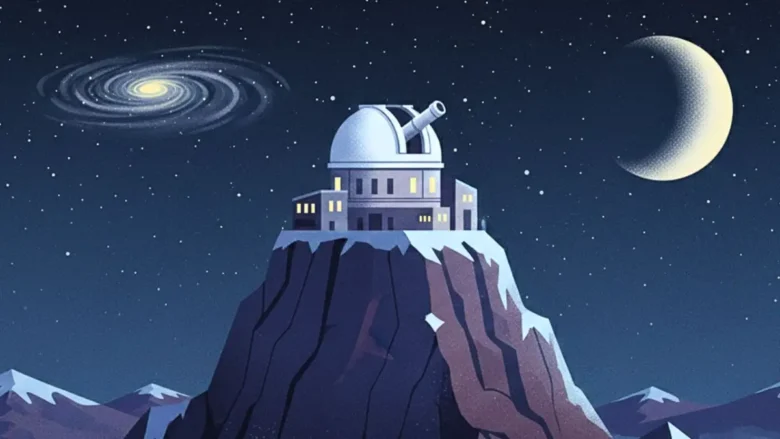
Most work still happens on Earth. Large observatories sit on high mountains in places with dry air and dark skies. Some missions use satellites to avoid clouds and city lights. Even so, a quiet backyard can offer clear views of the Moon, bright planets, and many stars.
What People Observe
The Moon is the easiest target. Its phases and surface features change in ways that help beginners practice. Planets show steady paths across the sky. Venus grows brighter and dimmer. Jupiter’s four large moons shift position each night. Saturn’s rings tilt over the years.
Stars offer steady light, but some vary. These changes help researchers measure distance and motion. Star clusters reveal how stars form and age. Nebulae show glowing gas shaped by stars nearby. Galaxies appear as faint smudges, yet they help map large parts of the universe.
Why Observational Astronomy Matters
Observations help confirm theories and reveal new questions. Watching the sky helps track objects that pass near Earth, study storms on other planets, and follow events like eclipses and meteor showers. The field mixes simple curiosity with patient watching. Not every moment is dramatic, but every clear sky has something to teach.
How to Start
A beginner needs only a clear night. Apps and star charts can guide the way. Binoculars help, and a small telescope opens more detail. The key is to step outside, give your eyes time to adjust, and look around. The universe does not hurry, and it will not mind if you take your time either.
Types of Observational Astronomy
Observational astronomy is divided into different branches based on the type of light being studied:
- Optical Astronomy: Focuses on visible light emitted by celestial bodies like stars and galaxies.
- Radio Astronomy: Detects radio waves to study phenomena such as pulsars and the cosmic microwave background.
- Infrared Astronomy: Examines cooler objects like dust clouds and exoplanets.
- X-ray and gamma-ray Astronomy: Investigates high-energy processes like black hole accretion and supernova explosions.
Important concepts in Observational Astronomy
The Doppler Effect, which explains why light from objects moving toward us shifts toward shorter wavelengths (blue shift) and light from objects moving away shifts toward longer wavelengths (redshift).
Redshift measurements, which show the expansion of the universe and allow astronomers to estimate distances of galaxies and quasars.
Together, these tools help explain how galaxies evolved, how stars are born and die, and how the universe has changed over billions of years.
Tools Used in Observational Astronomy
Astronomers use a wide range of instruments to study the sky. Each detects a different type of light, offering a unique window into the universe:
Optical telescopes study visible light. They come in two forms: refractors (which use lenses) and reflectors (which use mirrors). Many professional observatories use large reflecting telescopes with adaptive optics to sharpen images affected by atmospheric turbulence.
Radio telescopes detect radio waves from sources like pulsars, gas clouds, and the cosmic microwave background. Arrays such as ALMA combine multiple dishes to create one powerful instrument.
Spectroscopes separate light into wavelengths, helping astronomers identify chemical elements and temperatures of stars and gases.
Space-based observatories, such as Hubble and the James Webb Space Telescope, avoid atmospheric distortion entirely. From orbit, they capture high-precision images and data that ground-based telescopes cannot.
Challenges in Observational Astronomy
Despite advancements, observational astronomy faces challenges. Light pollution from urban areas makes it difficult to observe faint objects, and the increasing number of satellites and space debris in orbit hinders astronomical observations.
Atmospheric conditions, such as clouds and turbulence, can distort images. Ground-based telescopes are also limited by the Earth’s atmosphere, which is why space-based observatories are crucial.
While these challenges may act as a barrier to astronomical observations, modern-day solutions and space policies to reduce satellite launches and space debris management may help astronomers stay captivated while space-based telescopes keep advancing and continue observing the universe.
Astronomy is not only a hobby; there are numerous ways by which you can turn your astronomy from a hobby to your passion.
You can read our astrophotography guide to learn the aspect of capturing the night sky or read our astronomy guide to learn about the different career paths and get a roadmap to becoming a professional in this field.