Tag: Conjunction

  • Must see Astronomical events in July 2025

    Must see Astronomical events in July 2025

    Attention, stargazers! July 2025 offers some exciting stargazing opportunities for both casual observers and professional astronomers around the globe. Starting with the conjunction of Antares and the Moon, the month will end with the peak of the Delta Aquarids meteor shower.

    This article serves as a clear and reliable guide to help you navigate the celestial events of July, offering detailed insights into each event so you can make the most of your stargazing experience.

    Key astronomical events in July 2025

    • July 1-7: Mercury appears bright and easy to see low in the western sky 30 to 45 minutes after sunset. A clear horizon is required for visibility before it sets.
    • July 3: Mercury lies near the Beehive Cluster in the western sky after sunset, visible until around 8:20 p.m. At the same time, Spica appears close to the Moon and remains in view until midnight.
    • July 4: Earth reaches its farthest distance from the Sun (Aphelion): 152 million kilometers. Mercury reaches its greatest eastern elongation, offering its widest separation from the Sun in the evening sky.
    • July 21-22: A crescent moon appears close to Venus and Jupiter in the eastern sky just before sunrise. Several bright stars remain visible in the same region.
    • July 28: A crescent moon appears near Mars in the western sky after sunset.
    • July 30-31: The Delta Aquariids meteor shower peaks, with as many as 25 meteors per hour visible from 9:30 p.m. until dawn. (Check Radiant Point.)

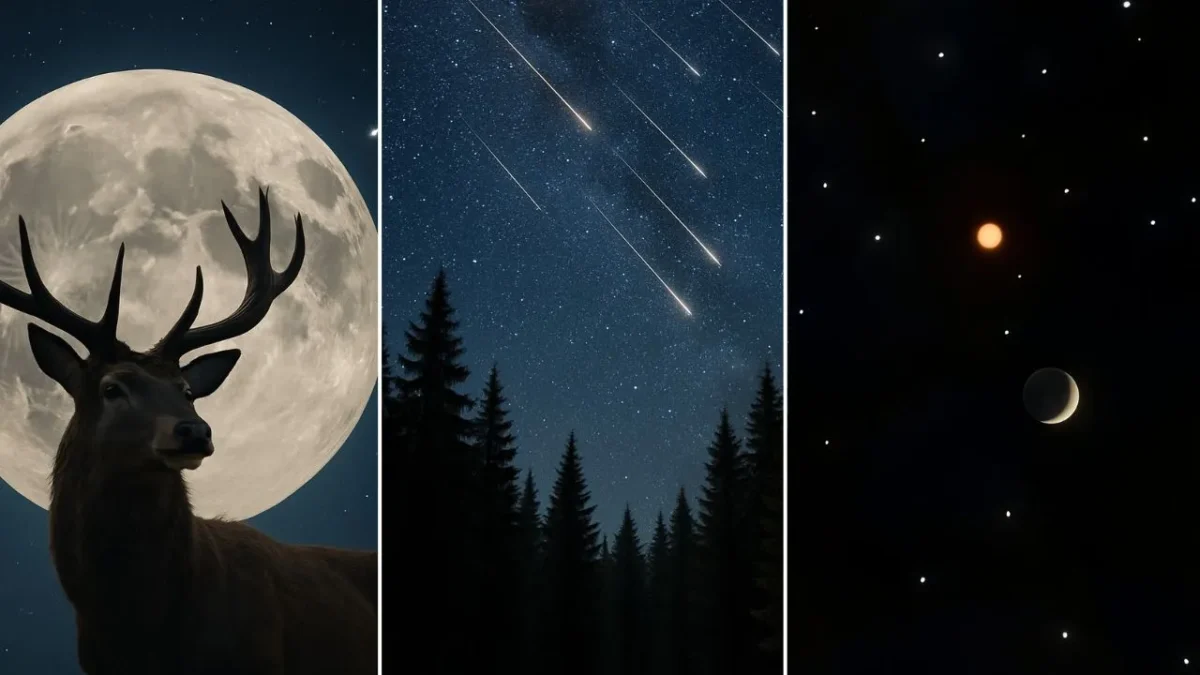
    The Buck Moon

    The Buck Moon/the July full moon.
    (Artists’s Concept)

    According to Forbes, the Buck Moon (Full Moon of July) will reach its full phase at 4:38 p.m. EDT on Thursday, July 10. While it will appear full the night before and after its peak, the most breathtaking view will be during moonrise at dusk on July 10. That is when the full moon will hang low on the horizon, appearing larger, brighter, and more dramatic.

    According to Farmer’s Almanac, the name comes from Native American traditions, referring to the time of year when male deer, or bucks, begin to grow new antlers covered in soft velvet. The term has since become widely recognized in modern lunar calendars.

    This yearโ€™s Buck Moon does not coincide with the Delta Aquariids peak, allowing clearer views of the meteor shower later in the month.

    Planets and constellations visible in July 2025

    • Venus shines brightly in the eastern sky during the two hours before sunrise, appearing near the Pleiades star cluster, Aldebaran, and Capella throughout the month.
    • Mars appears low in the west after sunset and remains visible for a couple of hours. Its brightness gradually fades as the month continues.
    • Jupiter begins rising in the east around an hour before sunrise from mid-July onward, climbing higher each morning.
    • Saturn rises around midnight and stays high in the southern sky through the early morning hours.
    • The Aquila constellation is visible in the eastern sky during the first half of the night. Its brightest star, Altair, forms one corner of the Summer Triangle and remains easy to locate, even from areas with light pollution.

    Space History

    The month of July 2025 marks 60 years since NASAโ€™s Mariner 4 performed the first successful flyby of Mars in July 1965. It was the first mission to send back close-up images of another planet and revealed that Mars has a very thin, cold atmosphere.

    Moon phases for July 2025

    • First quarter: July 2
    • Full Moon: July 10
    • Third quarter: July 17
    • New Moon: July 24

    Darker skies around the new moon offer ideal conditions for viewing faint stars, planets, and meteor showers. Topped with multiple conjunctions, July remains a rewarding month for skywatching.

  • June Skywatching Tips: Strawberry Moon, Solstice, and World Asteroid Day!

    June Skywatching Tips: Strawberry Moon, Solstice, and World Asteroid Day!

    If you missed stargazing in May, there’s no need to worry! June offers some exciting stargazing events. From the Strawberry Moon to World Asteroid Day, immerse yourself in the wonders of the night sky this month.

    Celestial EventDate
    Milky Way Core SeasonAll June
    Strawberry MoonJune 11
    Moon-Saturn ConjunctionJune 19
    June SolsticeJune 20
    Moon-Venus ConjunctionJune 22
    Moon-Mars ConjunctionJune 29-30
    World Asteroid DayJune 30

    Milky Way core season

    The beginning of June usually means the Milky Way core season is here. According to NASA, this is the time of year when the Milky Way is visible as a faint band of hazy light arching across the sky all night. Just head to a dark sky site away from the city lights and observe the bright central core of our galaxy.

    Strawberry Moon

    The full moon of June, also known as the ‘Strawberry Moon,’ will occur on June 11. According to the Farmer’s Almanac, the term ‘Strawberry Moon’ is used by the Native American Algonquian tribes in the northeastern United States, as well as by the Ojibwe, Dakota, and Lakota peoples, to signify the ripening of โ€œJune-bearingโ€ strawberries that are ready for harvesting; i.e., the name ‘Strawberry Moon’ has nothing to do with the appearance or color of the moon.

    Moon-Saturn conjunction

    On June 19, the moon and Saturn will be aligned close to each other in the eastern sky a few hours before dawn.

    June solstice

    June marks the beginning of a solstice for both hemispheres. It brings the summer solstice in the northern hemisphere and the winter solstice in the southern hemisphere. This means that the northern hemisphere will experience the longest day of the year, whereas the southern hemisphere will experience the shortest day of the year.

    Moon-Venus conjunction

    The moon and Venus will be aligned close to each other on June 22 in the eastern sky a few hours before sunrise.

    Moon-Mars conjunction

    On June 29-30, the moon and Mars will be closely aligned in the evening sky in the western direction after the sunset.

    World Asteroid Day

    June 30, i.e., the anniversary of the Tunguska event, is celebrated as World Asteroid Day. The first celebration took place on June 30, 2015. World Asteroid Day aims to raise awareness about asteroids and what can be done to protect the Earth, its families, communities, and future generations from a catastrophic event.

    We hope you are now all set to observe and celebrate these beautiful events this June. Bookmark this page so that you don’t forget any of these events!

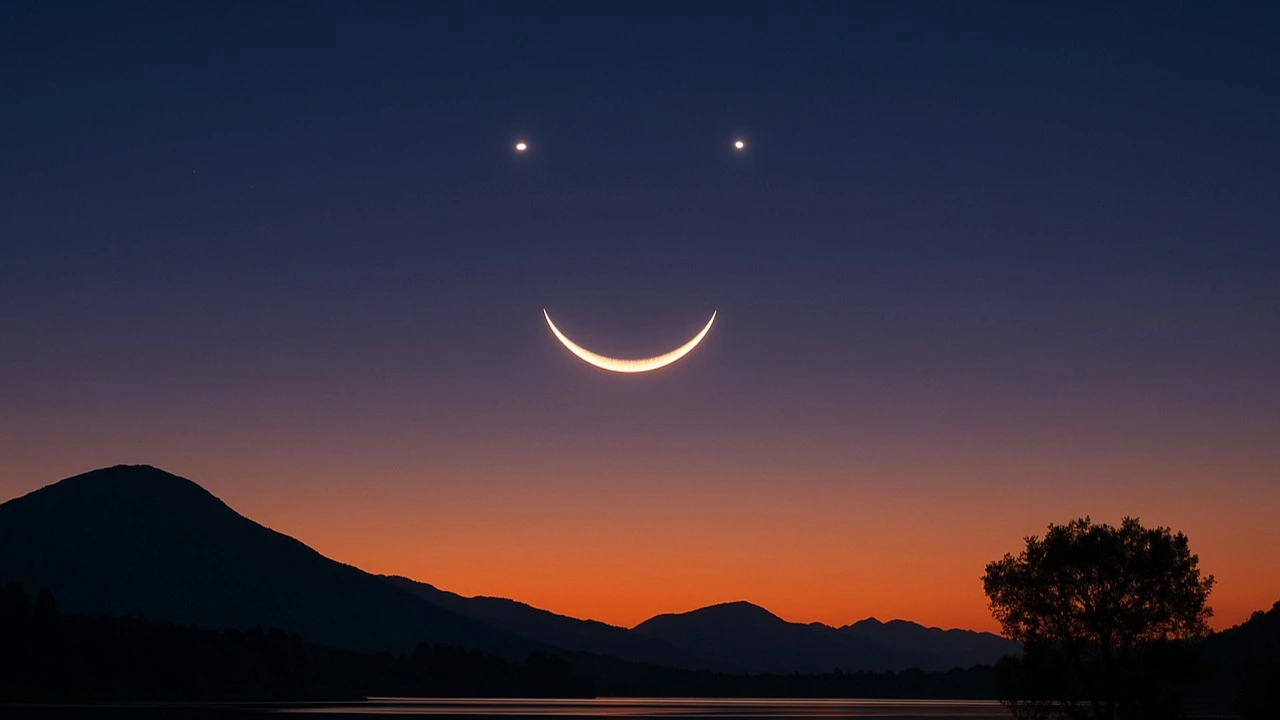
  • Image: ‘Smiley Face’ Conjunction April 2025

    Image: ‘Smiley Face’ Conjunction April 2025

    On April 26, 2025, I captured the rare “smiley face” conjunction of the Moon, Venus, and Saturn.

    For a moment, it truly felt like the universe smiled right back at me. Iโ€™m not a morning person, but that day I woke up at 5:25 AM, driven by pure excitement. I rushed up to my terrace with sleepy eyes and a racing heart. Living in a small town really helped! The sky was clear, the air was fresh, and the scene was just perfect.

    The moon was the big, bright smile, and Venus and Saturn were like tiny, sparkling eyes. By the time I grabbed my camera, they had started drifting apart, but I quickly adjusted the settings to fit them all into one frame. This turned out to be one of my favorite shots ever.

    Picture Information

    • Date and Time: April 26, 2025, 5:43 AM IST
    • Location: Kolhapur, Maharashtra, India
    • Camera: Fujifilm FINEPIX HS35EXR
    • Camera Settings: ISO 200 | Shutter +2 sec | Aperture Auto | White Balance Auto
    • Photo Credit: Nihal Sayyad via wondersinspace.com

    Note for journalists/editors: This image was featured in BBC Sky at Night Magazine and Sky & Telescope under a CC BY-SA 4.0 license, and the image shall only be shared under these conditions.ย 

  • A rare triple conjunction; ‘smiley face’ planetary alignment will occur on April 25. Don’t miss it!

    A rare triple conjunction; ‘smiley face’ planetary alignment will occur on April 25. Don’t miss it!

    A rare triple conjunction, ‘smiley face planetary alignment,’ will occur on April 25, 2025, right before sunrise. During this event, the Moon, Venus, and Saturn will align to create a ‘smiley face’ in the sky. Mark your calendar to witness this rare occurrence, as it won’t happen again for several years!

    What Creates the Smiley Face Alignment?

    Venus and Saturn will serve as the “eyes,” and below them, the crescent Moon will curve into a gentle “smile.” Together, these three bodies will resemble a ‘smiley face.’

    How and when to watch it?

    The alignment will be visible worldwide, provided the sky is clear and the eastern horizon is unobstructed. You won’t need a telescope or binoculars to enjoy this celestial event, but using a telescope can help you get a closer look at the planets and the crescent moon.

    What is a conjunction?

    A conjunction occurs when two or more celestial bodies appear close together in the sky, and they occur frequently. However, a triple conjunction, like this one, is quite rare. The celestial bodies might appear close during a conjunction, but in reality, they are separated by vast distances.

    Catch the Lyrids and the triple conjunction on the same day!

    If you are planning to watch the triple conjunction on April 25, you can start your observations at night, and you can even catch the Lyrid meteor shower near its peak (April 22-23).