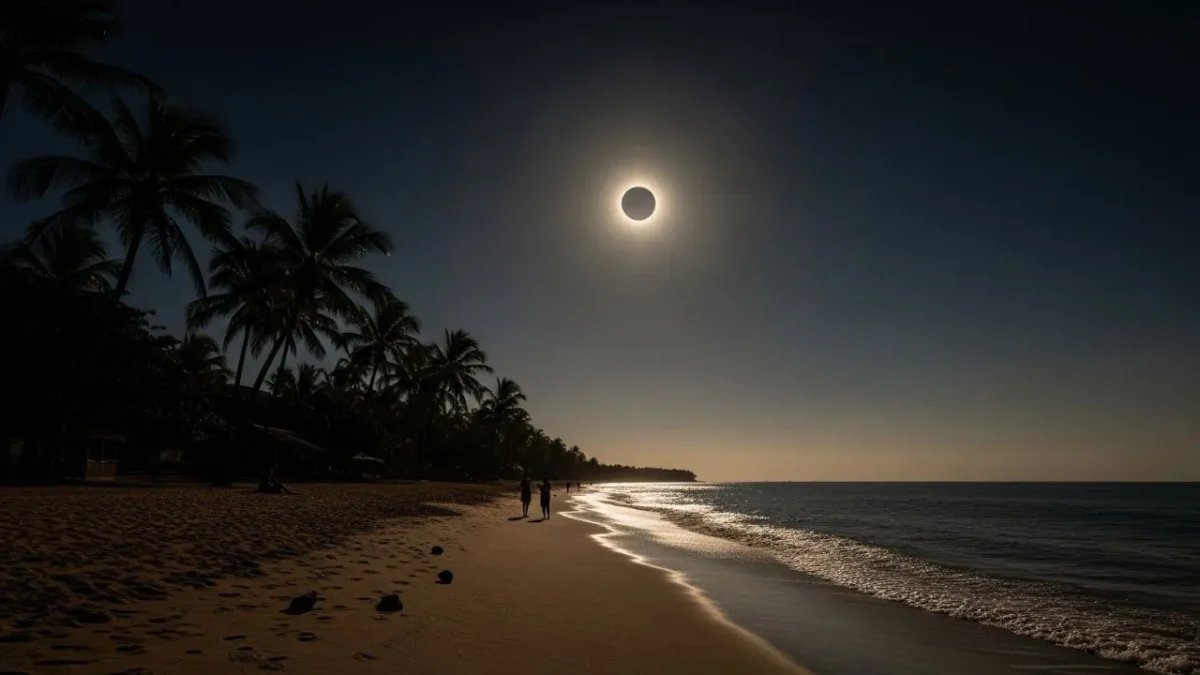
Tag: Eclipse

  • A Total Lunar Eclipse Will Turn the Moon Red on September 7โ€“8, 2025

    A Total Lunar Eclipse Will Turn the Moon Red on September 7โ€“8, 2025

    A total lunar eclipse will paint the Moon red on September 7–8, 2025, visible across Europe, Africa, Asia, and Australia. Known as a “Blood Moon,” the event happens when Earth blocks direct sunlight from reaching the Moon, causing it to glow in shades of red. The eclipse will last for about five hours, with totality peaking at 6:11 p.m. UTC on September 7.

    During this eclipse, observers in North America may see the start or end, depending on time zones. The rest of the world can watch the full sequence unfold, from the faint penumbral stage to the deep red of totality.

    What is a Blood Moon?

    The term “Blood Moon” refers to the reddish color the Moon takes on during a total lunar eclipse. The color isn’t mystical; it comes from basic physics. When the Sun, Earth, and Moon line up, Earth blocks sunlight. But Earth’s atmosphere bends some of that light around its edges. Shorter blue wavelengths scatter, leaving behind longer red wavelengths that illuminate the Moon.

    The exact shade depends on the atmosphere at the time. Dust, smoke, or volcanic ash can make the Moon appear darker or more orange. On clearer nights, the red can look brighter.

    How does a Lunar Eclipse occur?

    A lunar eclipse occurs when the Moon moves into Earth’s shadow. The process has three stages. First, the penumbral phase makes the Moon appear slightly dimmer. Next, the partial phase begins as Earth’s central shadow takes a bite out of the Moon. Finally, the total phase, or umbra, covers the Moon completely.

    Unlike solar eclipses, lunar eclipses are safe to watch with the naked eye. No special glasses are needed, though binoculars or a telescope can reveal surface details during the dim red glow.

    History

    Ancient cultures often saw lunar eclipses as omens. The Incas, for example, believed a jaguar was attacking the moon during an eclipse. Today, astronomers understand it as a natural alignment of Earth and its satellite.

    In some cases, lunar eclipses line up with perigee (the point when the Moon is closest to Earth), creating what’s called a “supermoon eclipse.” That makes the Moon appear slightly larger in the sky. The September 2025 eclipse won’t coincide with perigee, but the view will still be striking.

    Why observe an Eclipse?

    Eclipses connect sky watchers to the rhythms of the solar system. They happen a few times a year, but total lunar eclipses are less frequent and widely anticipated. This one offers a long viewing window and a clear display of Earth’s shadow at work.

    Astronomers recommend finding a dark location away from city lights for the best view. Apps such as SkySafari and NASA’s Eclipse Explorer will provide local timings. With clear skies, millions of people worldwide will have the chance to see the Moon turn red in real time.

  • NASAโ€™s SDO captures a stunning Solar Eclipse from Space

    NASAโ€™s SDO captures a stunning Solar Eclipse from Space

    On July 25, 2025, NASAโ€™s Solar Dynamics Observatory (SDO) captured a rare solar eclipse from orbit, revealing 62% of the sun blocked by the moon for 35 minutes. This event, invisible from Earth because the moonโ€™s shadow missed the planetโ€™s surface, marked the second space-based eclipse of 2025, following the European Space Agencyโ€™s Proba-3 mission that used satellites to block the sun.

    Scientists at NASA aim to study solar activity and its effects on Earthโ€™s technology through these observations. The SDOโ€™s images, taken from its unique vantage point, provide clear data on the sunโ€™s behavior.

    NASA launched the SDO on February 11, 2010, to orbit Earth at 19,000 miles per hour, matching the planetโ€™s rotation. Its three tools, the Atmospheric Imaging Assembly, Helioseismic and Magnetic Imager, and Extreme Ultraviolet Variability Experiment, gather 1.5 terabytes of data daily. These instruments record the sun in multiple wavelengths, avoiding distortion from Earthโ€™s atmosphere.

    The eclipse showed the sunโ€™s outer layer, the corona, normally hidden by the starโ€™s bright light. The sunโ€™s magnetic fields sometimes break and reconnect, causing solar flares and bursts of charged particles. These events can harm satellites, power grids, and radio signals. โ€œWe saw glowing coronal loops and bright flares at the sunโ€™s edge,โ€ said NASA scientist Dr. Emily Mason.

    NASA charged the SDOโ€™s batteries before the eclipse to keep it running during the dimming. The spacecraftโ€™s solar panels lost sunlight briefly, but its design ensured steady operation. This planning allowed the SDO to capture clear images without interruption.

    The SDO sees lunar transits a few times yearly, but this eclipse stood out for its 62% coverage. Its images revealed jagged edges and glowing coronal patterns, offering a rare view of the sunโ€™s atmosphere. Proba-3โ€™s earlier eclipse, created by aligning satellites, supports these findings by mimicking a total eclipse.

    Solar activity affects Earthโ€™s space environment, disrupting technology like GPS and communication systems. The SDOโ€™s data helps NASA and agencies like NOAA predict when flares or particle bursts might occur. This information protects satellites and ground-based systems from damage.

    The public can view a partial solar eclipse on September 21, 2025, in New Zealand, Tasmania, parts of the Indian Ocean, and Antarctica. Up to 80% of the sun will be blocked, but viewers need solar eclipse glasses or filters for safe observation.

    A total solar eclipse on August 12, 2026, will cross Greenland, western Iceland, and northern Spain. For about 2 minutes and 18 seconds in Iceland, the sunโ€™s corona will be visible. This event draws crowds for its rare beauty.

    The SDOโ€™s work helps scientists understand the sunโ€™s impact on Earth. Its July 25 images, showing vivid coronal loops and surface flares, will fuel research for months. Proba-3โ€™s data adds to this effort, improving space weather predictions. Eclipse fans on Earth can prepare for the next solar spectacle.

  • No, the โ€˜Eclipse of the Centuryโ€™ isnโ€™t happening in 2025. Claims circulating on Social Media are false!

    No, the โ€˜Eclipse of the Centuryโ€™ isnโ€™t happening in 2025. Claims circulating on Social Media are false!

    Viral social media posts claim that the world will go dark on August 2, 2025. That’s false. There will be no eclipse or global blackout on that date. But there is something worth getting excited about: a total solar eclipse on August 2, 2027. According to Time & Date, it will be the longest total solar eclipse of this century and hence it’s named as the ‘Eclipse of the Century.’

    Solar eclipses happen when the Moon passes between Earth and the Sun, casting a shadow that briefly blocks sunlight. On August 2, 2027, the Moon will completely cover the Sun for up to 6 minutes and 22 seconds. That’s nearly two full minutes longer than the April 8, 2024, eclipse that passed over North America.

    Path of Totality of the 2027 Total Solar Eclipse
    A 2D map showing the path of totality of the 2027 total solar eclipse. Image credit: Created using MapHub.net. Source: Esri, Maxar, GeoEye, Earthstar Geographics, CNES/Airbus DS, USDA, USGS, AeroGRID, IGN, and the GIS User Community; path from Xavier M. Jubier.

    The path of totality will stretch over 9,462 miles and pass through 11 countries: Spain, Gibraltar, Morocco, Algeria, Tunisia, Libya, Egypt, Sudan, Saudi Arabia, Yemen, and Somalia. The Moon will appear slightly larger in the sky because it will be closer to Earth, making the shadow wider, but it will still only cover a small portion of the planet.

    In India, the eclipse will be partial. Cities like Mumbai and Bengaluru will see 32% to 39% of the sun covered in the late afternoon, between 3:34 PM and 5:53 PM IST. Cloud cover may block the view in many places, so clear skies will be key.

    A Composite of Total Solar Eclipse
    A time-lapse composition of the August 2017 eclipse from start to totality, captured at Crooked River Ranch, Oregon. Each frame was taken about 10 minutes apart, with totality shown at the center. Image credit: Bryan Goff/Unsplash

    The 2025 rumor likely comes from confusion around a real, but unrelated, partial eclipse happening on September 21, 2025. That one will only be visible in parts of the Pacific and Antarctica

    During a total solar eclipse, daylight fades, temperatures drop, and the Sun’s glowing outer atmosphere, called the corona, becomes visible. It’s an eerie and unforgettable experience.

    For 2027, some of the best places to see it include Tarifa, Spain; Tunisia’s Mediterranean coast; and Luxor, Egypt. If you’re outside the path of totality, you’ll still be able to see a partial eclipse from much of Africa, Europe, and southern Asia. But again, the view depends on the weather.

    Other upcoming eclipses include a partial one on September 21, 2025, and a total eclipse on August 12, 2026. For Indian skywatchers, the 2027 event is the most notable one in the coming years.

    This total eclipse will be the longest visible on land until July 2114, offering a rare chance that most people alive today will see only once. Keep visiting our website and follow us on Instagram for future updates!

  • Annular Solar Eclipse October 2, 2024

    Annular Solar Eclipse October 2, 2024

    An annular solar eclipse occurred on October 2, 2024, beginning at 11:42 a.m. EDT (1542 GMT) and peaking at 2:45 p.m. EDT (1845 GMT). The eclipse was fully visible as an annular eclipse from parts of Argentina and Chile, while a partial eclipse was observed in regions of South America, North America, Antarctica, and parts of the Atlantic and Pacific Oceans.

    The annular eclipse, visible from Santa Cruz, Argentina, and Easter Island, Chile, produced the characteristic ‘ring of fire’ as the moon, at its farthest point from Earth, appeared smaller than the sun. Approximately 93% of the sun was covered during the event, forming the annulus, Latin for ‘ring.’

    Partial solar eclipse visibility extended to Punta Arenas, Chile; Santiago, Chile; Buenos Aires, Argentina; Montevideo, Uruguay; and Rio de Janeiro and São Paulo, Brazil, as well as parts of Antarctica, Hawaii, Kiribati, Tokelau, Samoa, the Cook Islands, French Polynesia, Tuvalu, and Fiji.

    The detailed list is published on Timeanddate.com.

    Map of Annular solar eclipse
    A map showing the path of the eclipse. Image credit: NASA

    When does an Annular Solar Eclipse occur?

    Annular solar Eclipse diagram
    A diagrammatical representation of a solar eclipse.

    An annular solar eclipse occurs when the moon passes between the earth and the sun when it is at its farthest point from the earth, making it appear smaller than the sun and creating a ring around the moon, or what we call a ‘ring of fire’ in the sky.

    During this year’s annular solar eclipse, the sun will be 93% covered by the moon, creating an ‘annulus,’ Latin for ‘ring.’

    When does a Partial Solar Eclipse occur?

    A partial solar eclipse occurs when the moon passes between the earth and the sun. The partial solar eclipse is observed from places that lie away from the center of the eclipse but still within the moon’s shadow. The sun looks crescent, as it is not completely covered by the moon.

    Will the Annular Solar Eclipse be visible from India?

    The eclipse will be visible from parts of South America, North America, Antarctica, the Atlantic Ocean, and the Pacific Ocean, but it won’t be visible from India, as the eclipse will occur at night when the sun will be below the horizon, and thus the observers from India won’t be able to see it.

    How to see a Solar Eclipse safely?

    During an eclipse, the moon covers part of the sun. This scenic view is beautiful to watch, but looking straight at the sun can harm your eyes and make you blind. Using solar eclipse glasses is much better, as it will protect your eyes from any damage and will allow you to see other future celestial events.

    Also, you should never look at the sun with binoculars, a telescope, a camera lens, or any other type of optical object, as the concentrated sun rays collected by these objects can cause serious harm and permanent blindness in some cases if viewed through them.

  • Stunning Photos Capture Rare Supermoon Harvest Moon Eclipse on September 17-18, 2024
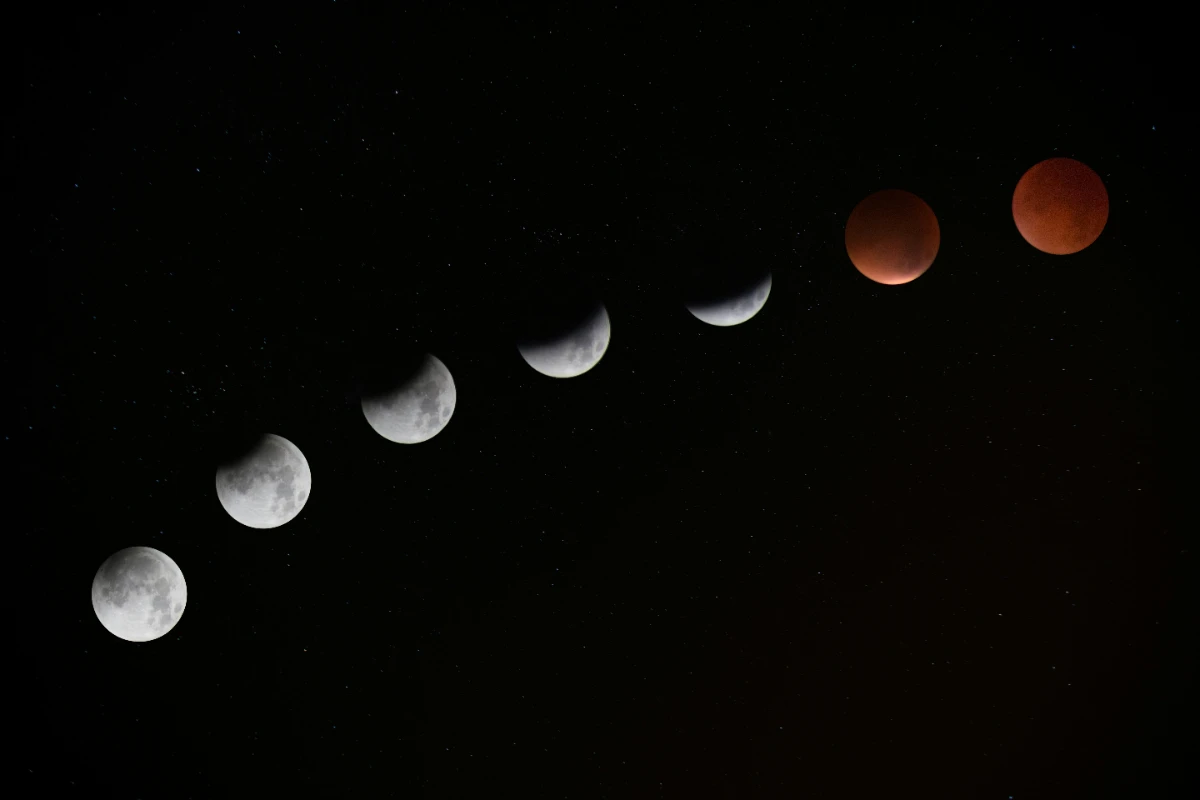
    Stunning Photos Capture Rare Supermoon Harvest Moon Eclipse on September 17-18, 2024
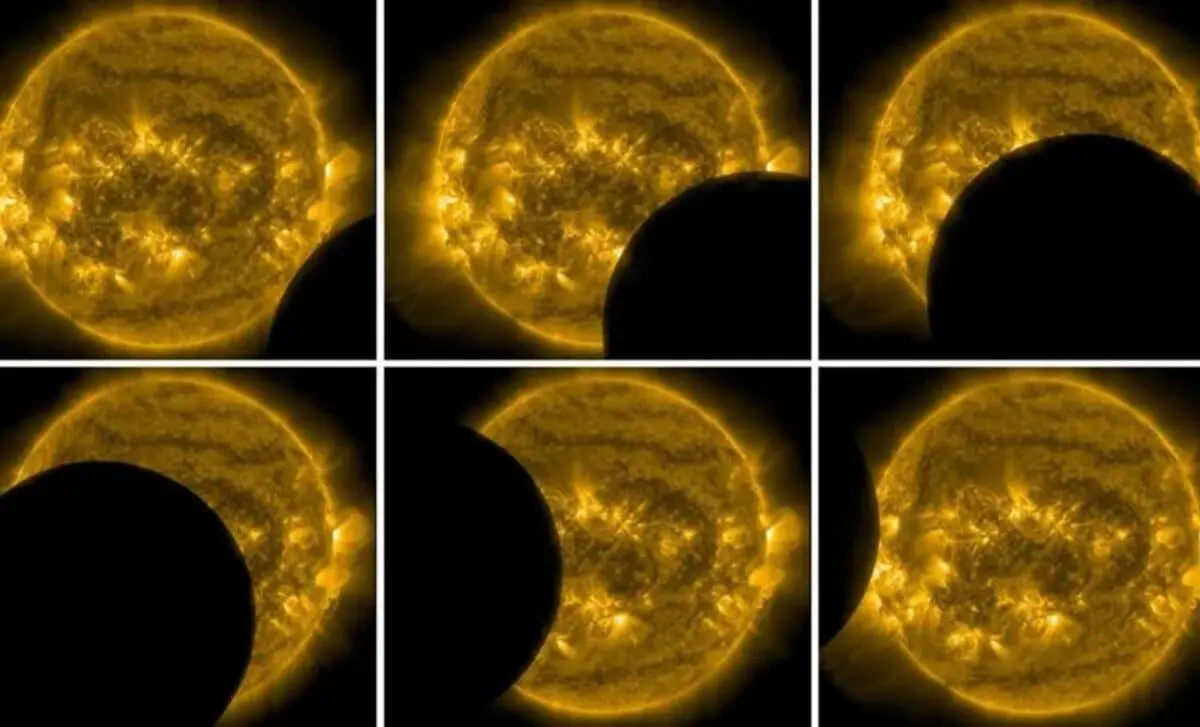
    The rare combination of a supermoon and the harvest moon eclipse on September 17-18, 2024, captivated observers around the world. The partial lunar eclipse coincided with the harvest moon, enhancing its visual impact and leaving witnesses amazed by the celestial display.

    Photographers, both professional and amateur, captured some remarkable images of the event. Highlights include shots from Abhimanyu Singh, Rami Ammoun, Evan Benko, and Jeremy Gil Chris. These photographs showcase the intricate details and rich colors of the moon during the eclipse.

    mini magick20240921 34469 mm49aw
    Image credit: Abhimanyu Singh
    The partial lunar eclipse right now PartialLunarEclipse
    Image credit: Rami Ammoun
    mini magick20240921 35446 6wnojw
    Image credit: Evan Benko
    mini magick20240921 34469 2jnv3v scaled
    Image credit: Jeremy Gil Chris

    Capturing such images requires knowledge of astrophotography techniques, telescope adjustments, and camera settings. Read our detailed astrophotography guide and telescope guide to learn more about photographing the night sky and experiencing the magic of celestial events firsthand.