Tag: Lunar Eclipse

  • A Total Lunar Eclipse Will Turn the Moon Red on September 7โ€“8, 2025

    A Total Lunar Eclipse Will Turn the Moon Red on September 7โ€“8, 2025

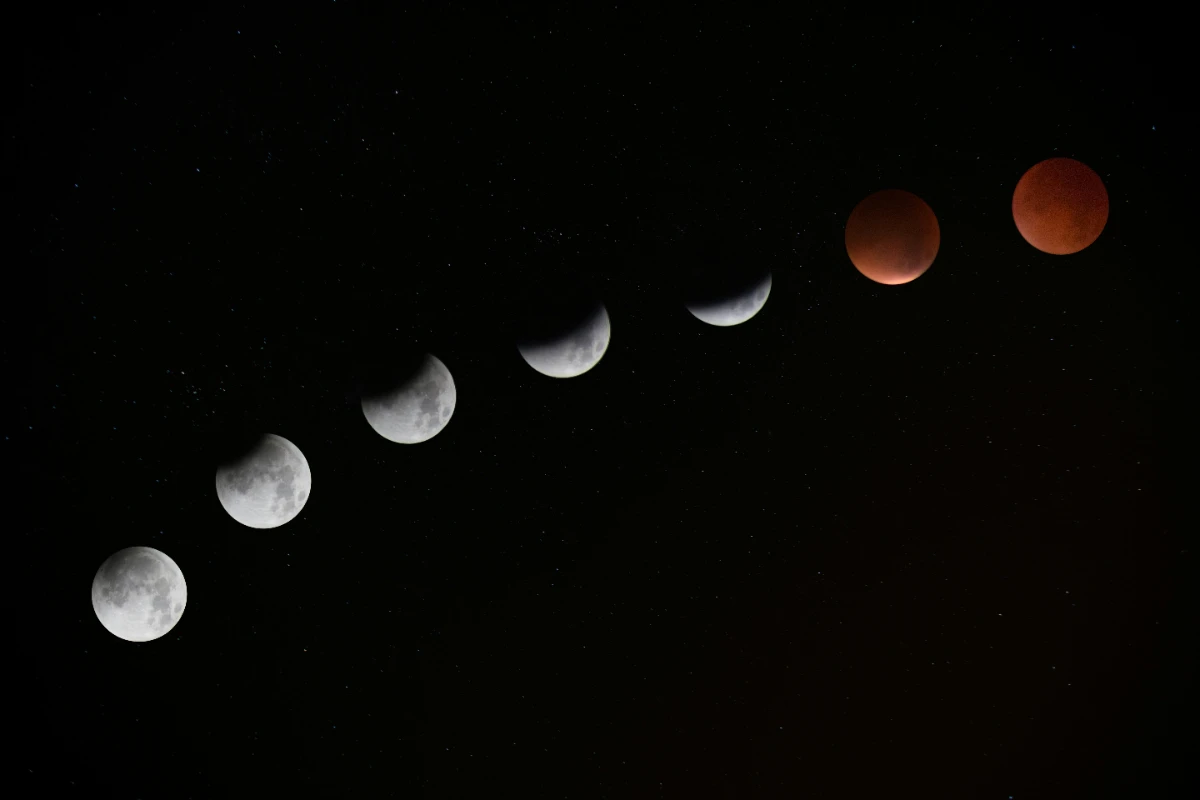
    A total lunar eclipse will paint the Moon red on September 7–8, 2025, visible across Europe, Africa, Asia, and Australia. Known as a “Blood Moon,” the event happens when Earth blocks direct sunlight from reaching the Moon, causing it to glow in shades of red. The eclipse will last for about five hours, with totality peaking at 6:11 p.m. UTC on September 7.

    During this eclipse, observers in North America may see the start or end, depending on time zones. The rest of the world can watch the full sequence unfold, from the faint penumbral stage to the deep red of totality.

    What is a Blood Moon?

    The term “Blood Moon” refers to the reddish color the Moon takes on during a total lunar eclipse. The color isn’t mystical; it comes from basic physics. When the Sun, Earth, and Moon line up, Earth blocks sunlight. But Earth’s atmosphere bends some of that light around its edges. Shorter blue wavelengths scatter, leaving behind longer red wavelengths that illuminate the Moon.

    The exact shade depends on the atmosphere at the time. Dust, smoke, or volcanic ash can make the Moon appear darker or more orange. On clearer nights, the red can look brighter.

    How does a Lunar Eclipse occur?

    A lunar eclipse occurs when the Moon moves into Earth’s shadow. The process has three stages. First, the penumbral phase makes the Moon appear slightly dimmer. Next, the partial phase begins as Earth’s central shadow takes a bite out of the Moon. Finally, the total phase, or umbra, covers the Moon completely.

    Unlike solar eclipses, lunar eclipses are safe to watch with the naked eye. No special glasses are needed, though binoculars or a telescope can reveal surface details during the dim red glow.

    History

    Ancient cultures often saw lunar eclipses as omens. The Incas, for example, believed a jaguar was attacking the moon during an eclipse. Today, astronomers understand it as a natural alignment of Earth and its satellite.

    In some cases, lunar eclipses line up with perigee (the point when the Moon is closest to Earth), creating what’s called a “supermoon eclipse.” That makes the Moon appear slightly larger in the sky. The September 2025 eclipse won’t coincide with perigee, but the view will still be striking.

    Why observe an Eclipse?

    Eclipses connect sky watchers to the rhythms of the solar system. They happen a few times a year, but total lunar eclipses are less frequent and widely anticipated. This one offers a long viewing window and a clear display of Earth’s shadow at work.

    Astronomers recommend finding a dark location away from city lights for the best view. Apps such as SkySafari and NASA’s Eclipse Explorer will provide local timings. With clear skies, millions of people worldwide will have the chance to see the Moon turn red in real time.

  • Astronomical Events in March 2025: Blood Moon, Lunar Eclipse, and more!

    Astronomical Events in March 2025: Blood Moon, Lunar Eclipse, and more!

    Here are some astronomical events in March 2025 that you won’t want to miss!

    Total Lunar Eclipse (March 14)

    On March 14, a total lunar eclipse will occur, during which the Moon will pass through Earth’s shadow, causing it to appear redโ€”a phenomenon often referred to as a “Blood Moon.” This event will be visible across North and South America, as well as parts of Europe and Africa.

    Partial Solar Eclipse (March 29)

    On March 29, the Moon will cover a portion of the Sun, making it appear as if a “bite” has been taken out of it. This eclipse will be observable from regions including the northeastern United States, eastern Canada, Greenland, Europe, northwest Africa, and northwestern Russia.

    Planetary Conjunctions

    • Mercury and Venus (Early March): In the early evenings of early March, Mercury and Venus will appear close together in the western sky during twilight. This offers a good opportunity to observe the elusive Mercury, using bright Venus as a reference point.

    • Moon and Mars (March 9): On March 9, the Moon will appear near Mars in the night sky, creating a striking visual pairing.

    March Equinox (March 20)

    The March equinox will occur on March 20, marking the beginning of spring in the Northern Hemisphere and autumn in the Southern Hemisphere. On this day, day and night are approximately equal in length.

    These events provide excellent opportunities for both amateur and seasoned astronomers to observe and appreciate the dynamics of our solar system.

  • Stunning Photos Capture Rare Supermoon Harvest Moon Eclipse on September 17-18, 2024

    Stunning Photos Capture Rare Supermoon Harvest Moon Eclipse on September 17-18, 2024

    The rare combination of a supermoon and the harvest moon eclipse on September 17-18, 2024, captivated observers around the world. The partial lunar eclipse coincided with the harvest moon, enhancing its visual impact and leaving witnesses amazed by the celestial display.

    Photographers, both professional and amateur, captured some remarkable images of the event. Highlights include shots from Abhimanyu Singh, Rami Ammoun, Evan Benko, and Jeremy Gil Chris. These photographs showcase the intricate details and rich colors of the moon during the eclipse.

    mini magick20240921 34469 mm49aw
    Image credit: Abhimanyu Singh
    The partial lunar eclipse right now PartialLunarEclipse
    Image credit: Rami Ammoun
    mini magick20240921 35446 6wnojw
    Image credit: Evan Benko
    mini magick20240921 34469 2jnv3v scaled
    Image credit: Jeremy Gil Chris

    Capturing such images requires knowledge of astrophotography techniques, telescope adjustments, and camera settings. Read our detailed astrophotography guide and telescope guide to learn more about photographing the night sky and experiencing the magic of celestial events firsthand.