Tag: Mars

  • NASAโ€™s Perseverance rover records the first-ever clear sounds of Lightning on Mars

    NASAโ€™s Perseverance rover records the first-ever clear sounds of Lightning on Mars

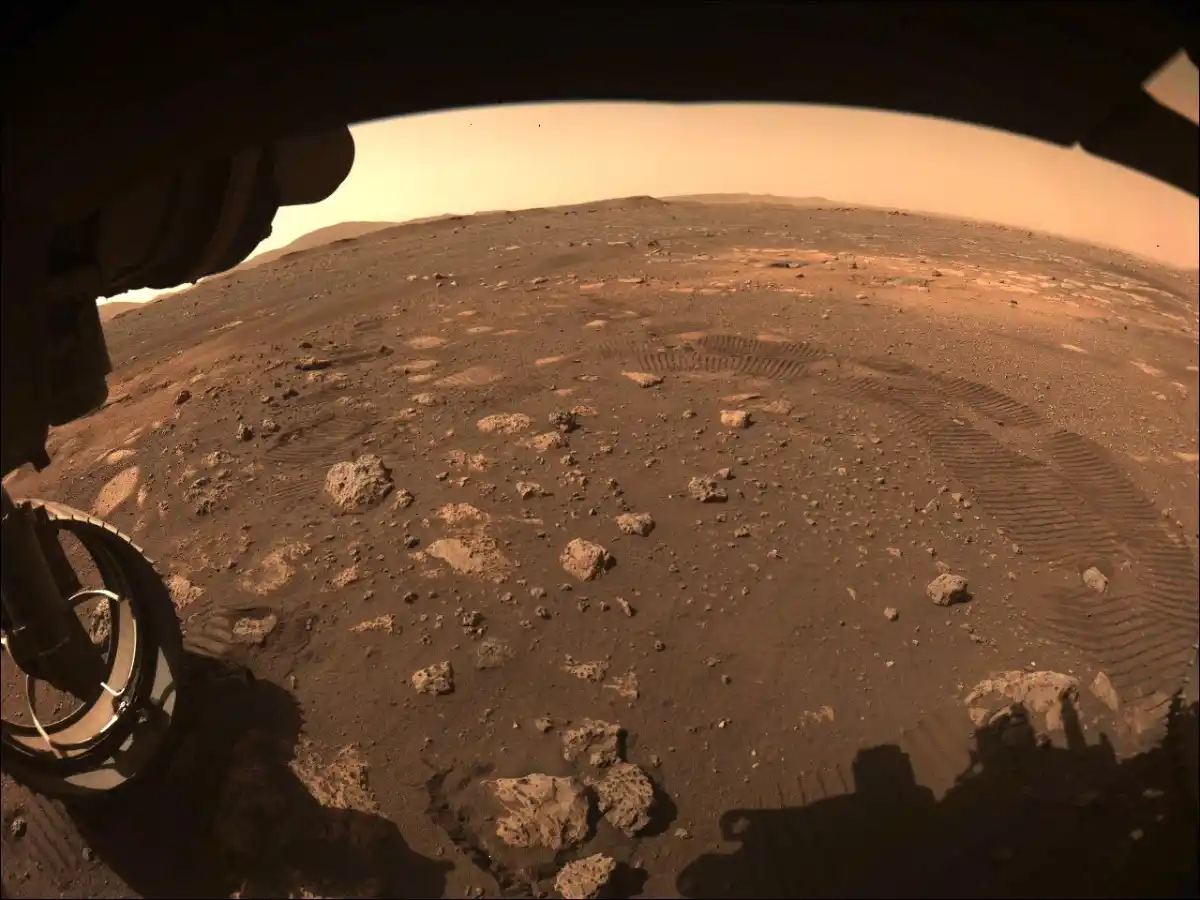
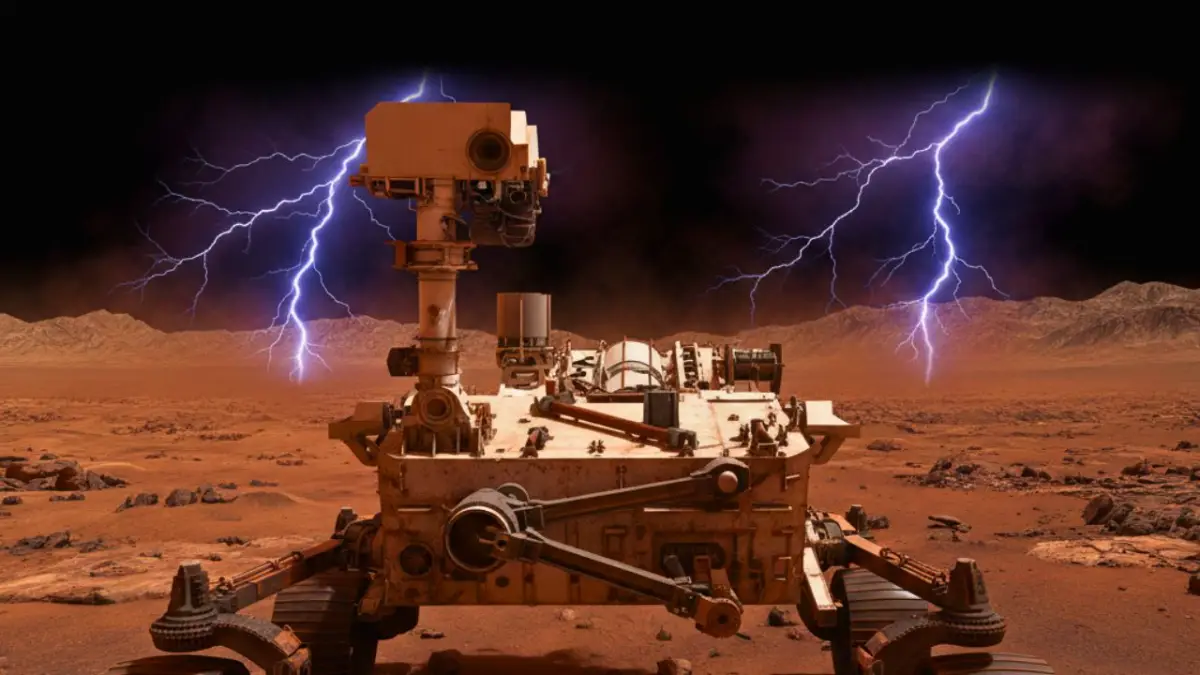
    NASA’s Perseverance rover has picked up the first confirmed sounds of lightning on Mars while operating inside Jezero Crater over the past two Martian years, recording 55 electrical discharges during dust devils and storm fronts and proving that the red planet can produce small bursts of thunder.

    The discovery came from the rover’s SuperCam microphone, which is mounted on its mast. While its main job is to study rocks, the microphone also stays on during windy periods. During these times, it captured sharp clicks followed by faint snaps. These short sounds lasted less than a tenth of a second and matched what scientists expect from small electrical sparks in Mars’ thin air.

    Out of the 55 detections, seven were full events. Those included both an electrical signal and a small sound that followed. This confirmed that the discharges were real and not just background noise from moving dust or the rover’s parts.

    On Earth, lightning carries massive energy. A single strike can hold around a billion joules. On Mars, the numbers were far lower. Most of the events measured between 0.1 and 150 nanojoules. One stronger discharge reached about 40 millijoules. Scientists believe this larger event happened when the rover itself built up charge and released it into the ground.

    Even this stronger discharge was still around a million times weaker than a normal lightning bolt on Earth. The thin air on Mars limits how much energy can build up before it jumps between surfaces.

    These sparks did not come from storm clouds filled with water. Mars has little water in its air. Instead, the charges formed when dry dust particles rubbed against each other. This happens most when winds rise sharply. The data shows that the discharges happened when wind speeds were in the highest 30 percent of all readings taken by the rover.

    Sixteen of the detected sparks came from dust devils, which are fast, spinning columns of air filled with dust. The rest were linked to the front edges of larger regional storms moving across the surface.

    To confirm the results, the team built a copy of the SuperCam microphone setup on Earth. They used a Wimshurst machine, which creates static electricity, to make controlled sparks near the device. The sound pattern it recorded was the same as what Perseverance picked up on Mars. This confirmed that the Martian signals were caused by real electrical discharges.

    Mars’ atmosphere plays a big role in how this sounds. It is about 99 percent thinner than Earth’s and mostly made of carbon dioxide. Sound moves more slowly, and high tones fade quickly. That is why there is no deep rumble like on Earth. Instead, the sound is short and sharp, and then it stops.

    These tiny sparks also matter for chemistry on Mars. When a discharge hits carbon dioxide, it can break the molecule apart. This can create reactive compounds such as nitrates and peroxides. On early Earth, similar reactions helped form basic building blocks for life. Scientists think the same process may have taken place on ancient Mars, when it had rivers and lakes.

    Today, these reactions could still leave traces in the soil. Future missions may look for those signs to learn more about the planet’s past environment. The discovery also raises safety questions for future missions. Spacecraft and habitats could slowly build up static charge on the surface. A sudden discharge may not harm a person, but it could damage unprotected electronics. Engineers may need better grounding and shielding on equipment sent to Mars.

    Perseverance continues to listen during each storm season. Thousands of hours of audio are already stored. As more storms pass over the rover, researchers expect to collect many more events. Combined with images from the rover’s cameras, this will create the first detailed audio and visual record of weather activity on another planet.

    Mars is not silent. It produces quiet, brief sounds that carry real science and real risk, and they are now finally being heard.

  • Mars โ€œLakeโ€ Near South Pole Likely Not Liquid Water After New Radar Check by NASA Orbiter

    Mars โ€œLakeโ€ Near South Pole Likely Not Liquid Water After New Radar Check by NASA Orbiter

    Scientists now say the supposed lake of liquid water beneath Mars’ south pole is probably not real. The claim, first made in 2018 using data from the European Space Agency’s Mars Express orbiter, has been challenged after NASA engineers used a new method with the Mars Reconnaissance Orbiter in May 2025. The fresh scan showed a weak signal that does not match what liquid water would produce. This matters for the search for life and future human missions to Mars.

    Back in 2018, a team using Mars Express reported a bright radar return from beneath the south polar ice. They said the signal looked like water trapped under thick frozen layers. The idea of a hidden lake on Mars quickly gained attention.

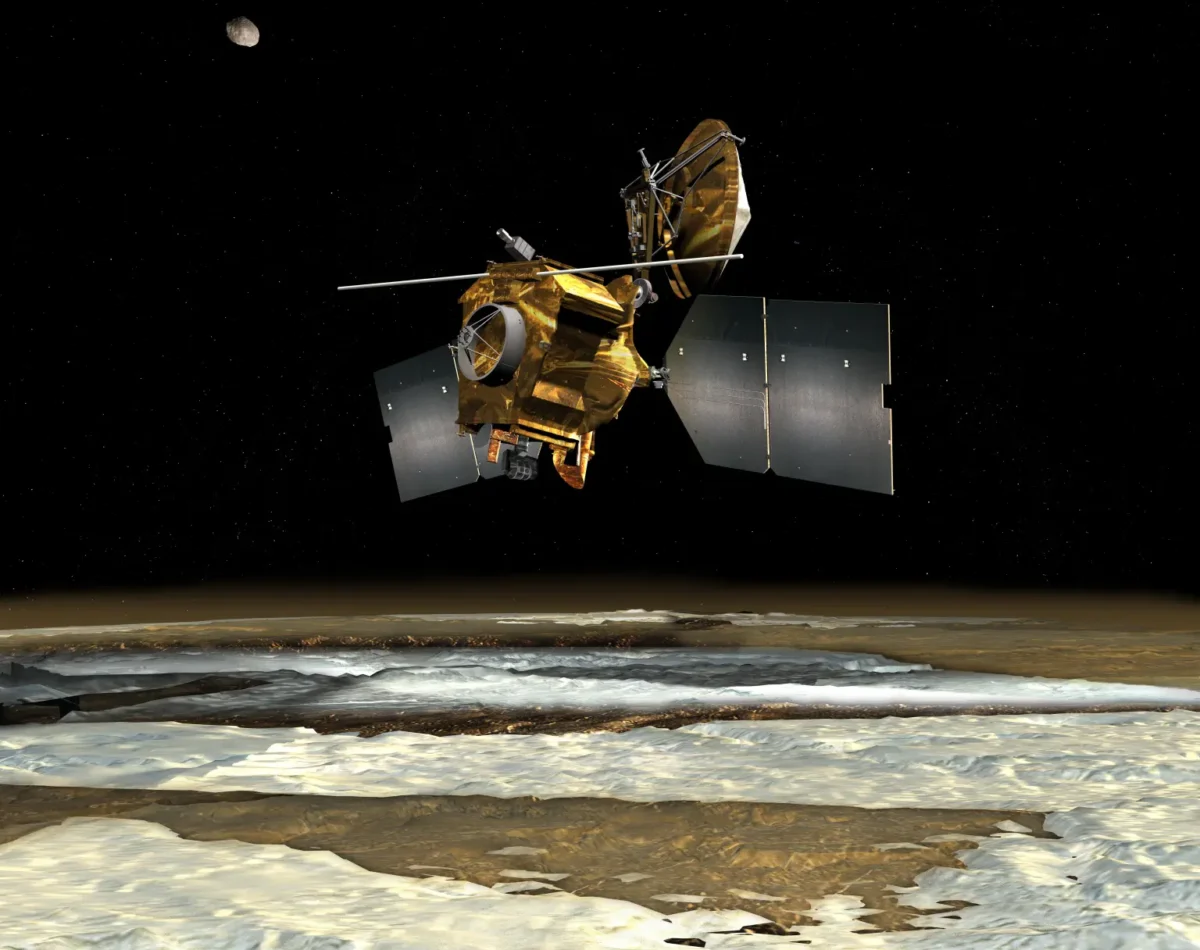
    For years, NASA’s Mars Reconnaissance Orbiter tried to check the same area using its SHARAD radar system. It could not see the same strong signal. The target area sits under thick ice, and the spacecraft’s position made it hard to get a clean view.

    In May 2025, engineers tried something different. They rolled the entire orbiter about 120 degrees so the radar antenna could point more directly at the surface below. This extreme move gave SHARAD a clearer path to the exact spot that caused the excitement in 2018.

    The map marks the 2018 Mars Express lake signal and nearby Mars Reconnaissance Orbiter paths.
    This map shows where ESA’s Mars Express detected a possible underground lake in 2018, along with the nearby flight paths of NASA’s Mars Reconnaissance Orbiter. Image credit: Planetary Science Institute

    On May 26, the orbiter passed over the area and sent back new data. Instead of a strong return, the signal was faint. Nearby areas showed nothing unusual. A real body of liquid water would have reflected the radar much more clearly.

    Researchers now think the earlier signal came from solid features, not water. The region includes buried craters, old lava layers, and mixed dust and rock under the ice. Smooth rock or thin, dusty layers can sometimes reflect radar in strange ways. That is likely what misled the earlier study.

    Even though the lake idea is fading, the new method is a big step forward. Rolling the spacecraft gave scientists a deeper and clearer look under the surface. This approach can now be used in other places on Mars.

    One key area is Medusae Fossae, a massive deposit near the planet’s equator. Some data suggest it may hide large amounts of ice under dry material. If confirmed, this ice would sit in a warmer and sunnier region than the poles. That makes it a strong candidate for future human landings.

    Mars is known to hold a lot of frozen water. Thick ice covers both poles, and buried glaciers sit in several regions. What scientists have not yet confirmed is stable liquid water on the surface today. Average temperatures near the South Pole drop to around minus 80 degrees Fahrenheit. The air pressure is also very low. Under these conditions, water struggles to stay in liquid form unless it is very salty or trapped at the correct depth.

    Each new study helps researchers better understand how radar behaves on Mars. It also shows how easy it is to mistake rock and dust for water. For now, there is no underground lake at the South Pole. But the tools used to search for one just became more precise.

    Source: NASA Orbiter Shines New Light on Long-Running Martian Mystery

  • ESA Study Tracks Over 1,000 Dust Devils on Mars, Revealing Surprising Wind Speeds and Patterns

    ESA Study Tracks Over 1,000 Dust Devils on Mars, Revealing Surprising Wind Speeds and Patterns

    Scientists using ESA’s Mars Express and ExoMars Trace Gas Orbiter have tracked more than a thousand dust devils across the Martian surface, revealing winds far stronger than expected. The study, published in Science Advances, shows that these spinning columns of dust can reach speeds up to 158 kilometers per hour. The findings help researchers understand how Martian weather works and how it could affect future missions.

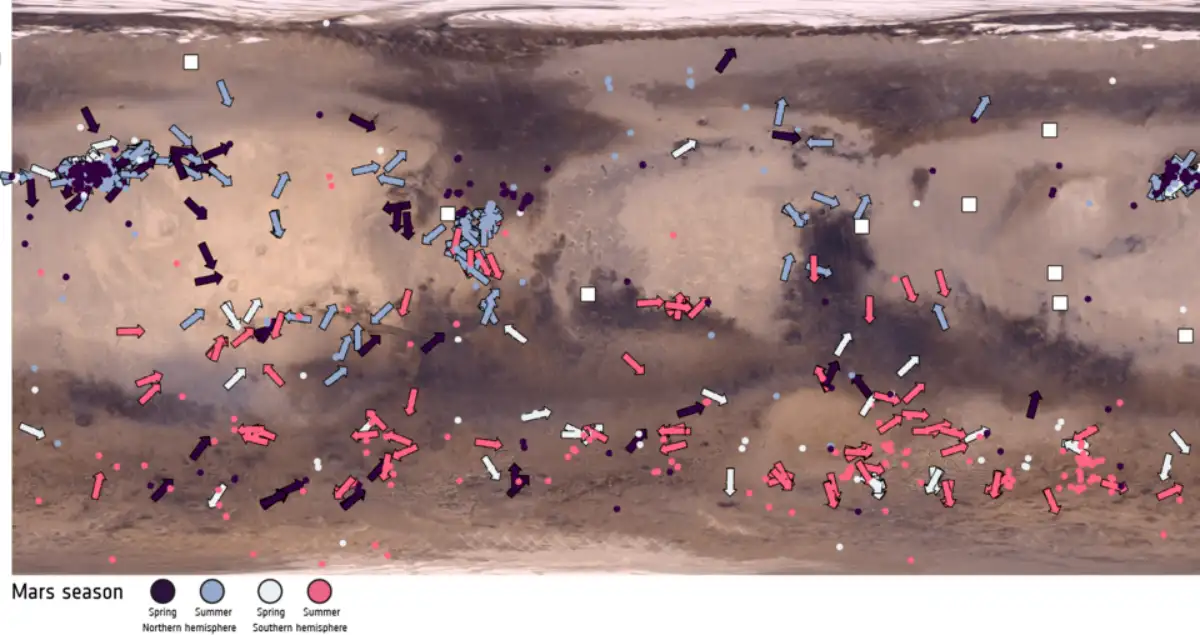
    Dust devils form when warm air rises through cooler air, creating rotating vortices that lift dust from the ground. On Mars, they leave visible streaks behind as they clear fine material from the surface. Unlike on Earth, they thrive in an atmosphere just one percent as dense, yet they are strong enough to move dust high into the sky.

    The new survey catalogued 1,039 dust devils, the first time scientists have been able to map them on a global scale. Many were found in dusty plains such as Amazonis Planitia. The study shows that some whirlwinds wobble as they move, changing direction unexpectedly. Seasonal patterns also emerged, with activity peaking in the Martian spring and summer, between late morning and early afternoon.

    To measure wind speed, researchers used a neural network to identify dust devils in two decades of images from the orbiters. The spacecraft’s cameras, designed to photograph the surface, occasionally recorded the same scene several seconds apart.

    Dust devils shifted between these exposures, and scientists used that displacement to calculate speed and direction. Mars Express provided delays of up to 19 seconds, while ExoMars’ CaSSIS camera offered longer delays of up to 46 seconds, making movement easier to track.

    A Dust Devil on Mars.
    A dust devil on Mars captured by ESA’s ExoMars TGO. Image credit: ESA

    Some dust devils were clocked at 44 meters per second, faster than anything previously measured by rovers on the surface. These high speeds mean that dust storms on Mars may carry more material than current models predict, affecting the climate and shaping how the thin atmosphere evolves over time.

    Dust plays an important role in Mars’ environment. It cools the surface during the day, warms the air at night, and can seed clouds. On a larger scale, storms can lift water vapor into the upper atmosphere, where it may escape into space. The dust also impacts robotic missions. Accumulation on solar panels reduces power, as seen with NASA’s InSight lander, which shut down in 2022 after losing too much energy.

    Understanding when and where dust devils occur could help engineers select safer landing sites and design more resilient equipment. The new catalog shows where activity is most common and provides data for improving climate models.

    The researchers also highlighted how these dust devils are not evenly spread across the planet. While Amazonis Planitia produced many of them, areas such as Hellas Basin recorded fewer, likely because of less loose material. Some whirlwinds were also observed on the slopes of giant Martian volcanoes, showing that elevation does not prevent them from forming.

    Future work will focus on combining observations from both orbiters taken at the same time, which could confirm speed calculations. As the catalog grows, scientists expect to refine models of Martian weather, helping prepare for both robotic and eventual human missions.

    Mars Express and ExoMars continue to send back images, adding new examples of dust devils to the record every week. Researchers say these findings are a step toward understanding how winds shape the planet’s surface and atmosphere.

    Sources: Dancing dust devils trace raging winds on Mars; Dust devil migration patterns reveal strong near-surface winds across Mars

  • ESA Mars Orbiters Capture Rare Images of Interstellar Comet 3I/ATLAS Passing Near the Red Planet

    ESA Mars Orbiters Capture Rare Images of Interstellar Comet 3I/ATLAS Passing Near the Red Planet

    Two European spacecraft orbiting Mars have captured rare images of an interstellar comet passing nearby. On October 3, ESA’s ExoMars Trace Gas Orbiter and Mars Express turned their cameras toward comet 3I/ATLAS as it came within about 30 million kilometers of the red planet. The close approach gave scientists an unusual chance to study material from beyond our solar system.

    Comet 3I/ATLAS was first spotted in July 2025 by the ATLAS telescope in Chile. It is only the third interstellar comet ever confirmed, following ‘Oumuamua in 2017 and Borisov in 2019. These comets travel on hyperbolic paths, meaning they are not bound to the sun and will not return once they pass through.

    Astronomers believe 3I/ATLAS may be far older than our solar system. Models suggest it formed about 7.6 billion years ago, roughly three billion years before the sun and planets. Its orbit shows that it likely escaped from a distant star system long ago and has been drifting through space ever since, carrying frozen material from another corner of the galaxy.

    The ExoMars orbiter used its CaSSIS camera to take a series of long exposures, capturing the comet as a faint white spot moving across the sky. That blur represents the nucleus and its coma, the cloud of dust and gas released as sunlight warms the surface.

    The nucleus itself is estimated to be only about a kilometer wide, too small to be resolved directly from such a distance. By comparison, scientists described it as like trying to see a phone from the surface of the moon.

    The coma already measures thousands of kilometers across, though its edges are hard to see against the background. No tail has yet been detected, but astronomers expect one to form as the comet moves closer to the sun in the coming weeks.

    Mars Express also attempted to record the event, but its shorter exposures made the comet more difficult to pick out. Teams are combining and processing multiple images to improve visibility. Both orbiters also tried to collect spectral data to identify gases escaping from the comet.

    Capturing these images was a technical challenge. The orbiters are built to photograph the Martian surface, which is only hundreds of kilometers away. The comet, by contrast, was tens of millions of kilometers distant and tens of thousands of times dimmer. According to CaSSIS team leader Nick Thomas, the task pushed the limits of the spacecraft’s instruments.

    Studying interstellar comets is important because they are made of material that formed around other stars. Small differences in their chemistry, such as isotope ratios or unusual ice content, help researchers compare how planetary systems form across the galaxy.

    When astronomers studied 2I/Borisov, for example, they found unusually high levels of carbon monoxide, suggesting it came from a colder environment than our solar system.

    Analysis of the Mars images will continue for several weeks, as scientists measure the coma’s size and look for chemical signatures. The comet will also be observed by ESA’s Juice spacecraft, which is currently on its way to Jupiter. Juice is expected to capture new data after 3I/ATLAS makes its closest approach to the sun. Because of the spacecraft’s distance, that information will not reach Earth until February 2026.

    Looking ahead, ESA plans to launch the Comet Interceptor mission in 2029. The spacecraft will wait in space for a target, which could be an untouched comet from the Oort Cloud or even another interstellar visitor. Unlike current observations from afar, a direct encounter would allow scientists to study the surface and structure of such an object up close.

    Source: ESA’s ExoMars and Mars Express observe comet 3I/ATLAS

  • Researchers develop a new Nuclear Rocket Design that could Cut Mars Trip Time by Half

    Researchers develop a new Nuclear Rocket Design that could Cut Mars Trip Time by Half

    Researchers at Ohio State University have introduced a new nuclear propulsion design that could slash the time it takes to reach Mars. The system, called the centrifugal nuclear thermal rocket (CNTR), uses liquid uranium spinning at high speeds to heat propellant more efficiently than chemical or earlier nuclear designs. If successful, it could reduce the current six- to nine-month trip to Mars to as little as three months.

    In standard nuclear thermal rockets, a solid reactor core heats hydrogen gas, which then expands and provides thrust. CNTR modifies this by melting uranium into liquid form and using centrifugal force to keep it stable. Hydrogen propellant is passed through bubbles in the liquid fuel, transferring heat directly.

    This method could achieve a specific impulse of around 1,800 seconds, compared to about 900 for conventional nuclear rockets and 450 for chemical engines.

    Reducing travel time is key for human missions to Mars. Long stays in space increase exposure to radiation and health issues from microgravity, such as bone loss. A faster transit window would lower those risks and make round trips possible in about one year instead of three.

    Centrifugal Nuclear Thermal Rocket (CNTR) with 19 Centrifugal Fuel Elements (CFEs) anoted image.
    Diagrammatic Representation of a Centrifugal Nuclear Thermal Rocket (CNTR) with 19 Centrifugal Fuel Elements (CFEs). Image credit: ntrs.nasa.gov.

    The Ohio State team is led by associate professor Dean Wang, working with PhD student Spencer Christian and other researchers. Their work has attracted partial funding from NASA, which has renewed interest in nuclear propulsion as part of its long-term plans for human exploration beyond Earth orbit.

    CNTR also offers flexibility in fuel choice. Researchers suggest methane, which may be harvested from asteroids or Martian resources, could serve as propellant, reducing the need to carry large reserves from Earth.

    The engineering challenges remain steep. Liquid uranium reaches about 5,000 Kelvin, and the system must contain it without leaks while resisting corrosion at extreme heat. The proposed reactor includes 37 fuel elements and 12 control drums to manage the nuclear reaction. Testing the concept in the lab could take up to five years, focusing heavily on safety for crewed missions.

    If CNTR works, its reach goes beyond Mars. Faster nuclear propulsion could make missions to Saturn or Neptune more practical for robotic probes. Current spacecraft, like the Voyager probes, took years to cross the outer solar system. A system like CNTR could shorten those timelines and open new opportunities to study distant moons and planets.

    The next step for the Ohio State team is to conduct ground-based demonstrations that replicate the extreme conditions of spaceflight. If successful, the concept may progress toward in-space testing. While still in development, the design represents one of the most advanced attempts yet to make nuclear propulsion practical for human and robotic missions across the solar system.

    Source: Addressing challenges to engineering feasibility of the centrifugal nuclear thermal rocket

  • NASA’s Mars rover Perseverance finds a rock in Jazero Crater with possible traces of past life

    NASA’s Mars rover Perseverance finds a rock in Jazero Crater with possible traces of past life

    NASA’s Perseverance rover may have found its most promising hint of Martian habitability yet. In July 2024, the rover drilled into a rock in Jezero Crater’s ancient river valley and extracted a core sample that shows chemical signatures often tied to microbial activity on Earth. The results, described this week in the journal Nature, have sparked debate among scientists about whether Mars once hosted life.

    The rock, known as Cheyava Falls, lies in Neretva Vallis, a channel carved by water billions of years ago. The extracted core, named Sapphire Canyon, is one of 27 samples collected so far by Perseverance for eventual return to Earth. Jezero Crater itself once held a large lake, making it a prime site for the search for biosignatures.

    Two of Perseverance’s instruments, PIXL and SHERLOC, detected organic carbon, sulfur, phosphorus, and iron oxides in the sample. These elements were not scattered randomly but arranged in distinct patterns nicknamed “leopard spots.” The mineral mix includes vivianite, a hydrated iron phosphate, and greigite, an iron sulfide. On Earth, both are often linked to microbial processes in wet environments.

    Colorized SHERLOC ACI image highlighting the authigenic nodule reaction front features.
    Colorized SHERLOC ACI image highlighting the authigenic nodule reaction front features. Image credit: NASA/JPL-Caltech/MSSS

    Vivianite typically forms in sediments containing decaying organic matter. Greigite can appear when microbes use sulfate for energy. The presence of both together, in specific textures, suggests electron exchanges between organics and minerals, reactions commonly driven by bacteria. Scientists note that similar features are seen in peat bogs and lake beds on Earth.

    However, chemistry alone cannot prove biology. Non-living processes, such as chemical reactions with heat or acid, can create similar patterns. Researchers point out that this rock does not show signs of extreme heat or acidity, raising the chances (but not confirming) that microbes once played a role.

    To assess such findings, scientists use the CoLD scale, which ranks the strength of evidence for past life. The Sapphire Canyon sample meets some early criteria but falls short of definitive proof. Future laboratory testing will be required to confirm whether these chemical traces were truly biological.

    Perseverance’s-path-through-Neretva-Vallis-and-views-of-the-Bright-Angel-formation.
    Perseverance’s path through Jezero Crater’s Neretva Vallis, showing science targets and the contact between the Bright Angel Formation and the Margin Unit. Image credit: NASA/JPL-Caltech/ASU/MSSS

    Perseverance’s discoveries matter because they suggest Mars may have remained habitable longer than once thought. Previous missions, such as Curiosity in Gale Crater, also found organic molecules, but Sapphire Canyon adds evidence from younger rocks in a once-wet delta.

    The rover’s work is meant to support the proposed Mars Sample Return mission, which aims to bring these samples back to Earth in the 2030s. That mission faces funding and technical hurdles, but it remains the most likely path to confirming or rejecting signs of Martian life. Scientists still recall the controversy around the ALH84001 meteorite, which in 1996 was claimed to contain fossils but was later proved inconclusive.

    For now, Perseverance will continue its survey of Jezero, while Europe’s planned ExoMars rover prepares to drill deeper into the surface. Each mission adds new clues to one of science’s biggest questions: whether Mars ever supported life.

    Source: Redox-driven mineral and organic associations in Jezero Crater, Mars

  • Mars’ Mantle Holds Ancient Debris From Violent Impacts, InSight Data Reveals

    Mars’ Mantle Holds Ancient Debris From Violent Impacts, InSight Data Reveals

    New research using NASA’s InSight mission has revealed that Mars’ mantle contains leftover fragments from massive collisions that shaped the planet about 4.5 billion years ago. The findings, published in Science on August 28, 2025, show that the Red Planet’s interior has preserved rocky debris from its violent past in a way Earth has not.

    InSight landed on Mars in 2018 and operated until 2022. It recorded more than 1,300 marsquakes with its seismometer. Scientists studying those signals found unusual slowdowns in seismic waves that traveled deep into the mantle, a layer up to 960 miles thick beneath the crust. The waves scattered and delayed in ways that suggested the presence of dense, uneven patches within the mantle.

    At first, researchers thought the changes came from the crust. But as the delays increased with depth, computer models pointed instead to lumps of rock within the mantle, some stretching up to 2.5 miles across. These chunks are believed to be remnants of ancient impacts from asteroids or protoplanets that struck young Mars, creating magma oceans where debris sank and became locked in place.

    “We’ve never seen the inside of a planet in such fine detail before,” said Constantinos Charalambous of Imperial College London, lead author of the study. “The survival of these fragments shows that Mars’ mantle has changed very slowly over time, unlike Earth, where tectonics and convection erase features like this.”

    The discovery suggests Mars has acted as a long-term archive of the early solar system. With no plate tectonics, the planet’s mantle retains records of catastrophic events that shaped it billions of years ago. Tom Pike, also from Imperial College and a coauthor, said the clarity of the data was unexpected, noting that what was first thought to be a crustal effect turned out to be mantle structure instead.

    On Earth, mantle mixing and shifting tectonic plates erase traces of its early history. Mars, however, has remained far quieter, preserving evidence of massive impacts that shaped not only itself but also the solar system. The preserved lumps highlight the contrast between Earth’s active interior and Mars’ static one.

    The findings build on InSight’s earlier mapping of the Martian interior, which outlined the structure of its crust, mantle, and core. They also point to what might be found inside other planets without plate tectonics, such as Venus and Mercury.

    The InSight mission, managed by NASA’s Jet Propulsion Laboratory with support from partners in France and Germany, ended in 2022. But its data continues to deliver discoveries, offering new ways to study planets without drilling beneath their surfaces.

    Source: Seismic evidence for a highly heterogeneous martian mantle

  • NASAโ€™s Curiosity rover spots a coral-like, flower-shaped Mars rock, hinting at ancient water systems

    NASAโ€™s Curiosity rover spots a coral-like, flower-shaped Mars rock, hinting at ancient water systems

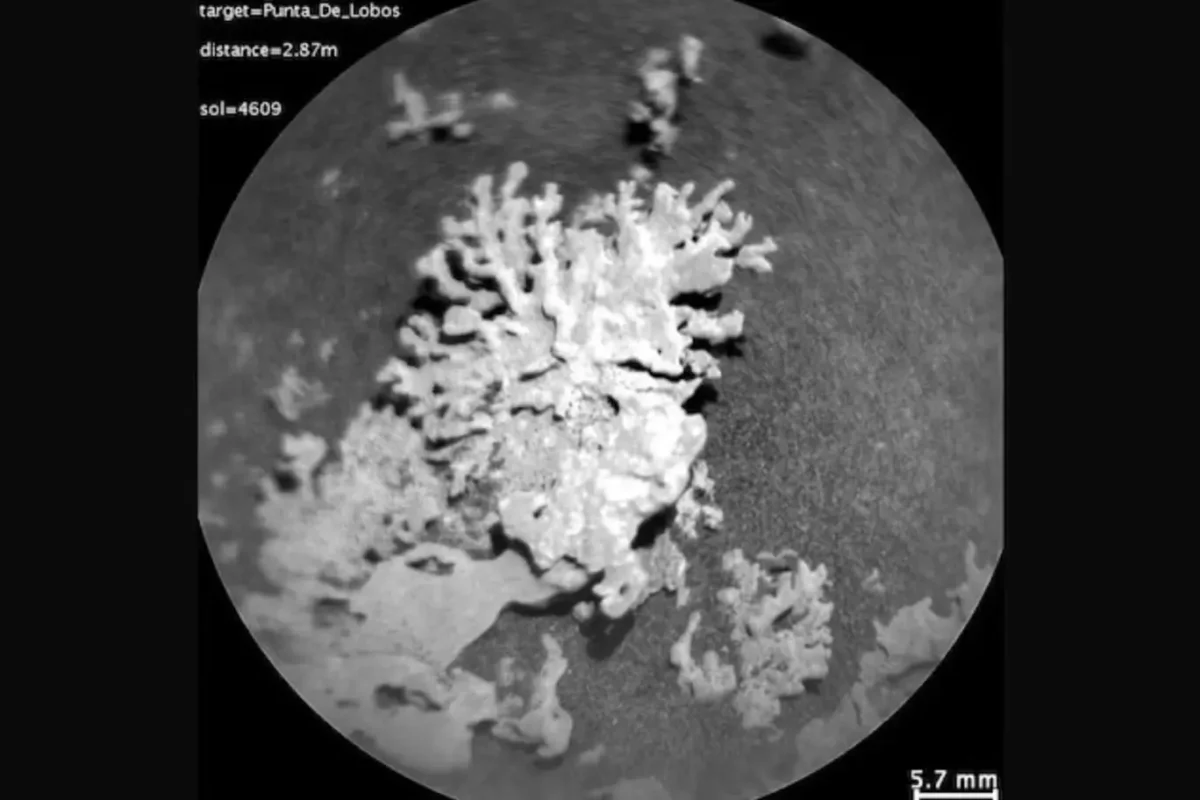
    NASA’s Curiosity rover has spotted rock formations on Mars that look strikingly like coral or flowers. One of the most recent finds, photographed on 24 July, 2025, is a wind-eroded rock about an inch wide, shaped like a piece of reef. These unusual shapes formed when mineral-rich water once flowed through cracks in the rock and left hardened deposits behind.

    Billions of years ago, Mars had rivers, lakes, and possibly an ocean. Water carried dissolved minerals into fractures in the bedrock. When the water evaporated, it left behind minerals that hardened over time. On Earth, the same process creates intricate structures in deserts and dried lakebeds.

    On Mars, eons of wind-driven sand have worn away softer material, leaving behind the more resistant mineral ridges in shapes resembling flowers or corals.

    Flower-shaped structure on Mars.
    Flower-shaped structure on Mars captured by NASA’s Curiosity rover on February 24, 2022. Image credit: NASA

    The newly photographed “Paposo” rock joins a growing list of similar discoveries. In 2022, Curiosity found another flower-shaped rock believed to have formed in the same way. In June this year, the rover also imaged “spiderweb” patterns—networks of ridges that are further evidence of water activity beneath the surface in the planet’s past.

    Curiosity landed in Gale Crater in 2012 after an eight-month, 352-million-mile journey from Earth. Since then, it has travelled over 22 miles, studying Martian geology and climate. Its findings confirm that Mars once had environments that could have supported microbial life.

    The ongoing mission continues to collect samples and images, helping scientists piece together the story of how the Red Planet changed from a watery world to the cold desert we see today.

    These coral-like rocks are physical records of ancient Martian water systems. Each new discovery adds detail to our understanding of Mars’ history and raises fresh questions about the planet’s past climate, its underground water reserves, and its potential to have once hosted life.

  • Must see Astronomical events in July 2025

    Must see Astronomical events in July 2025

    Attention, stargazers! July 2025 offers some exciting stargazing opportunities for both casual observers and professional astronomers around the globe. Starting with the conjunction of Antares and the Moon, the month will end with the peak of the Delta Aquarids meteor shower.

    This article serves as a clear and reliable guide to help you navigate the celestial events of July, offering detailed insights into each event so you can make the most of your stargazing experience.

    Key astronomical events in July 2025

    • July 1-7: Mercury appears bright and easy to see low in the western sky 30 to 45 minutes after sunset. A clear horizon is required for visibility before it sets.
    • July 3: Mercury lies near the Beehive Cluster in the western sky after sunset, visible until around 8:20 p.m. At the same time, Spica appears close to the Moon and remains in view until midnight.
    • July 4: Earth reaches its farthest distance from the Sun (Aphelion): 152 million kilometers. Mercury reaches its greatest eastern elongation, offering its widest separation from the Sun in the evening sky.
    • July 21-22: A crescent moon appears close to Venus and Jupiter in the eastern sky just before sunrise. Several bright stars remain visible in the same region.
    • July 28: A crescent moon appears near Mars in the western sky after sunset.
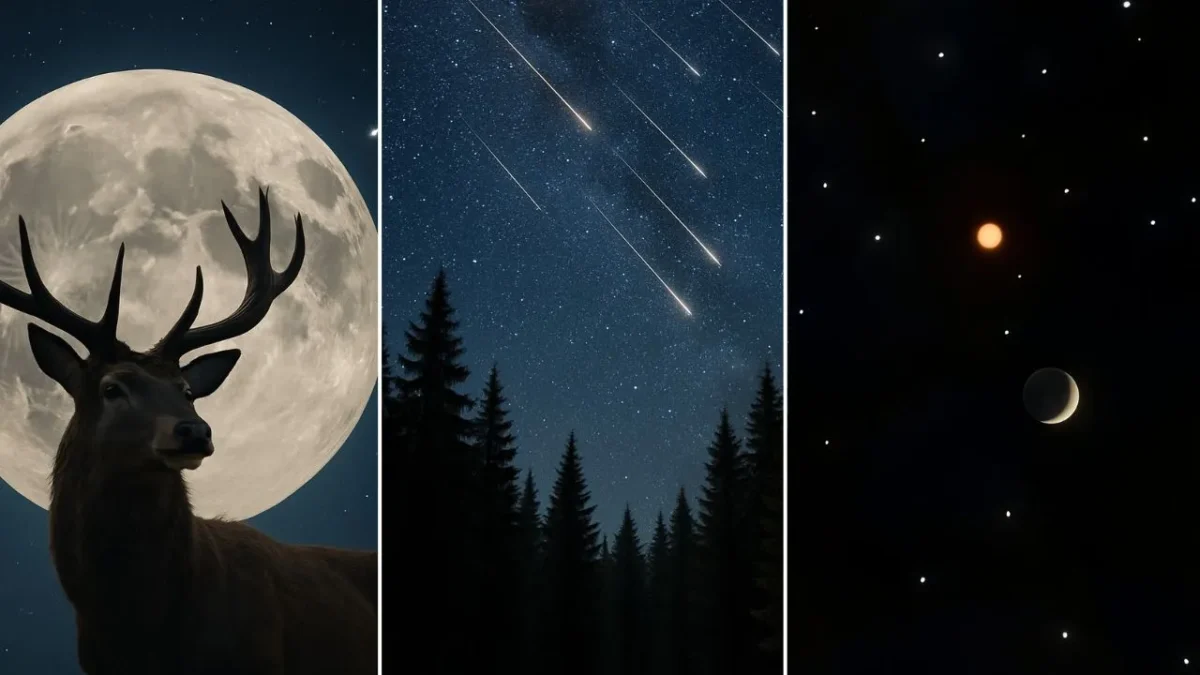
    • July 30-31: The Delta Aquariids meteor shower peaks, with as many as 25 meteors per hour visible from 9:30 p.m. until dawn. (Check Radiant Point.)

    The Buck Moon

    The Buck Moon/the July full moon.
    (Artists’s Concept)

    According to Forbes, the Buck Moon (Full Moon of July) will reach its full phase at 4:38 p.m. EDT on Thursday, July 10. While it will appear full the night before and after its peak, the most breathtaking view will be during moonrise at dusk on July 10. That is when the full moon will hang low on the horizon, appearing larger, brighter, and more dramatic.

    According to Farmer’s Almanac, the name comes from Native American traditions, referring to the time of year when male deer, or bucks, begin to grow new antlers covered in soft velvet. The term has since become widely recognized in modern lunar calendars.

    This yearโ€™s Buck Moon does not coincide with the Delta Aquariids peak, allowing clearer views of the meteor shower later in the month.

    Planets and constellations visible in July 2025

    • Venus shines brightly in the eastern sky during the two hours before sunrise, appearing near the Pleiades star cluster, Aldebaran, and Capella throughout the month.
    • Mars appears low in the west after sunset and remains visible for a couple of hours. Its brightness gradually fades as the month continues.
    • Jupiter begins rising in the east around an hour before sunrise from mid-July onward, climbing higher each morning.
    • Saturn rises around midnight and stays high in the southern sky through the early morning hours.
    • The Aquila constellation is visible in the eastern sky during the first half of the night. Its brightest star, Altair, forms one corner of the Summer Triangle and remains easy to locate, even from areas with light pollution.

    Space History

    The month of July 2025 marks 60 years since NASAโ€™s Mariner 4 performed the first successful flyby of Mars in July 1965. It was the first mission to send back close-up images of another planet and revealed that Mars has a very thin, cold atmosphere.

    Moon phases for July 2025

    • First quarter: July 2
    • Full Moon: July 10
    • Third quarter: July 17
    • New Moon: July 24

    Darker skies around the new moon offer ideal conditions for viewing faint stars, planets, and meteor showers. Topped with multiple conjunctions, July remains a rewarding month for skywatching.

  • Boxabl’s $60,000 Foldable Homes Draw Global Attention Amid Housing Crisis
    Boxabl’s $60,000 Foldable Homes Draw Global Attention Amid Housing Crisis
    Boxabl

    , a Las Vegas-based housing startup founded in 2017 by mechanical engineer and industrial designer Paolo Tiramani, is making headlines with its foldable modular home called the Casita. Priced at $60,000, the 375-square-foot unit is designed to be built in just a few hours, offering what the company says is a faster, cheaper, and more sustainable alternative to traditional housing.

    The idea has attracted nearly 70,000 preorders worldwide, raising questions about whether this innovation could help solve affordability problems in U.S. cities and beyond.

    Launched with $2 million in seed funding from its cofounders, Boxabl has since raised more than $150 million, mostly through crowdfunding campaigns.

    The company’s factory in North Las Vegas now produces these prefabricated foldable homes at scale, with the goal of making housing more accessible. According to Boxabl, demand has surged not only from individual buyers but also from governments and organizations looking for emergency housing solutions.

    The company gained widespread attention in 2020 after reports suggested that Elon Musk had purchased a unit. Musk confirmed in September 2021 that he was indeed living in a Boxabl Casita near SpaceX’s Starbase facility in Texas, boosting the company’s visibility worldwide.

    Inside the $60,000 Casita

    The Casita is designed as a compact but fully equipped home. According to Boxabl, the unit includes a kitchen fitted with an oven, stove, microwave, sink, refrigerator, HVAC system, and storage cabinets. The living area is large enough for a king-size bed, couch, and optional designer closet. Multiple power outlets and 8-foot-tall, 3-foot-wide windows and doors add to the sense of space and light.

    Boxabl says the entire home can be shipped on a standard truck and unfolded on-site within hours, significantly reducing the costs and environmental impact compared to traditional construction.

    Mixed Reactions Over Price and Value

    Reactions to the Casita’s $60,000 price tag have been divided. Some see it as a breakthrough for people who want affordable, fast housing solutions, while critics argue it is still too expensive for many working families.

    As of 2023, the average U.S. single-family home cost $381,287, according to Zillow, while condos in cities like New York ranged from $785,333 for a studio to over $10 million for larger units, according to Castle Avenue. By comparison, the Casita offers an entry point at a fraction of urban real estate prices, though land, permits, and utility connections remain additional costs.

    Wider Applications and Future Potential

    Beyond personal housing, Boxabl’s foldable homes are being considered for disaster relief, military housing, and humanitarian efforts in regions facing displacement. The company has hinted at future collaborations with governments to supply rapid-deployment housing during natural disasters.

    The homes have also sparked discussion about their potential role in space exploration. Advocates argue that lightweight, prefabricated modules like the Casita could support long-term missions on Mars, where shipping building materials would cost billions of dollars, even with rockets like SpaceX’s Starship. While this application remains speculative, it highlights the flexibility of Boxabl’s technology.

    What’s Next for Boxabl?

    With demand outpacing supply, Boxabl is expanding its production facilities and exploring automation to meet orders faster. The company has stated that delivering its backlog of preorders could take years, but it remains focused on scaling up.

    As cities face rising housing costs and growing homelessness, Boxabl positions itself as a company aiming to disrupt the way homes are built and owned. Whether it becomes a mainstream housing solution or remains a niche product, the Casita has already reshaped the conversation about affordable housing.