Tag: Meteor Shower

  • Meteor Shower Calendar 2026: Major Meteor Showers and the Best Nights to See Them

    Meteor Shower Calendar 2026: Major Meteor Showers and the Best Nights to See Them

    From the Quadrantids in January to the Geminids in December, this guide covers all major meteor showers in 2026 with their active periods, peak dates, and viewing conditions. Whether you are a beginner or an experienced observer, understanding when and where to look can significantly improve your chances of seeing meteors under dark skies.

    Here is a complete list of the major meteor showers in 2026, including their active periods and peak dates.

    Meteor Shower Peak Dates 2026.
    Meteor Shower Peak Dates 2026

    Quadrantids Meteor Shower

    Active: December 28, 2025-January 12, 2026
    Peak: January 2-3, 2026

    The Quadrantids are one of the strongest meteor showers, but their peak is very short. At maximum activity, they can produce a high number of fast-moving meteors. Clear skies during the peak night are crucial, as missing the peak window can significantly reduce visible activity.

    Best viewing time: Pre-dawn hours
    Best hemisphere: Northern Hemisphere

    Lyrids Meteor Shower

    Active: April 14-April 30, 2026
    Peak: April 21-22, 2026

    The Lyrids are among the oldest recorded meteor showers in human history. They are known for occasional bright meteors and short bursts of increased activity. While not the most intense shower, the Lyrids remain a reliable springtime event for stargazers.

    Best viewing time: Late night to early morning
    Best hemisphere: Northern Hemisphere

    Eta Aquariids Meteor Shower

    Active: April 19-May 28, 2026
    Peak: May 5-6, 2026

    Associated with Halleyโ€™s Comet, the Eta Aquariids are famous for fast, long-lasting meteors that often leave glowing trails. This meteor shower is especially favorable for the Southern Hemisphere, though observers in the Northern Hemisphere can still catch meteors before sunrise.

    Best viewing time: Pre-dawn hours
    Best hemisphere: Southern Hemisphere

    Alpha Capricornids Meteor Shower

    Active: July 3-August 15, 2026
    Peak: July 30-31, 2026

    Alpha Capricornids produce fewer meteors compared to other meteor showers in 2026, but they are well known for slow-moving fireballs. Even with low meteor counts, the brightness of individual meteors makes this shower worth watching.

    Best viewing time: After midnight
    Best hemisphere: Both hemispheres

    Southern Delta Aquariids Meteor Shower

    Active: July 12-August 23, 2026
    Peak: July 30-31, 2026

    This long-lasting meteor shower overlaps with the Alpha Capricornids, increasing overall meteor activity in late July. The Southern Delta Aquariids typically produce faint meteors, making dark sky conditions essential for the best experience.

    Best viewing time: Midnight to dawn
    Best hemisphere: Southern Hemisphere

    Perseids Meteor Shower

    Active: July 11-August 24, 2026
    Peak: August 12-13, 2026

    The Perseids are the most popular and widely observed meteor shower. Known for bright, frequent meteors, they are ideal for beginners and casual stargazers. Perseids are easy to observe and often produce impressive fireballs.

    Best viewing time: After midnight
    Best hemisphere: Northern Hemisphere

    Orionids Meteor Shower

    Active: October 2-November 7, 2026
    Peak: October 21-22, 2026

    Another meteor shower linked to Halleyโ€™s Comet, the Orionids are known for fast meteors and occasional bright fireballs. Autumn nights provide comfortable viewing conditions, making this a favorite among experienced observers.

    Best viewing time: Pre-dawn hours
    Best hemisphere: Both hemispheres

    Southern Taurids Meteor Shower

    Active: September 20-November 20, 2026
    Peak: November 4-5, 2026

    The Southern Taurids are known for slow-moving meteors and a higher chance of bright fireballs. Activity is spread out over several weeks, allowing observers multiple opportunities to catch meteors without relying on a single peak night.

    Best viewing time: Late evening
    Best hemisphere: Both hemispheres

    Northern Taurids Meteor Shower

    Active: October 20-December 10, 2026
    Peak: November 11-12, 2026

    This meteor shower overlaps with the Southern Taurids, creating an extended period of Taurid activity in late autumn. The combined effect often results in enhanced fireball activity.

    Best viewing time: Late evening
    Best hemisphere: Northern Hemisphere

    Leonids Meteor Shower

    Active: November 6-November 30, 2026
    Peak: November 16-17, 2026

    The Leonids are famous for producing meteor storms in some years. Although 2026 is not expected to be a storm year, the Leonids still offer fast and bright meteors that make them worth observing.

    Best viewing time: Pre-dawn hours
    Best hemisphere: Both hemispheres

    Geminids Meteor Shower

    Active: December 4-December 17, 2026
    Peak: December 13-14, 2026

    The Geminids are considered the most reliable and intense meteor shower 2026 will deliver. They produce bright, colorful meteors and are often visible throughout the night, making them the highlight of the year for many stargazers.

    Best viewing time: Late evening to early morning
    Best hemisphere: Both hemispheres

    Ursids Meteor Shower

    Active: December 17-December 26, 2026
    Peak: December 21-22, 2026

    Closing out the year, the Ursids offer a modest but steady display around the winter solstice. While less intense than the Geminids, they are still worth watching from dark locations.

    Best viewing time: Pre-dawn hours
    Best hemisphere: Northern Hemisphere

    Check out the Astronomical Calendar 2026 for more events.

    Best Tips to Watch Meteor Showers in 2026

    • Choose a dark location away from city lights
    • Allow at least 20 minutes for your eyes to adapt to the dark
    • Avoid using telescopes or binoculars
    • Check moon phases before peak nights
    • Watch after midnight or before dawn for higher rates

    Frequently Asked Questions

    What is the best meteor shower to watch in 2026?

    The Geminids and Perseids are the most reliable and intense meteor showers in 2026.

    Can meteor showers be seen with the naked eye?

    Yes, all major meteor showers can be observed without any equipment.

    What time is best to watch meteor showers?

    Late night to pre-dawn hours usually offer the highest activity.

    Do moon phases affect meteor visibility?

    Yes, bright moonlight can significantly reduce the number of visible meteors. Check the moon phase today before planning your observations.

  • Geminid Meteor Shower Study Reveals Why These Asteroid Fragments Break Apart High Above Earth

    Geminid Meteor Shower Study Reveals Why These Asteroid Fragments Break Apart High Above Earth

    Every December, the Geminid meteor shower fills the night sky with bright streaks, but a new study explains why these meteors behave unlike almost any others. Scientists have found that Geminids begin cracking far higher above Earth than expected, not because of air resistance, but because sudden heating tears them apart from the inside as they plunge toward the planet.

    The Geminids appear each year in mid-December, peaking with as many as 120 meteors per hour under dark skies. They seem to radiate from the constellation Gemini and trace back to asteroid 3200 Phaethon, not a comet. That detail has long puzzled researchers, since most meteor showers form from icy debris shed by comets, not rocky bodies.

    A research team from the Czech Academy of Sciences analyzed 39 Geminid fireballs and faint meteors using detailed computer models matched to real camera and sensor data. They tracked brightness, speed, and paths to see how these space rocks fall apart as they enter the atmosphere. The results point to heat as the main trigger.

    As Geminid meteors slam into the upper atmosphere at about 35 kilometers per second, their surfaces heat up in seconds. This rapid heating creates stress between the hot outer layer and the colder interior. The study shows that this stress alone can crack the rocks at altitudes near 120 kilometers, where the air is still extremely thin. In some cases, the rocks fail under pressures lower than those from air drag.

    Size plays a major role. Small Geminids, lighter than a chocolate bar, often shatter completely from heat and turn into fine dust. Medium-sized pieces tend to glow evenly and lose material bit by bit. Larger chunks develop deep surface cracks early on, which later cause them to break apart lower in the atmosphere. The densest pieces match what scientists expect from carbon-rich asteroids like Phaethon.

    These findings also help explain Phaethonโ€™s strange behavior. The asteroid swings closer to the Sun than Mercury and releases dust during each close pass. Intense solar heating likely fractures its surface over time, feeding the Geminid stream without the icy jets seen on comets.

    In 2029, Japanโ€™s DESTINY+ spacecraft will fly past Phaethon and study its surface and dust up close. If it finds cracked, compact fragments, it will confirm what these Earth-based observations already suggest.

    Source: Geminids are initially cracked by atmospheric thermal stress

  • Must see Astronomical events in July 2025

    Must see Astronomical events in July 2025

    Attention, stargazers! July 2025 offers some exciting stargazing opportunities for both casual observers and professional astronomers around the globe. Starting with the conjunction of Antares and the Moon, the month will end with the peak of the Delta Aquarids meteor shower.

    This article serves as a clear and reliable guide to help you navigate the celestial events of July, offering detailed insights into each event so you can make the most of your stargazing experience.

    Key astronomical events in July 2025

    • July 1-7: Mercury appears bright and easy to see low in the western sky 30 to 45 minutes after sunset. A clear horizon is required for visibility before it sets.
    • July 3: Mercury lies near the Beehive Cluster in the western sky after sunset, visible until around 8:20 p.m. At the same time, Spica appears close to the Moon and remains in view until midnight.
    • July 4: Earth reaches its farthest distance from the Sun (Aphelion): 152 million kilometers. Mercury reaches its greatest eastern elongation, offering its widest separation from the Sun in the evening sky.
    • July 21-22: A crescent moon appears close to Venus and Jupiter in the eastern sky just before sunrise. Several bright stars remain visible in the same region.
    • July 28: A crescent moon appears near Mars in the western sky after sunset.
    • July 30-31: The Delta Aquariids meteor shower peaks, with as many as 25 meteors per hour visible from 9:30 p.m. until dawn. (Check Radiant Point.)

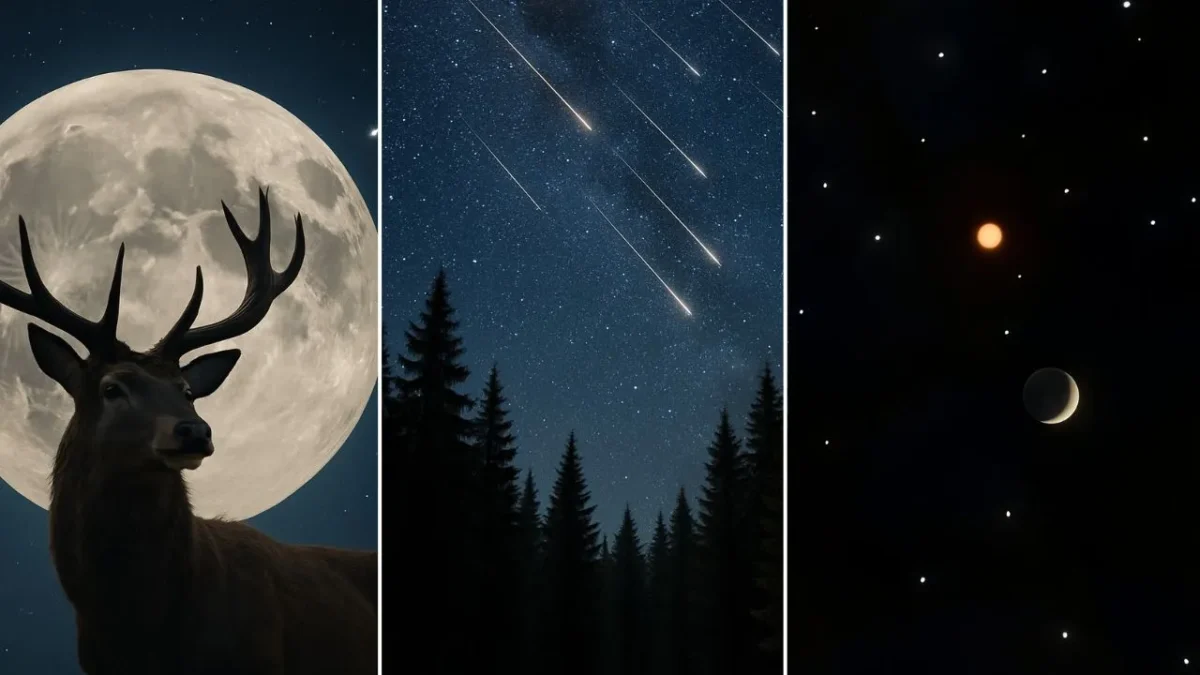
    The Buck Moon

    The Buck Moon/the July full moon.
    (Artists’s Concept)

    According to Forbes, the Buck Moon (Full Moon of July) will reach its full phase at 4:38 p.m. EDT on Thursday, July 10. While it will appear full the night before and after its peak, the most breathtaking view will be during moonrise at dusk on July 10. That is when the full moon will hang low on the horizon, appearing larger, brighter, and more dramatic.

    According to Farmer’s Almanac, the name comes from Native American traditions, referring to the time of year when male deer, or bucks, begin to grow new antlers covered in soft velvet. The term has since become widely recognized in modern lunar calendars.

    This yearโ€™s Buck Moon does not coincide with the Delta Aquariids peak, allowing clearer views of the meteor shower later in the month.

    Planets and constellations visible in July 2025

    • Venus shines brightly in the eastern sky during the two hours before sunrise, appearing near the Pleiades star cluster, Aldebaran, and Capella throughout the month.
    • Mars appears low in the west after sunset and remains visible for a couple of hours. Its brightness gradually fades as the month continues.
    • Jupiter begins rising in the east around an hour before sunrise from mid-July onward, climbing higher each morning.
    • Saturn rises around midnight and stays high in the southern sky through the early morning hours.
    • The Aquila constellation is visible in the eastern sky during the first half of the night. Its brightest star, Altair, forms one corner of the Summer Triangle and remains easy to locate, even from areas with light pollution.

    Space History

    The month of July 2025 marks 60 years since NASAโ€™s Mariner 4 performed the first successful flyby of Mars in July 1965. It was the first mission to send back close-up images of another planet and revealed that Mars has a very thin, cold atmosphere.

    Moon phases for July 2025

    • First quarter: July 2
    • Full Moon: July 10
    • Third quarter: July 17
    • New Moon: July 24

    Darker skies around the new moon offer ideal conditions for viewing faint stars, planets, and meteor showers. Topped with multiple conjunctions, July remains a rewarding month for skywatching.