Tag: Rubin Observatory

  • Rubin Observatorys’ Early Data Release: Globular Star Cluster 47 Tucanae

    Rubin Observatorys’ Early Data Release: Globular Star Cluster 47 Tucanae

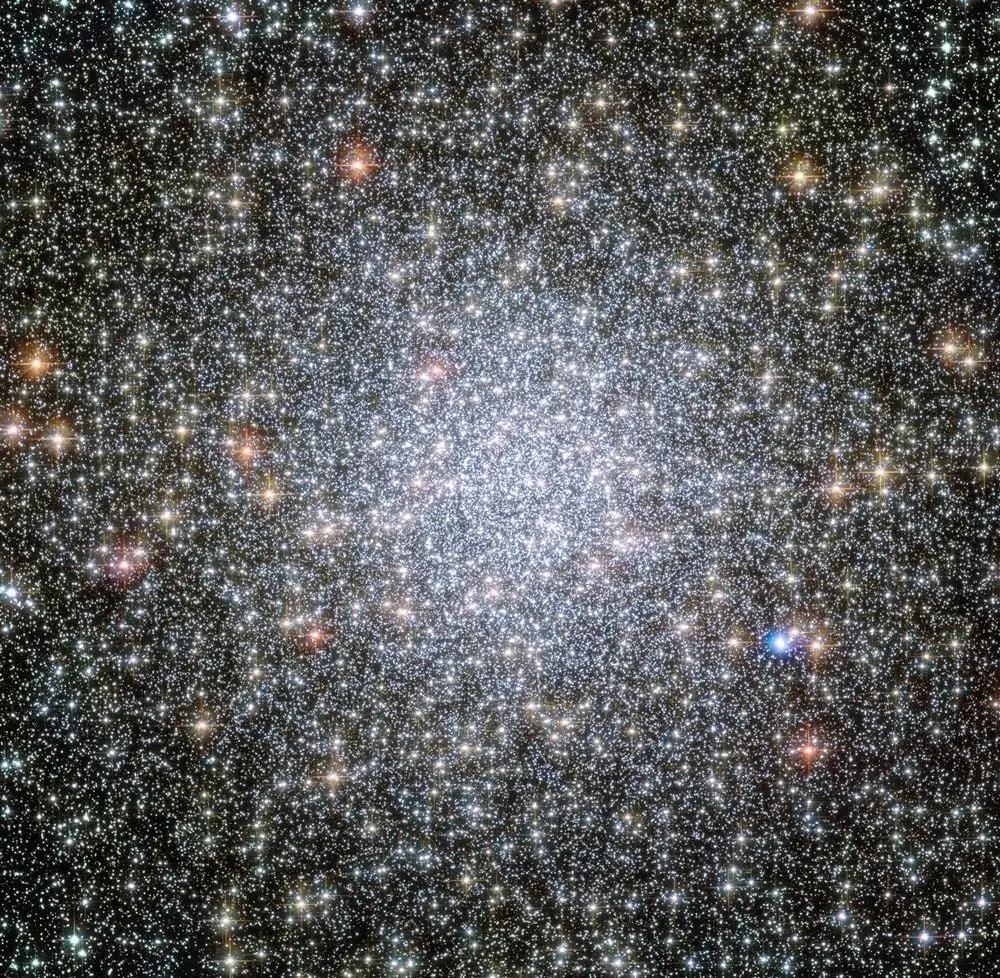
    Astronomers have revealed a remarkably detailed view of 47 Tucanae, one of the most intriguing globular clusters in the night sky. This insight comes from the Vera C. Rubin Observatoryโ€™s first public dataset from its Legacy Survey of Space and Time (LSST).

    Led by Yumi Choi of the University of Washingtonโ€™s DIRAC Institute, this early study, published on July 3, 2025, on arXiv, uses the observatoryโ€™s Data Preview 1 (DP1).

    Located 14,700 light-years away in the constellation Tucana, 47 Tucanae, also known as NGC 104, is the second-brightest globular star cluster. This stellar metropolis, packed with hundreds of thousands of stars more than 12 billion years old, stands as a relic from the universeโ€™s earliest days.

    On June 23, 2025, the observatory amazed the scientific community by releasing its first images and detecting 2,104 previously unknown asteroids, including seven near-Earth objects, in just 10 hours of test observations. This remarkable achievement, representing more than 10 percent of the annual global asteroid discoveries, demonstrates Rubinโ€™s exceptional capabilities.

    The methodical process to pinpoint 47 Tuc 3576 member stars.
    The methodical process to pinpoint 47 Tuc 3576 member stars. Image credit: Choi et al. 2025

    The DP1 dataset, processed at the SLAC National Accelerator Laboratory, spans over 5 terabytes and catalogs 23 million celestial objects. Focusing on a field centered on 47 Tuc, the team used multi-band imaging (g, r, i, y) to study the clusterโ€™s stellar composition.

    By combining color-magnitude diagrams, Gaia DR3 proper-motion data, and advanced color-color filtering, they identified 3,576 member stars. This careful analysis confirms the clusterโ€™s distance at 4.5 kiloparsecs (14,700 light-years) and reveals an old, metal-rich stellar population. The team also identified variable stars, including three RR Lyrae and two eclipsing binaries, highlighting the observatoryโ€™s sensitivity to changes in stellar brightness despite limited observation time.

    The clusterโ€™s dense core poses significant challenges. Saturation and overlapping starlight, along with contamination from the nearby Small Magellanic Cloud, led to gaps in the data. To address this, the team applied polynomial fitting in color-color diagrams to better separate stars from background galaxies compared to traditional methods.

    A map showing how crowding and SMC stars limit object detection near the 47 Tuc core.
    A map showing how crowding and SMC stars limit object detection near the 47 Tuc core. Image credit: Choi et al. 2025

    They also studied photometric scatter, or changes in star brightness, and linked it to crowding, uneven dust, and instrumental noise. By simulating the clusterโ€™s stellar population, they quantified these effects, laying the groundwork for more accurate future studies.

    The Rubin Observatoryโ€™s early findings highlight its ability to observe dense stellar systems like 47 Tucanae, even amid crowding and saturation. As LSST moves toward its next data preview and first public release, astronomers look forward to even sharper views of this ancient cluster, offering new insights into stellar evolution and the early universe.

    Read the full research paper on astro-ph.SR

  • $800 million Camera at Rubin Observatory Released its debut images

    $800 million Camera at Rubin Observatory Released its debut images

    The Vera C. Rubin Observatory, located in the Chilean Andes, released the first images on Monday, June 23, 2025, marking the beginning of a revolutionary era in observational astronomy.

    The Vera Rubin Observatory, situated on Cerro Pachรณn mountain in central Chile, combines cutting-edge technology with one of the best stargazing locations on Earth. The site benefits from dry air, minimal pollution, and clear skies, all of which make it ideal for observing the stars. Observations made here are less likely to be disrupted by external environmental factors.

    This project is a joint effort between the U.S. National Science Foundation and the Department of Energy, with construction costs reaching approximately $800 million.

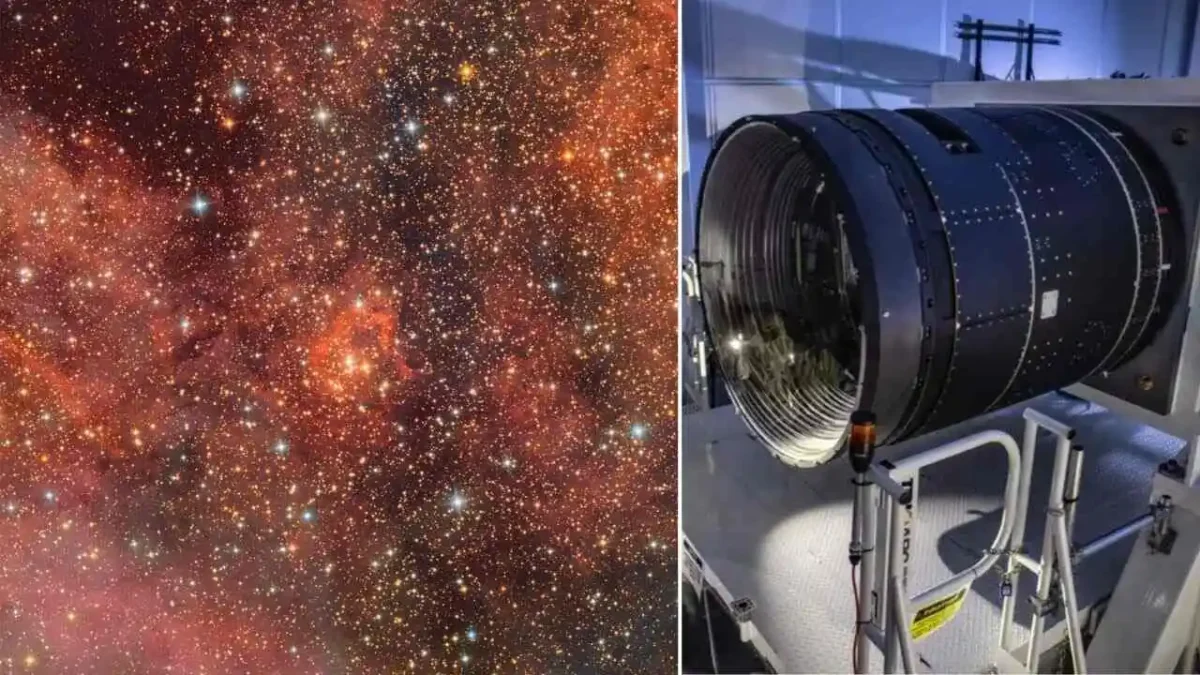
    The observatory is home to an 8.4-meter telescope paired with the world’s biggest digital camera that weighs 2.8 tons and measures roughly the size of a car.

    This camera captures images at 3,200 megapixels, creating photographs so detailed that they could spot a golf ball on the Moon’s surface. For perspective, displaying one image would require 400 ultra-high-definition television screens.

    The debut images revealed by the observatory showcase the ability of the instrument to capture the universe in exquisite detail.

    Trifid and Lagoon Nebulae captured by the Vera C. Rubin Observatory
    The first released image of the Vera C. Rubin Observatory featuring the Trifid and Lagoon Nebulae. Credit: NSF-DOE Vera C. Rubin Observatory

    This image combines 678 separate photographs taken over seven hours, revealing the Trifid and Lagoon nebulas in vivid detail. These star-forming regions, located thousands of light-years from Earth, appear as swirling clouds of pink and orange gas where new stars are born.

    Picture of the vast Virgo Cluster captured by the Vera C. Rubin Observatory
    Spiral galaxies and a large cluster of galaxies located in the vast Virgo Cluster. Credit: NSF-DOE Vera C. Rubin Observatory

    This image captures the Virgo Cluster, a massive collection of galaxies located about 55 million light-years away. The photograph shows bright spiral galaxies alongside countless distant galaxies, each containing billions of stars.

    Apart from these stunning images, during just 10 hours of test observations, the observatory discovered 2,104 previously unknown asteroids within our solar system. Seven of these space rocks qualify as near-Earth asteroids, though none pose any threat to our planet.

    This discovery rate far exceeds current capabilities. All other ground-based and space-based telescopes combined typically find about 20,000 new asteroids per year. The Rubin Observatory achieved more than 10 percent of that total in less than half a day of observations.

    The telescope’s rapid scanning ability allows it to capture images every 40 seconds throughout the night. This constant monitoring creates a time-lapse movie of the changing sky, revealing objects that move, brighten, dim, or explode across the cosmos.

    The observatory will spend the next 10 years conducting the Legacy Survey of Space and Time (LSST), photographing the entire southern sky every few nights. This massive undertaking will generate about 500 petabytes of data, which is far more than that produced by giant companies like Google, Netflix, or Amazon.

    International partnerships will help analyze the massive data streams, with processing centers planned for France, the United Kingdom, and other locations.

    Scientists expect this survey to catalog 20 billion galaxies while discovering millions of asteroids, comets, and other solar system objects.

    Scientists believe the observatory might finally solve longstanding mysteries, including the possible existence of a ninth planet in our solar system’s outer reaches. If such a world exists, the telescope’s powerful camera should spot it within the first year of full operations. The observatory is set to begin its scientific observation of the southern sky on July 4, 2025, and the world is looking forward to seeing it working at its full potential.