

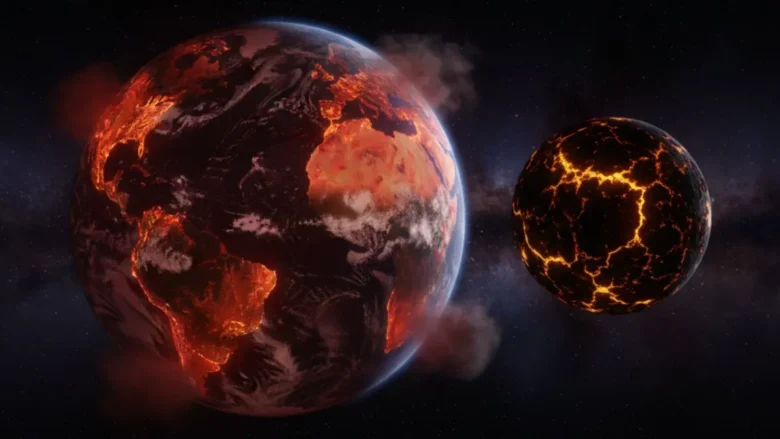
About 4.5 billion years ago, a Mars-sized world named Theia struck the early Earth in the inner solar system. The impact threw hot, broken rock into space. Over time, this material gathered and turned into the Moon. A new study published in Science shows that Theia formed close to Earth, not far away, changing where scientists think it came from and how the Moon began.
The research team studied tiny chemical differences in rocks from Earth and the Moon. They focused on forms of elements that vary slightly in weight. These small differences act like a signature that points to where a body formed in the solar system.
Their results show that Earth and the Moon share almost the same patterns in key elements, including oxygen, titanium, chromium, and iron. This close match means the Moon formed mostly from material thrown out of Earth’s outer layer, mixed with part of Theia.
No large piece of Theia exists today. Its material became part of Earth and the Moon after the impact. To find traces of it, scientists compared rock samples and measured the tiny weight differences in common elements.
Material that formed close to the Sun shows a different pattern than material that formed farther out. Bodies that formed in colder regions kept more of certain heavy forms of these elements. By matching these patterns, scientists can trace where an object likely formed billions of years ago.
Earth and the Moon show almost no difference in these patterns. This rules out the idea that Theia came from the outer solar system. Instead, it points to Theia forming in the same inner region as Earth, at a similar distance from the Sun or slightly closer.
Iron helped narrow the answer even more. Most of Earth’s iron moved into the core before the collision happened. Any iron left in the outer layer today must have come later, carried in by Theia. By measuring the iron pattern in Earth’s upper layer, the team could estimate what kind of body delivered it. They then ran thousands of computer models, testing different impact sizes and material mixes.
Only models with a nearby, Earth-like Theia recreated the Earth and Moon we see today. Models that used a more distant object did not match the real data.
Earlier theories suggested that a far-off body crashed into Earth. This helped explain why the Moon has less iron than Earth does today. These new results show that both Earth and Theia started with similar material. The differences seen now are more likely the result of the force of the impact and how the scattered debris later gathered in orbit around Earth.
This supports a view that planets in the inner solar system formed from material already close to their final paths around the Sun. Only fine dust and small rocks drifted in from farther regions.
The models still point to one unusual detail. A small part of Theia appears to be made of material that formed even closer to the Sun than Earth’s original building blocks. No known meteorite found on Earth perfectly matches this type of material. It may have been used up long ago during planet formation or pulled into the Sun early in the solar system’s history.
Even so, the main answer is now clearer. Theia was not a distant visitor. It formed in the same neighborhood as Earth, and its violent impact shaped both our planet and the Moon that orbits it today.
Source: The Moon-forming impactor Theia originated from the inner Solar System