
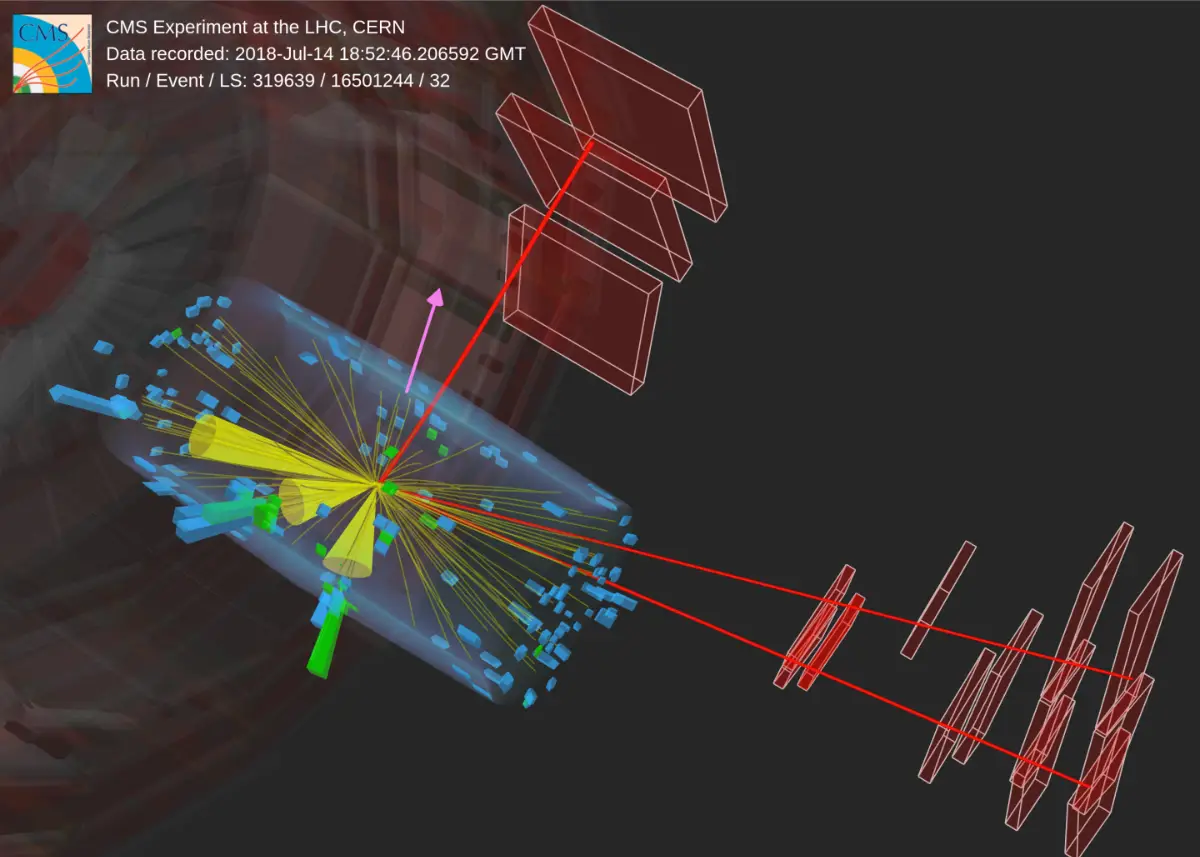
Physicists at CERN have confirmed the first observation of a single top quark produced with both a W and a Z boson, a result recorded by the CMS experiment at the Large Hadron Collider in Geneva and announced in November 2025.
The process appears only once in about a trillion proton-proton collisions, and the CMS team relied on machine-learning tools to pick it out from a much larger set of similar events. Researchers say this detection could help test how the known forces of nature behave and could point to physics that current theories do not explain.
The top quark, discovered in the 1990s, is the heaviest known elementary particle. Because of its mass, it has a strong connection to the Higgs field, which gives particles mass. When the top quark appears in the same collision as W and Z bosons, it creates a rare setting for studying that relationship. The W and Z bosons carry the electroweak force, so seeing all three particles in one event offers a new way to measure how this force interacts with matter.
The main difficulty was finding the signal. Another process, known as ttZ production, looks very similar and happens several times more often. CMS scientists used a machine-learning model that searched for small differences in the particle tracks and decay patterns. After analyzing data from millions of collisions, the team confirmed that the single-top-with-W-and-Z signal was present.
The measured rate came out slightly higher than expected, but the data is still limited. Physicists will collect more collisions in future runs of the LHC to confirm whether the difference is real or just a statistical bump. If the higher rate remains, it may indicate unknown interactions or new particles influencing the process.
The tWZ result adds to a growing list of rare observations at the LHC. Although most collisions produce common particle combinations, these unusual events help test the limits of the Standard Model of particle physics. Even a small mismatch between prediction and measurement can lead researchers toward new theories.
For now, the CMS collaboration has shown that the LHC can detect one of the rarest Standard Model events currently reachable with existing technology. More data will show whether this detection is just a step in confirming known physics or the start of something new.
Source: First observation of single top quark production with W and Z bosons

Leave a Reply