
NASA launched two small spacecraft toward Mars on Wednesday, using Blue Origin’s New Glenn rocket in a high-profile flight from Cape Canaveral. The twin probes, named Blue and Gold, will spend two years traveling through deep space before reaching the Red Planet in September 2027, where they will study how solar radiation stripped Mars of its thick atmosphere billions of years ago.
The mission was New Glenn’s cleanest performance to date. Its debut flight in January reached orbit but did not complete its landing. This time, the fairing opened on schedule, and the upper stage placed the EscaPADE spacecraft into a parking orbit. Engineers later confirmed the probes powered up and sent back signals. A ViaSat prototype satellite rode along to test new communication hardware.
Teams postponed earlier launch attempts on November 9 and 11 because of high winds near the Cape. Conditions improved on November 13, allowing New Glenn’s seven BE-4 engines to ignite at 3:55 p.m. EST. The rocket climbed through clear skies as crowds watched from beaches.
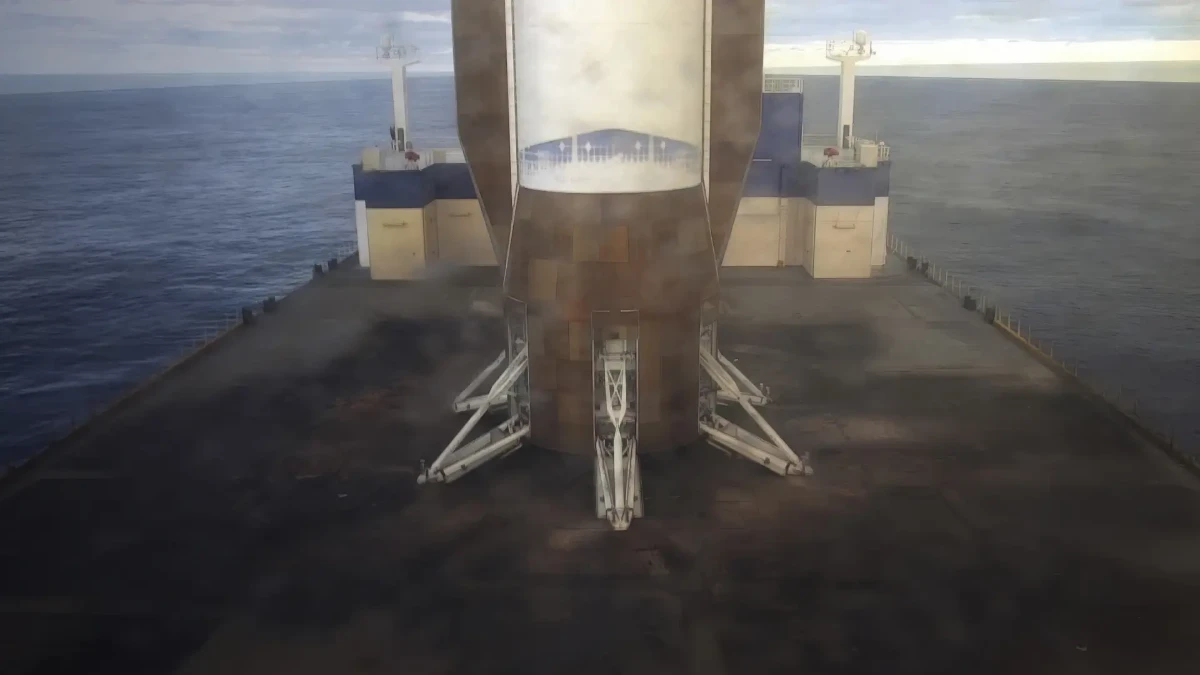
Seven minutes after liftoff, the first stage separated as planned, then steered itself to a landing on the barge Jacklyn about 375 miles offshore. It was New Glenn’s first successful booster recovery at sea.
“Today was a tremendous achievement for the New Glenn team, opening a new era for Blue Origin and the industry as we look to launch, land, repeat, again and again,” said Jordan Charles, Vice President, New Glenn.
Jeff Bezos posted a video of the booster landing on X shortly after the launch. The clip shows the rocket slowing above the barge before touching down. His post drew wide attention.
— Jeff Bezos (@JeffBezos) November 13, 2025
SpaceX CEO Elon Musk, whose company dominates the commercial launch industry, offered congratulations despite being a business rival.
“Congratulations, Jeff Bezos and the Blue Origin team!” Musk wrote in response to the landing announcement.
The probes, Blue and Gold, will track how charged particles from the Sun strike Mars and interact with its weak magnetic field. Mars once had a thick atmosphere but lost most of it across billions of years. Scientists want to better understand those losses and how they continue today.
Each spacecraft is about the size of a microwave oven and carries two simple tools: a magnetometer and a particle detector. NASA kept the mission under $100 million by using compact hardware and a high-altitude orbit that gives a wide view of the planet’s upper atmosphere.
EscaPADE will remain near Earth for about a year before using a gravity-assist maneuver in late 2026. A close pass in November 2026 will give the satellites the speed they need for the trip to Mars. They are expected to arrive in September 2027 and settle into long, stretched orbits.
Once there, Blue and Gold will measure the solar wind’s effect on the planet’s thin atmosphere and gather data linked to dust storms and radiation levels. NASA plans to use the results to support future crewed missions and work on Mars Sample Return.
EscaPADE joins decades of missions sent to Mars but stands out for its small design and focus on the planet’s outer atmosphere during a period of rising solar activity.
NASA sees the mission as a step toward better planning for future human travel. For Blue Origin, the flight strengthens New Glenn’s place in the heavy-lift market. The probes are now circling Earth, beginning a long journey toward a planet that continues to raise new questions.

Leave a Reply