
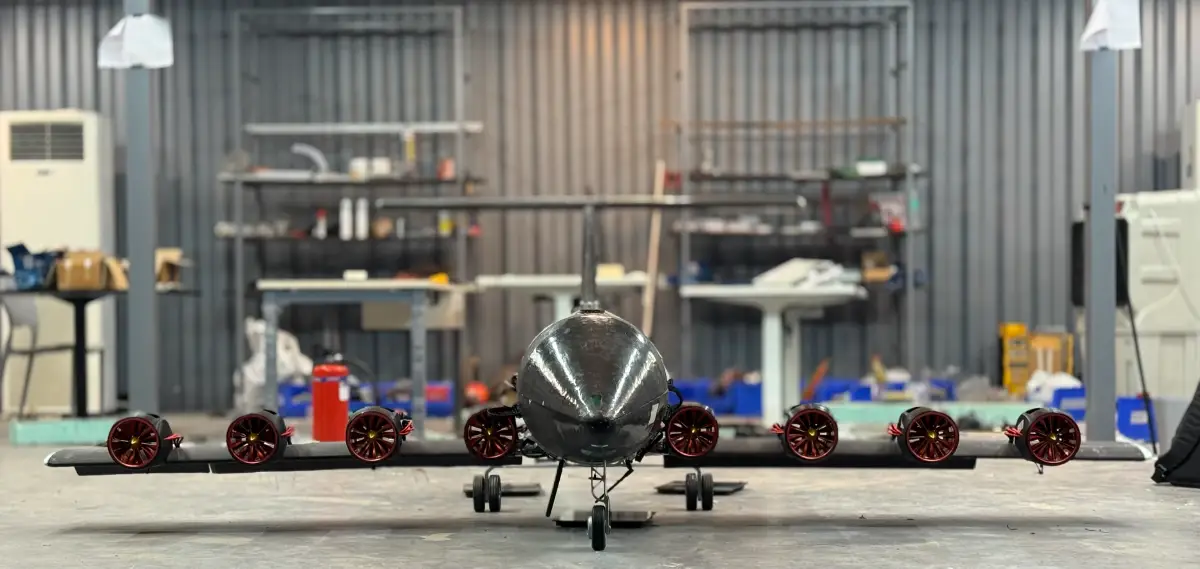
Zomato co-founder and Smart Shark Deepinder Goyal introduced a new fully electric fixed-wing drone this week, marking the first major public reveal from his young aviation startup, LAT Aerospace. Goyal shared photos and videos on X from an undisclosed test site showing the drone in early ground trials as the team prepares for its first flights.
The aircraft aims to prove whether a compact electric design with ultra-short takeoff ability can work in India’s crowded cities, where rapid air transport could ease pressure on roads.
Goyal launched LAT Aerospace earlier this year as a separate venture from Zomato and the Eternal group that oversees it. The company aims to build small electric aircraft for short trips over dense urban areas.
India’s major cities face heavy traffic and long commute times, and Goyal says lightweight aircraft could offer a faster option for moving packages or, eventually, passengers. The drone unveiled this week is the team’s test model to study basic performance before building larger versions.
The aircraft shown in his post has a black, fixed-wing frame and eight electric propellers. It was placed inside a temporary hangar for early checks. Videos show it moving down a short strip of pavement with its motors running at low power. Goyal described it as a USTOL demonstrator, meaning it aims to lift off within about 40 meters. LAT Aerospace built the aircraft in a few months to test the limits of electric takeoff in tight spaces.
The drone uses a lithium-ion battery pack designed to keep it in the air for about 60 minutes. At its planned cruise speed, that gives it a range of roughly 150 kilometers. The team sees that as enough for major regional routes, including trips between large cities like Mumbai and Pune without a charging stop. Electric motors also reduce noise, which is a major concern for aircraft operating near homes in crowded areas.
The company says its ultra-short takeoff ability comes from high lift at low speeds. The wing design includes extra surfaces that direct airflow and help push the aircraft upward during takeoff. Combined with fast-spinning electric propellers, the design supports use in narrow spaces such as rooftops or small fields. Ground tests this week showed the drone moving smoothly and handling low-speed taxi runs without issues.
Electric aircraft convert most of their stored battery power into thrust, while fuel-powered engines lose much of their energy as heat. That makes electric drones cleaner and quieter, though today’s battery limits restrict how far they can fly. Current cells hold around 250 watt-hours per kilogram, which sets a ceiling on range. LAT Aerospace is researching hybrid systems that pair batteries with small turbines for longer flights.
Goyal has hinted that the company may build those turbines in-house to control weight and fuel use. Early estimates suggest they could operate at about 30 percent efficiency, which would extend range while keeping the aircraft small. The company is also studying cooling systems for the batteries, as they heat up under heavy power loads. Wing strength in strong winds is another area the team is adjusting as it runs daily tests.
In his public post, Goyal wrote that the drone had completed its first ground rolls and that the team was pushing to fly it soon. He included a short clip showing all eight propellers spinning as engineers monitored the aircraft. His comment that he hoped it “doesn’t blow up” drew a wide reaction from India’s tech and aviation communities, with many asking when the first flight would take place.
The company expects its first flight tests within weeks. If successful, LAT Aerospace will use the data to develop cargo drones for routine tasks such as grocery delivery. The longer plan includes small air taxis that could carry people across cities in a few minutes. India’s aviation planners hope to see thousands of short urban flights per day by 2030, a goal that depends on quiet and compact aircraft.
Goyal says the drone uses mostly Indian-made parts. That includes motors, wings, sensors, and control systems. As battery technology advances toward 400 watt-hours per kilogram, LAT Aerospace expects its aircraft to double their range. The company says its work could mark the start of new urban flight networks across India, with the upcoming first flight serving as the project’s first major test.

Leave a Reply