
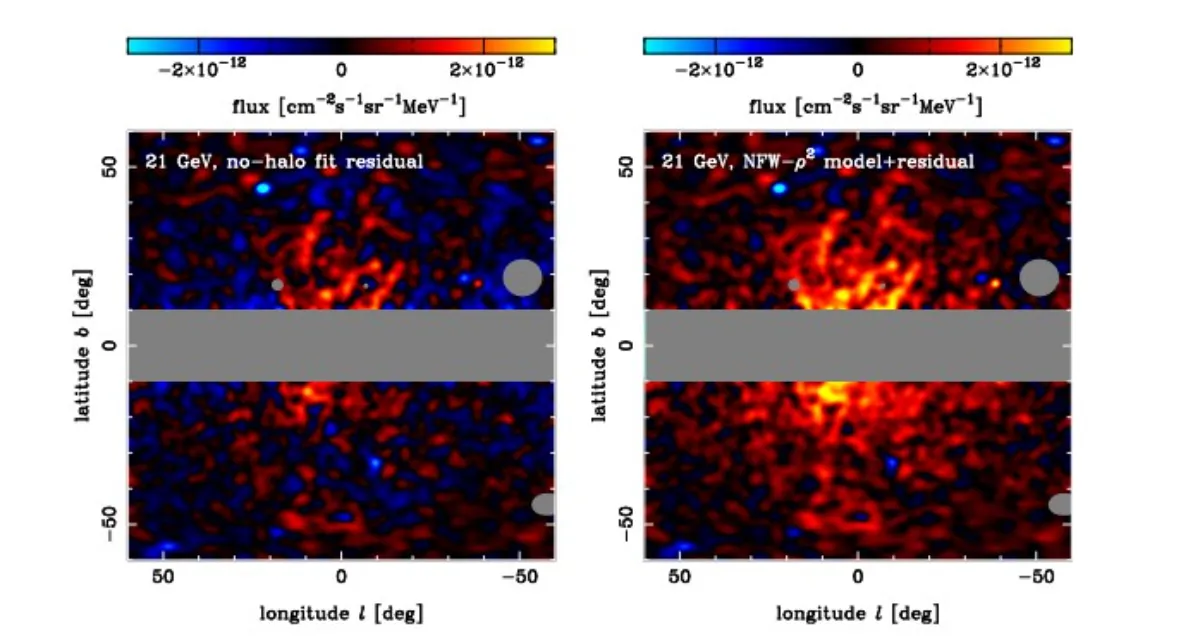
A Japanese astrophysicist has reported a faint but unusually sharp gamma-ray glow around the Milky Way, based on 15 years of data from NASA’s Fermi telescope. The signal peaks near 20 GeV, forms a round halo, and closely matches what researchers expect from dark matter. The result has renewed interest in one of physics’ biggest open questions.
Tomonori Totani studied a wide region around the galaxy while masking the bright central plane. He modeled all known gamma-ray sources and removed them from the data. What remained was a smooth, spherical excess centered on the Milky Way that did not match any familiar process.
The shape and energy peak stand out because most gamma-ray sources follow broad trends. This signal rises from a few GeV, peaks sharply at 20 GeV, and fades above 100 GeV. That pattern resembles the expected signature from dark matter particles that collide and produce ordinary particles. A 20 GeV peak would point to particles weighing about 500 to 800 GeV.
Totani reported a significance above 15 sigma and tested many ways to remove the signal, including changes to cosmic-ray models, the Fermi bubble outlines, and masking choices. The excess stayed in every test.
Alternative explanations exist but do not fit as well. Millisecond pulsars can explain a known excess near the galactic center, but they would not produce a large spherical halo. Cosmic-ray activity could mimic some energy features but would usually show signs of the disk. The inverse-Compton process comes closest but does not match the symmetry.
If the excess is from dark matter, the numbers suggest particles around 600 GeV with an interaction rate higher than simple models predict. This pushes against limits from dwarf galaxies but is not ruled out.
The signal also differs from the lower-energy excess at the galactic center, which many researchers now link to faint pulsars. The two features likely have separate origins.
More data will be needed to confirm or reject the dark matter idea. Ground-based gamma-ray telescopes and neutrino observatories can check for related signals. Fermi will also continue collecting data that may clarify whether the halo glow marks the long-awaited trace of dark matter.

Leave a Reply