
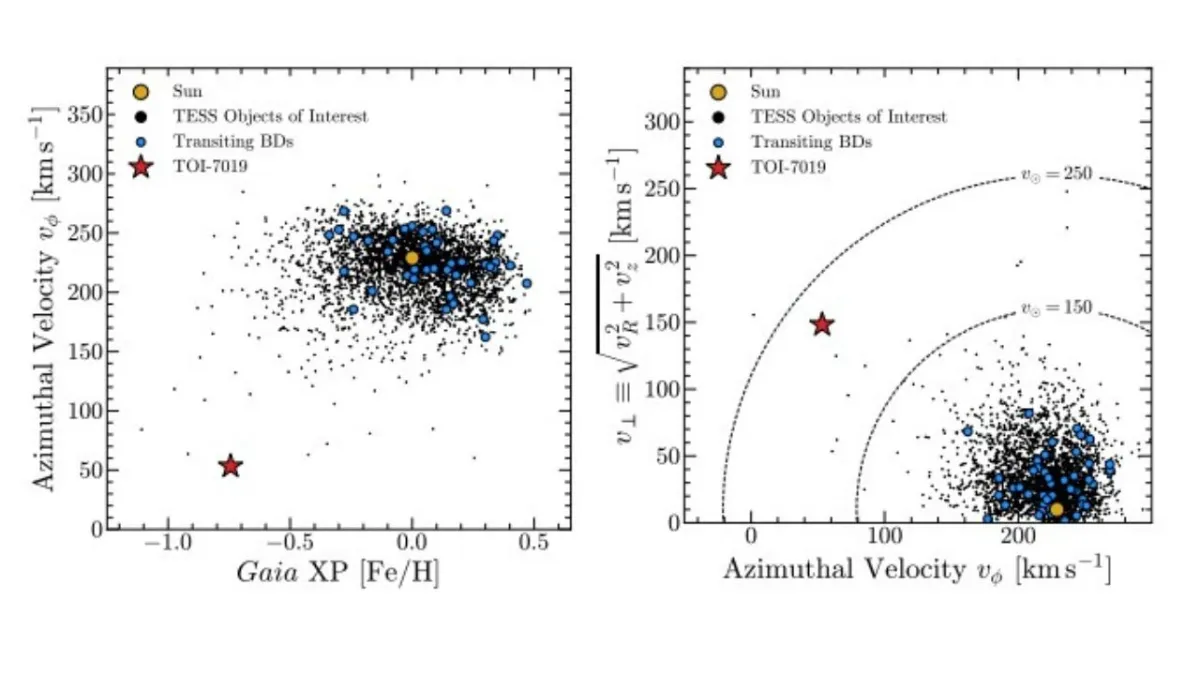
Astronomers have found the oldest known brown dwarf that passes in front of its star, a rare object that has survived nearly 12 billion years since the early days of the Milky Way. The object, called TOI-7019b, orbits a faint, metal-poor star about 435 light-years from Earth and was detected using NASA’s Transiting Exoplanet Survey Satellite, or TESS. The discovery offers a direct look at how star systems formed when the galaxy was young and heavy elements were scarce.
TOI-7019b sits in a gray zone between planets and stars. It weighs about 61 times as much as Jupiter but never grew large enough to ignite steady nuclear burning. Instead, it has spent billions of years slowly cooling. Despite its age, it remains slightly larger than expected, which has caught the attention of researchers.
The host star looks unremarkable at first glance, but its motion tells a different story. Data from the Gaia spacecraft show that it moves through the galaxy on a steep, fast path that marks it as part of the Milky Way’s thick disk. This population of stars formed early, when the universe was only a few billion years old. Chemical tests show the star has far less iron than the Sun, another sign of its great age.
TESS first spotted the system in 2021 when it noticed a small, regular dip in the star’s brightness every 48 days. That drop, less than one percent, signaled something passing in front of the star. Follow-up checks from ground-based telescopes confirmed the signal and ruled out other stars hiding nearby.
Measurements of the star’s motion revealed the companion’s mass and showed it follows an oval-shaped path, not a neat circle. That detail matters. Objects born like planets often settle into round orbits, while heavier companions tend to keep stretched paths.
The brown dwarf’s size raises new questions. Models suggest an object this old and this heavy should have shrunk more by now. Instead, it remains about 82 percent the size of Jupiter. Scientists suspect its unusual chemistry or internal structure may slow its cooling.
The find stands out because almost all known systems like this orbit younger, metal-rich stars. TOI-7019b proves such companions also formed in the galaxy’s youth. As one researcher joked, it is ancient hardware still running fine.
Astronomers hope future observations, including infrared studies, will reveal more about its makeup. For now, TOI-7019b offers a rare snapshot of how the Milky Way built its earliest systems and shows that the old neighborhood still has surprises left.
Source: An Ancient Brown Dwarf Transiting a Metal-Poor Thick Disk Star

Leave a Reply