
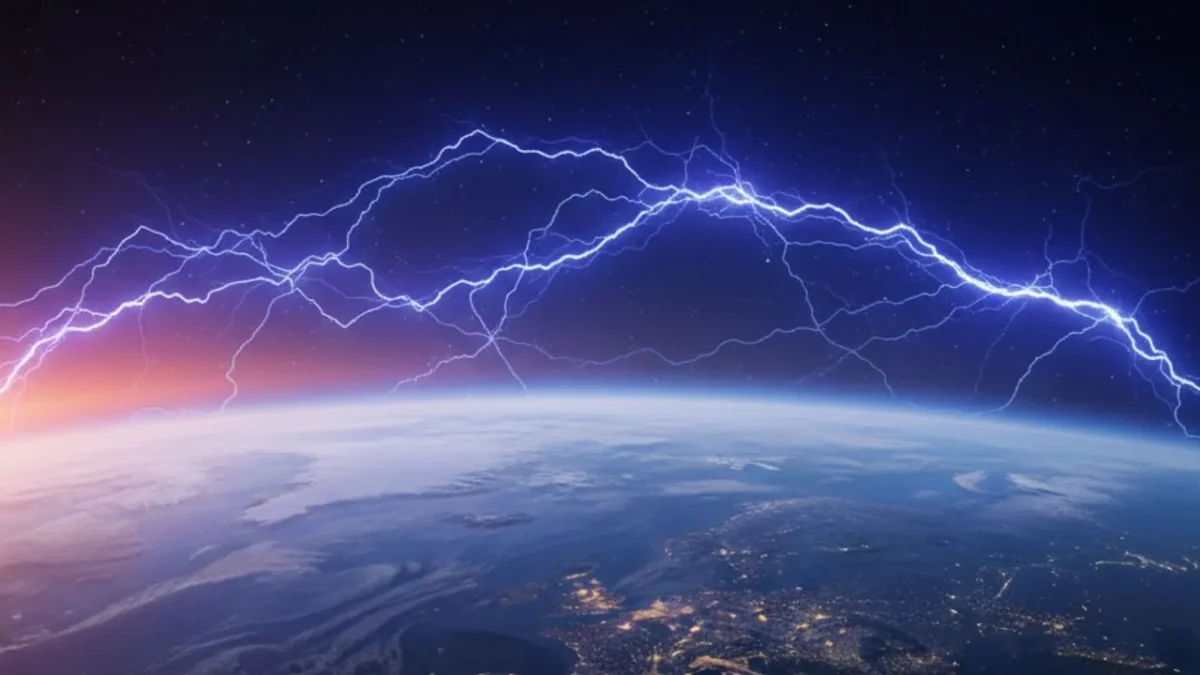
Scientists have shown that Earth’s rotation can produce a small but steady electric current, ending a debate that has lasted nearly 200 years. The finding comes from an experiment carried out by Princeton researchers published in March 2025 in Physical Review Research.
The idea sounds simple. Earth spins through its own magnetic field at high speed, especially near the equator. In theory, that motion should push electric charges and create power. In practice, every past attempt failed. Charges inside solid materials cancel the effect almost instantly. Even Michael Faraday could not make it work in the 1800s.
Physicist Christopher Chyba and his team found a workaround by changing the shape and material of the conductor. Instead of a solid object, they built a hollow cylinder made from a soft magnetic material called ferrite. They aligned it at a precise angle to Earth’s rotation and magnetic field.
That detail mattered. In this setup, the usual charge cancellation does not fully occur. When the device sat in the correct position, it produced a measurable voltage of about 17 microvolts and a current of 25 nanoamps. Rotate it the wrong way, and the signal disappeared. Flip it around, and the current reversed direction.
The team repeated the test at a second location miles away and saw the same result. Extensive checks ruled out heat effects, electrical noise, and other common sources of error. The power output is tiny and not meant for everyday use. You will not charge a phone or light a bulb with it. Still, the experiment proves that Earth’s spin can supply electrical energy in principle, drawing from the planet’s massive rotational energy store.
Researchers say the next step is independent replication. If confirmed, the idea could one day help power small sensors or space missions where sunlight is limited. For now, it answers a long-standing question with a clear yes: Earth’s rotation really can generate electricity, even if only a whisper of it.

Leave a Reply