
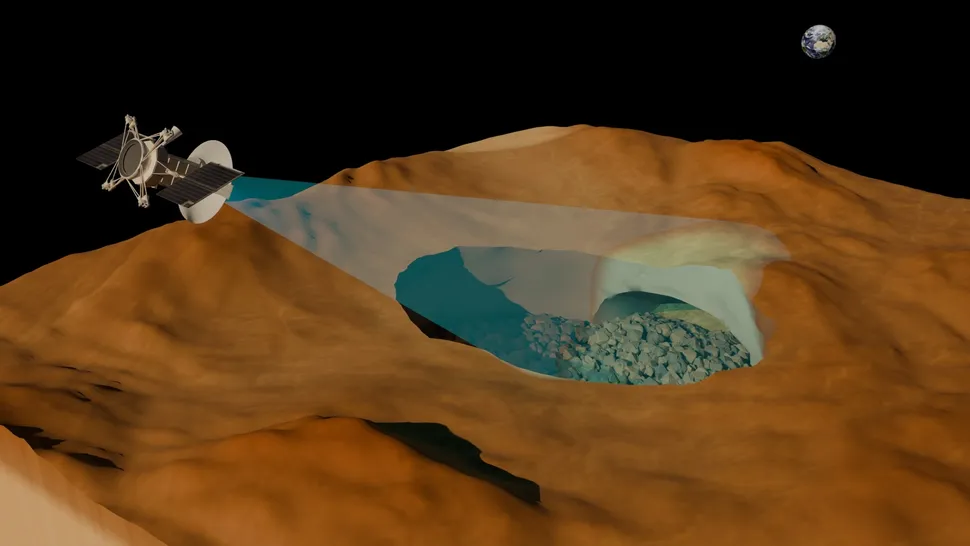
Scientists studying decades-old radar images from NASA’s Magellan orbiter suggest that Venus may contain a massive underground lava tube carved by ancient volcanic eruptions. The team identified the feature on the western flank of Nyx Mons and published their findings on Feb. 9 in Nature Communications. If confirmed, the structure would be only the second lava tube reported on Venus and would add weight to the idea that the planet is not geologically dead.
Researchers from the University of Trento, led by Lorenzo Bruzzone, reexamined radar data collected between 1990 and 1992, when the Magellan spacecraft mapped most of Venus through its thick cloud cover. Because dense clouds block visible light, Magellan used radar pulses to measure the planet’s surface and build detailed maps.
Those maps show long chains of pits across Venus. Scientists have long suspected that some of these depressions mark the collapse of underground lava tubes. On Nyx Mons, the team found a localized surface collapse that produced a radar pattern matching what scientists see when a lava tube roof caves in.
The data suggest the conduit may extend for several dozen kilometers below the surface, though only part of it can be confirmed with current imagery. The radar signature closely resembles collapsed lava tubes found on the moon and Mars, where similar volcanic processes shaped the terrain.
“Our knowledge of Venus is still limited, and until now we have never had the opportunity to directly observe processes occurring beneath the surface of Earth’s twin planet,” said Lorenzo Bruzzone in a statement.
Venus hosts about 1,600 major volcanoes and nearly a million smaller ones. For decades, many researchers viewed the planet as largely inactive today. However, recent studies have pointed to possible ongoing volcanic activity. The new finding adds another piece of evidence that Venus has remained geologically active longer than once believed.

Leave a Reply