
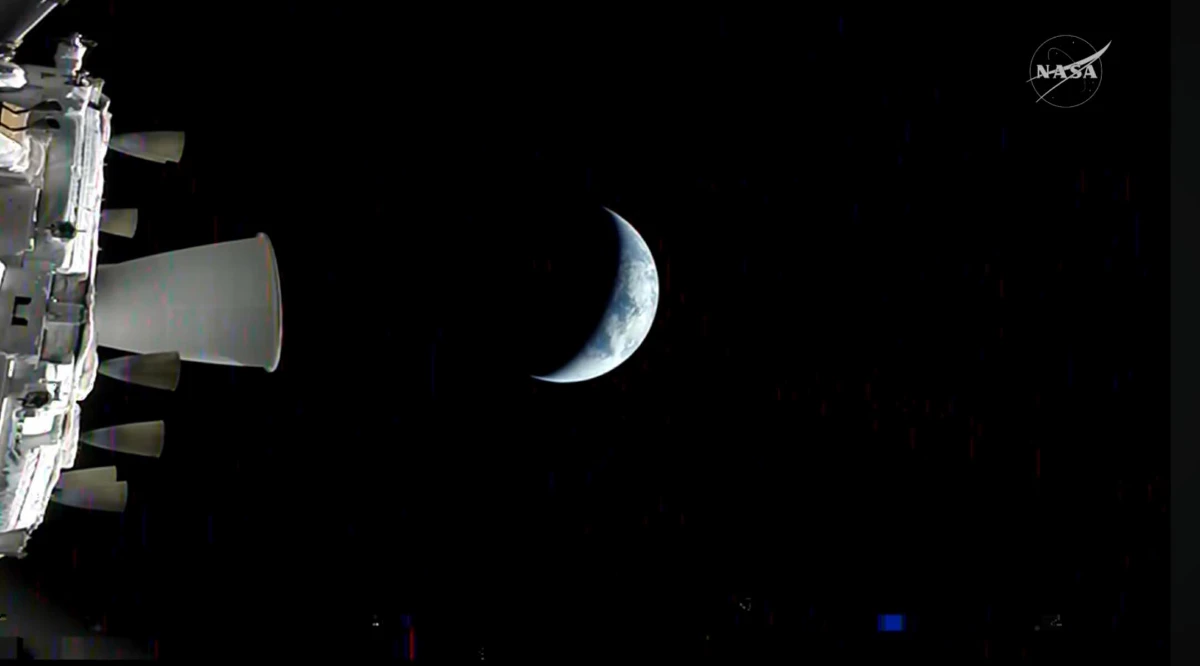
A new video from NASA shows the Artemis II Orion spacecraft switching from traditional radio signals to a laser-based system, sharply improving the clarity of images sent from space. The transition happens within seconds, and the difference is easy to spot. The test highlights how optical communication could reshape how spacecraft send data during future missions to the Moon and beyond.
The system, called the Optical Communications System or O2O, was developed by MIT Lincoln Laboratory in collaboration with NASA. It uses laser signals instead of radio waves to transmit data.
In the clip shared by the laboratory, the Moon appears slightly blurred at first. As soon as the system switches, the image becomes cleaner and more detailed. This direct comparison offers a simple but powerful demonstration of what the new technology can do.
Radio-frequency systems have served space missions for decades. They are reliable but limited in how much data they can carry at once. As missions grow more complex, spacecraft need to send high-resolution images, video, and larger data sets back to Earth. Optical communication addresses this gap by offering much higher data rates.
The Artemis program aims to return humans to the Moon and prepare for future missions to Mars. Artemis II will carry astronauts around the Moon and test key systems in deep space. Communication is one of those systems. A stable and fast data link is essential for navigation, safety, and real-time decision-making.
This test also builds on earlier efforts. NASA has been working on laser communication for years, including experiments in Earth orbit and deep space. Each step brings the agency closer to making it a standard feature for missions.
There are still challenges. Laser systems need precise alignment between the spacecraft and ground stations. Even small shifts can interrupt the signal. Weather conditions on Earth can also affect performance. Engineers continue to refine tracking systems to handle these issues.
The potential payoff is clear. Faster data transfer means scientists can receive more detailed information in less time. It could also improve communication with astronauts, making future missions safer and more efficient.

Leave a Reply