

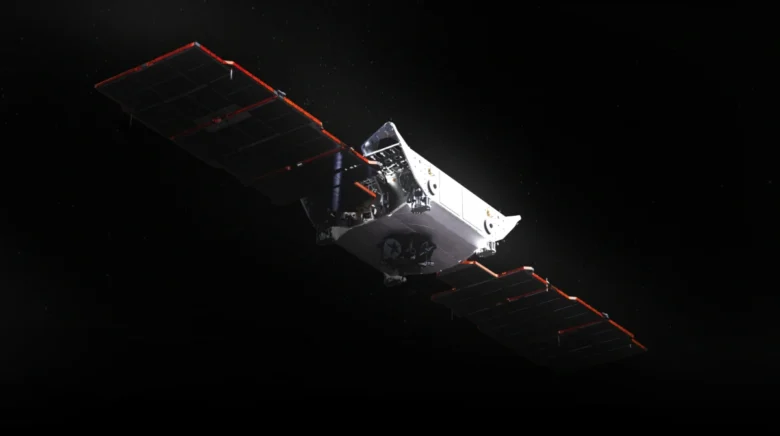
Two private space companies, Anduril Industries and Impulse Space, have announced plans for a 2026 mission to test autonomous spacecraft maneuvers in geosynchronous Earth orbit, 36,000 kilometers above Earth. The goal is to show how a spacecraft can approach and study satellites in this high orbit, a task that could transform how governments and companies operate in space.
The mission will rely on Impulse’s Mira spacecraft, a 300-kilogram orbital tug, carrying Anduril’s advanced payloads. After launch on a commercial rocket such as SpaceX’s Falcon 9, Mira will be boosted to high orbit by Impulse’s Helios stage, which uses the company’s Deneb chemical engine.
The transfer from low Earth orbit to geosynchronous orbit will take less than a day, far quicker than the slower electric propulsion systems often used for such maneuvers.
Once in place, Mira will separate and begin approaching satellites and other objects in orbit. It will collect images and navigate independently, using onboard software rather than constant ground commands. Helios will be retired to a “graveyard” orbit to avoid adding to the problem of space debris.
The companies say the project is designed to prove that rendezvous and proximity operations (known as RPO) can be carried out in a faster and cheaper way than before.
RPO involves a spacecraft moving close to another in orbit, which is useful for inspection, repair, or security purposes. In geosynchronous orbit, where satellites that support communication, weather monitoring, and defense are based, being able to maneuver reliably is seen as increasingly important.
Anduril will provide the mission’s brain. Its mission data processor will run Lattice software, allowing the spacecraft to process images and guide itself in real time.
The payload also includes a long-wave infrared camera to detect faint objects, which is especially important in the radiation-heavy environment of geosynchronous orbit. Impulse brings its experience with orbital transfer vehicles, with Mira already flight-tested on other missions.
The choice of chemical propulsion for Helios reflects the need for speed. While ion thrusters are efficient, they can take months to move spacecraft into higher orbits. The Deneb engine allows Mira to reach its target altitude in less than 24 hours, enabling quick demonstrations or urgent missions.
Radiation in high orbit is another obstacle. Electronics can be damaged by charged particles in Earth’s magnetosphere, so both companies have designed their systems with heavy shielding to ensure long-term performance.
Anduril and Impulse are funding the project themselves rather than relying on government contracts. Executives say this approach gives them more control over the schedule and allows them to prove the technology before offering it to the U.S. Space Force and other customers.
For Anduril, this will be its fourth independently funded space test, while Impulse continues to expand its work in satellite transport and orbital services.
If successful, the mission could open the way to a range of new operations. Spacecraft could be used to inspect satellites for damage, refuel them to extend their lives, or push broken equipment into safer orbits. The same technology could also support debris cleanup, which has become a growing concern as more satellites crowd Earth’s skies.
The broader impact would be to show that private companies can develop and demonstrate advanced orbital maneuvers without years of government planning. For both defense and commercial customers, that could mean quicker access to servicing, inspection, and protection of critical satellites in the most valuable region of Earth orbit.