


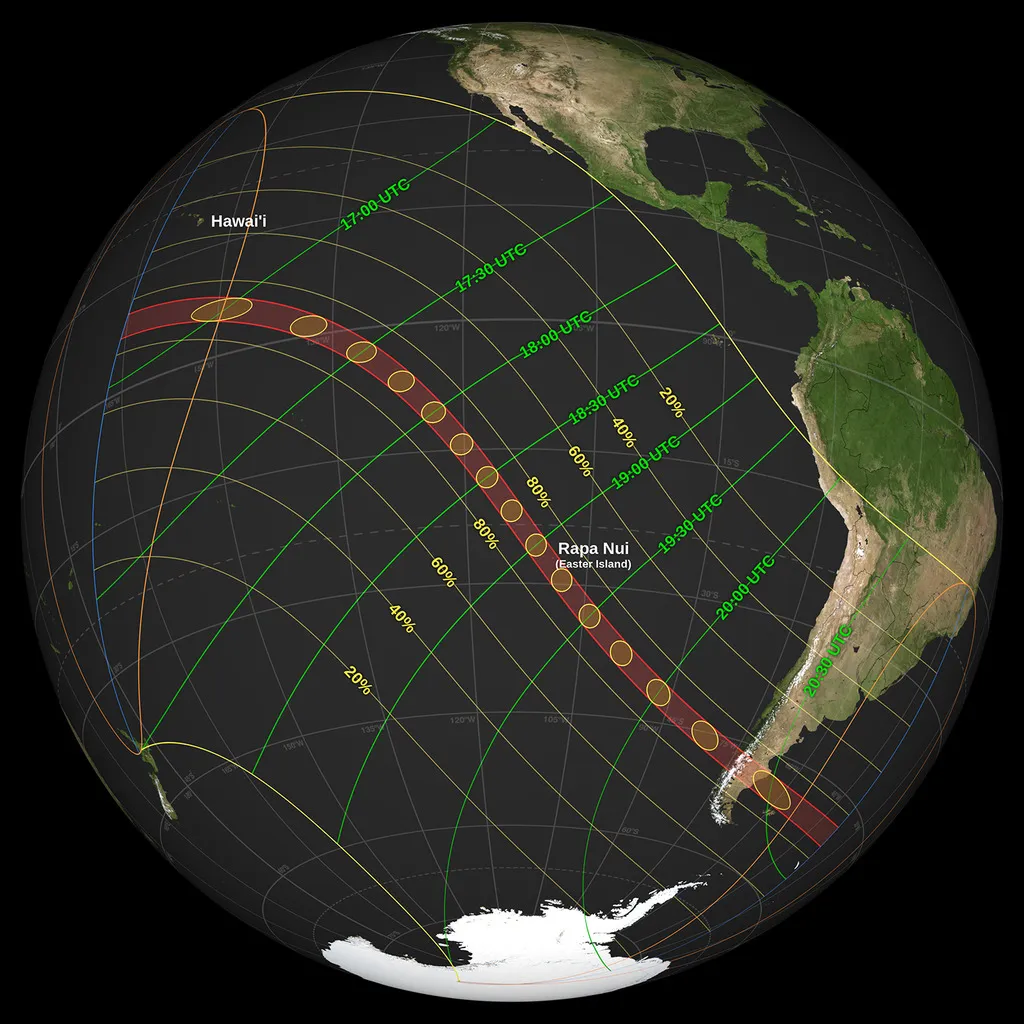
An annular solar eclipse occurred on October 2, 2024, beginning at 11:42 a.m. EDT (1542 GMT) and peaking at 2:45 p.m. EDT (1845 GMT). The eclipse was fully visible as an annular eclipse from parts of Argentina and Chile, while a partial eclipse was observed in regions of South America, North America, Antarctica, and parts of the Atlantic and Pacific Oceans.
The annular eclipse, visible from Santa Cruz, Argentina, and Easter Island, Chile, produced the characteristic ‘ring of fire’ as the moon, at its farthest point from Earth, appeared smaller than the sun. Approximately 93% of the sun was covered during the event, forming the annulus, Latin for ‘ring.’
Partial solar eclipse visibility extended to Punta Arenas, Chile; Santiago, Chile; Buenos Aires, Argentina; Montevideo, Uruguay; and Rio de Janeiro and São Paulo, Brazil, as well as parts of Antarctica, Hawaii, Kiribati, Tokelau, Samoa, the Cook Islands, French Polynesia, Tuvalu, and Fiji.
The detailed list is published on Timeanddate.com.
When does an Annular Solar Eclipse occur?

An annular solar eclipse occurs when the moon passes between the earth and the sun when it is at its farthest point from the earth, making it appear smaller than the sun and creating a ring around the moon, or what we call a ‘ring of fire’ in the sky.
During this year’s annular solar eclipse, the sun will be 93% covered by the moon, creating an ‘annulus,’ Latin for ‘ring.’
When does a Partial Solar Eclipse occur?
A partial solar eclipse occurs when the moon passes between the earth and the sun. The partial solar eclipse is observed from places that lie away from the center of the eclipse but still within the moon’s shadow. The sun looks crescent, as it is not completely covered by the moon.
Will the Annular Solar Eclipse be visible from India?
The eclipse will be visible from parts of South America, North America, Antarctica, the Atlantic Ocean, and the Pacific Ocean, but it won’t be visible from India, as the eclipse will occur at night when the sun will be below the horizon, and thus the observers from India won’t be able to see it.
How to see a Solar Eclipse safely?
During an eclipse, the moon covers part of the sun. This scenic view is beautiful to watch, but looking straight at the sun can harm your eyes and make you blind. Using solar eclipse glasses is much better, as it will protect your eyes from any damage and will allow you to see other future celestial events.
Also, you should never look at the sun with binoculars, a telescope, a camera lens, or any other type of optical object, as the concentrated sun rays collected by these objects can cause serious harm and permanent blindness in some cases if viewed through them.