
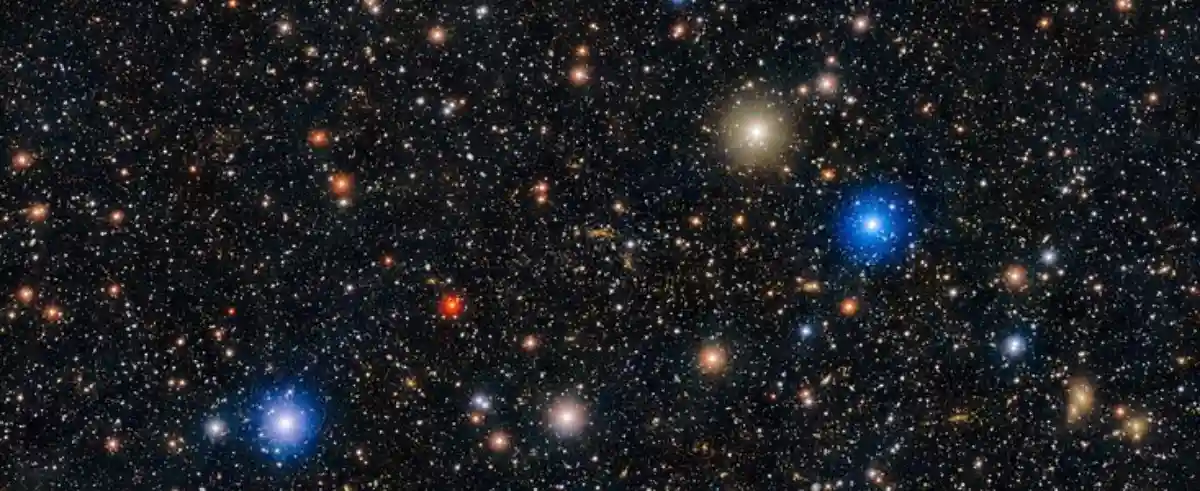
Astronomers have released the most detailed results yet from the Dark Energy Survey (DES), offering a clearer picture of how the universe has expanded and formed structure over billions of years. The findings, published on January 26, 2026, draw on the survey’s full six-year dataset and rely on observations of about 140 million distant galaxies spread across 5,000 square degrees of sky.
This breakthrough analysis draws from six years of data gathered by the Dark Energy Camera (DECam), a 570-megapixel instrument mounted on the U.S. National Science Foundation Víctor M. Blanco 4-meter telescope in Chile. The dataset includes 758 nights of observations conducted by the DES Collaboration from 2013 to 2019, covering one-eighth of the sky and capturing details from 669 million galaxies billions of light-years away.
“These results from the Dark Energy Survey shine new light on our understanding of the Universe and its expansion,” said Regina Rameika, Associate Director for the Office of High Energy Physics in the DOE’s Office of Science (DOE/SC).
The Dark Energy Survey began more than a decade ago with a clear goal: test whether the standard model of the universe can fully explain how galaxies grow and spread apart. Scientists used a telescope in Chile equipped with a powerful camera to track galaxy positions, shapes, and subtle distortions caused by gravity. Together, these signals reveal how matter clusters and how fast cosmic structures form.
Using three linked measurements: galaxy clustering, light bending by gravity, and the overlap between the two, the team measured the overall strength of cosmic structure growth at 0.789, with an error of about 1.5 percent. They also found that matter accounts for roughly 33 percent of the universe. Both numbers improve earlier results from the survey’s first three years by about a factor of two.
Growth rates inferred from nearby galaxies run slightly lower than those predicted from early-universe data. The difference stands at about 1.8 standard deviations overall and rises to 2.6 in certain measures. When combined with other probes such as exploding stars, early sound wave patterns, and galaxy groups, the gap reaches 2.8. Scientists stress that this level does not point to a failure of the standard model.
Adding results from other surveys tightened the picture further. With extra data, the team achieved about 0.8 percent precision on structure growth and 1 percent on the matter share. In a model that allows dark energy to change over time, they measured its pressure-to-density ratio at minus 0.98, consistent with a steady value.
Researchers credit the progress to better instruments, improved data methods, and detailed simulations that match real skies more closely. Future observatories, including the Rubin Observatory, will push these tests even harder. For now, the universe continues to follow the rules astronomers expect, but small tensions remain on the radar. In science, even quiet results can set the stage for bigger surprises later.

Leave a Reply