

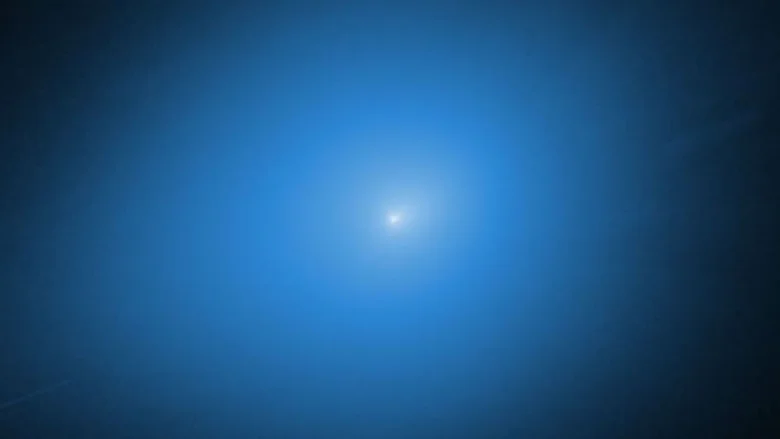
The Hubble Space Telescope has taken a second set of images of 3I/ATLAS, a comet from outside our solar system that made a brief pass near the Sun in late 2025. The updated view, recorded on November 30, shows the comet still active as it moves away, giving scientists another chance to study material that formed around a distant star.
Hubble used its Wide Field Camera 3 to photograph the visitor from about 286 million kilometers. The comet appears as a bright, hazy drop of dust and gas, while background stars stretch into faint streaks because the telescope tracked the comet’s quick motion. These new images help astronomers follow how the object behaves after its closest approach to the Sun.
This session followed Hubble’s first look in July 2025, captured shortly after the comet’s discovery. Those early images suggested a small icy core, likely under one kilometer wide, surrounded by a broad dust cloud. The November images show the coma slightly uneven, which hints that the nucleus is still venting gas as it cools.
The comet was first spotted on July 1, 2025, by the ATLAS survey telescope in Chile. It moved at 61 kilometers per second and followed a path that proved it came from beyond the solar system. By the next day, observatories around the world confirmed it. With that, 3I/ATLAS joined a very short list as only the third known interstellar visitor, after Oumuamua in 2017 and comet Borisov in 2019.
Once confirmed, the discovery set off a coordinated effort across the solar system. JWST observed the comet in August and detected carbon dioxide along with smaller amounts of water ice and gas. The Very Large Telescope (VLT) found cyanide and nickel.
NASA’s Psyche and Lucy spacecraft captured long-distance views that helped refine trajectory models. Even the Perseverance rover managed to spot a faint blur from the surface of Mars.
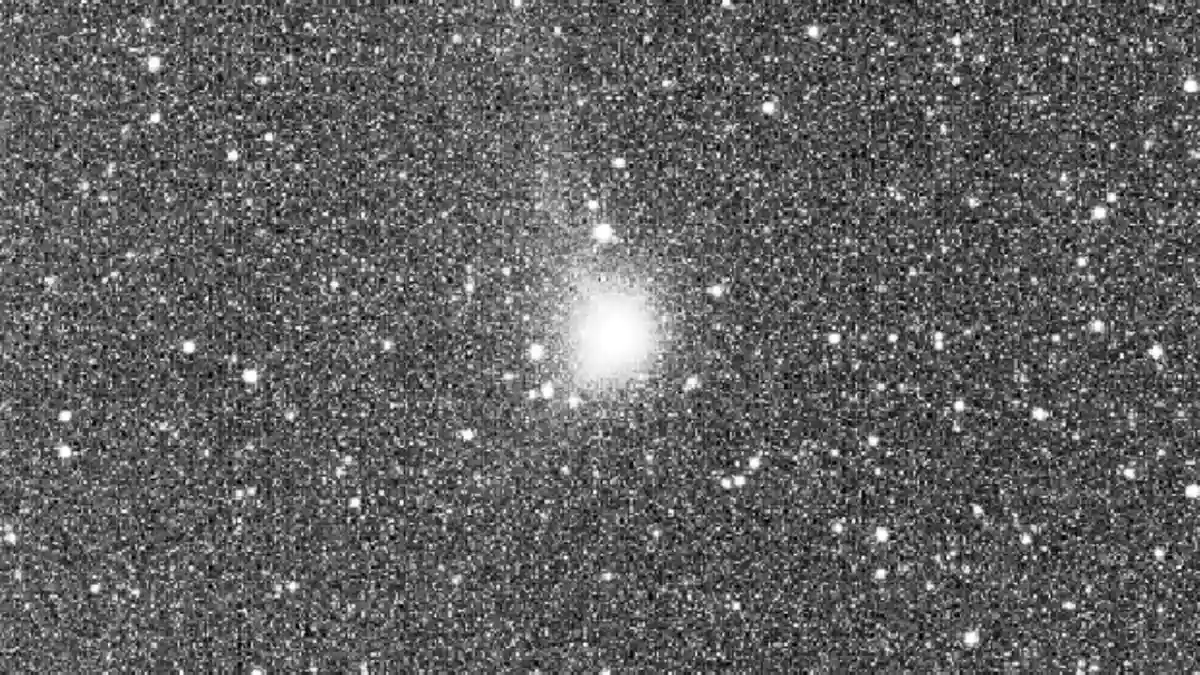
ESA’s Juice spacecraft observed interstellar comet 3I/ATLAS in November 2025 using five of its science instruments. While the full data set will not reach Earth until February 2026, the team downloaded a small portion of a single Navigation Camera image to get an early look. The camera, meant for navigation rather than detailed science, still captured the comet with surprising clarity.
The cropped image, taken on 2 November from about 66 million kilometers, shows the comet’s glowing coma and hints of two tails: a plasma tail extending upward in the frame and what may be a fainter dust tail stretching toward the lower left. The view came during the spacecraft’s first observation window and just before its closest approach on 4 November.
Juice is currently using its main antenna as a heat shield, so it must rely on a slower backup antenna to send data home. That is why the full instrument data from JANUS, MAJIS, UVS, SWI, and PEP will not arrive until 18 and 20 February 2026.
Scientists say the combined data gives a rare chance to compare material from another system with comets in our own. Early results show familiar ingredients, although the high level of carbon monoxide hints that the object formed in a colder region around its parent star.
The comet will skim near Jupiter’s orbit in March 2026 before fading from view. Hubble and JWST plan more observations into early next year.