
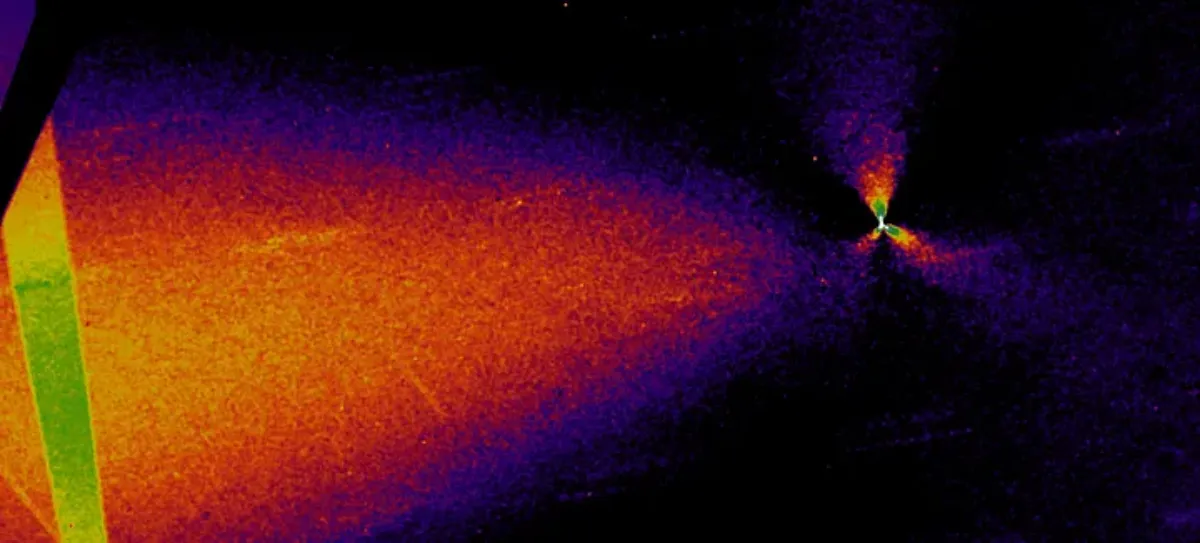
The Hubble Space Telescope has captured rare images of the interstellar object 3I/ATLAS during a brief alignment with the Sun and Earth on January 22, 2026. The observations, led by Harvard astrophysicist Avi Loeb and collaborators, show unusual jet activity and a bright anti-tail aimed almost directly toward Earth.
Hubble recorded six exposures, each lasting 170 seconds, over a 33-minute window using its Wide Field Camera 3. The images released by the Space Telescope Science Institute (STSCI) reveal a glowing cloud around 3I/ATLAS stretched roughly 100,000 kilometers toward the Sun. That distance is about ten times Earth’s diameter. The brightness rose sharply during the alignment because observers on Earth viewed the object nearly from the direction of the Sun, similar to seeing a full moon.
Loeb and his co-author Mauro Barbieri had predicted this “full moon phase” of the comet in advance. They calculated that Earth would fall within just 0.012 radians of the Sun-object line, an extremely tight angle by astronomical standards. That setup caused sunlight to scatter off material released from the object, boosting its apparent glow in a way that depends on the size and makeup of the particles involved.
Further image processing revealed even more unusual features. Using a rotational gradient filter, Loeb’s collaborator Toni Scarmato removed the smooth background glow around the nucleus. What remained was a clear system of four jets. One jet formed a bright anti-tail pointing almost straight toward the Sun and Earth. Three smaller jets appeared around the nucleus, spaced evenly by 120 degrees. One of those jets looked faint, likely because of how it faced Earth at the time.
In a separate study, Loeb and Scarmato found that the jet system does not stay fixed. It wobbles around the rotation axis every 7.2 hours by about 20 degrees. That motion makes a perfect alignment with Earth rare and brief, which explains why the anti-tail did not vanish into the surrounding glow.
“We still do not know the nature of the anti-tail that allows it to penetrate hundreds of thousands of kilometers through the solar wind and radiation without being deflected away from the Sun,” said Avi Loeb on Medium.
As researchers continue their analysis, 3I/ATLAS is reinforcing its status as one of the most unusual interstellar objects ever observed passing through our solar system.

Leave a Reply