

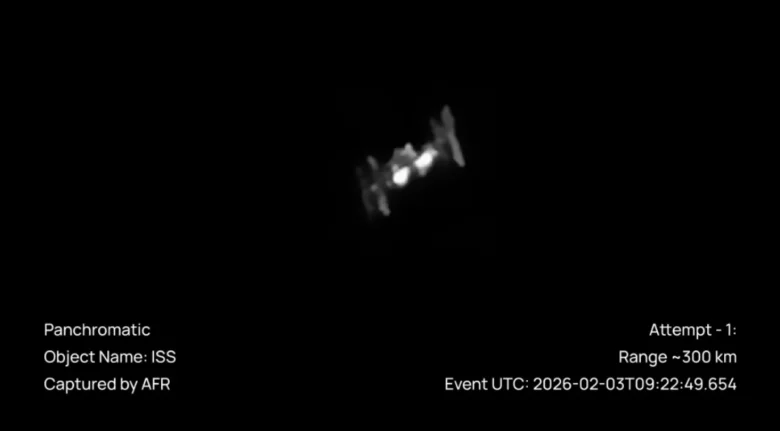
Hyderabad-based Azista Space Industries has captured an on-orbit image of the International Space Station (ISS) using its own space-grade optical system, marking the first time an Indian private company has carried out such an operation with fully indigenous hardware in space.
The achievement comes as part of a Space Situational Awareness and Non-Earth Imaging demonstration.
The company’s AFR sensor was tasked to track and image the station while operating in sunlit conditions at ranges of approximately 300 kilometers and 245 kilometers. Two independent attempts were conducted on 3 February 2026 at 09:22:49 UTC and 10:09:28 UTC. Both attempts achieved complete success, with the system capturing the ISS in 15 distinct frames.
The resulting acquisition delivered imagery with approximately 2.2-meter sampling resolution, validating the company’s tracking algorithms, pointing stability, and imaging precision. According to Azista, AFR is currently the only Indian-built and operated satellite to have demonstrated this level of on-orbit SSA imaging capability.
Capturing the ISS from orbit is technically demanding. The station travels at nearly 28,000 kilometers per hour in low Earth orbit. To secure a clear image, the observing spacecraft must predict the target’s trajectory with extreme accuracy, align its optics within tight tolerances, and maintain stable tracking while both objects move at high velocity.
Even a slight miscalculation in timing or orientation can result in blur or complete loss of the target. The successful on-orbit capture confirms that Azista has built and operated a system capable of high-precision space observation under dynamic conditions.
This milestone reflects the steady expansion of India’s private space sector. Companies such as Pixxel have developed advanced Earth imaging constellations, while Skyroot Aerospace is developing India’s first and biggest reusable rocket. Azista’s ISS imaging shows that private players are now moving into advanced operational roles.
Policy reforms have played a direct role in enabling this transition. The establishment of IN-SPACe created a formal framework for private participation and access to national space infrastructure. Clearer regulations around spacecraft design, testing, and operations have encouraged investment in high performance optical payloads and mission-ready satellite platforms.
On-orbit imaging of major space assets has growing practical value. It supports inspection, monitoring, and space traffic coordination in increasingly crowded orbital regions. As more satellites enter orbit, independent visual confirmation and accurate tracking are becoming critical for operational safety and long-term sustainability.
