

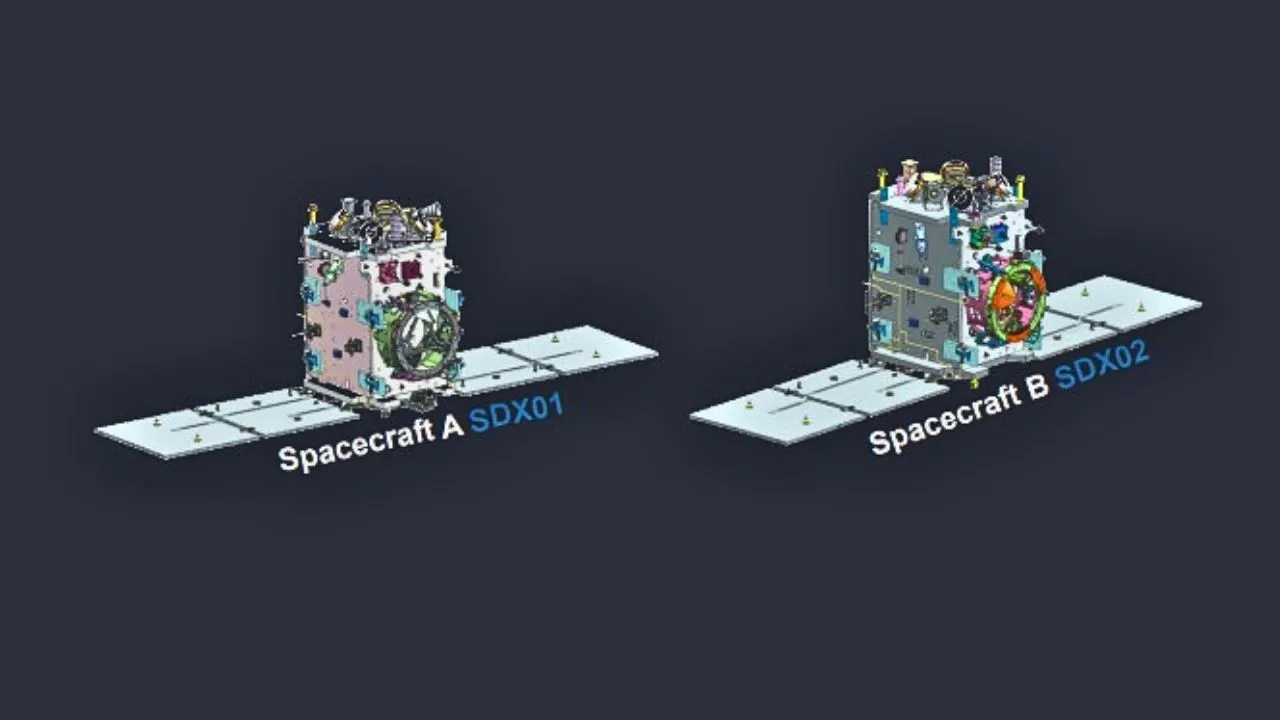
The Indian Space Research Organisation (ISRO) has successfully completed its Space Docking Experiment (SpaDeX) mission, marking a significant milestone in India’s space capabilities. This achievement positions India alongside the United States, Russia, and China in demonstrating autonomous space docking and de-docking technologies.
Launched on December 30, 2024, aboard the PSLV-C60 rocket from the Satish Dhawan Space Centre, the SpaDeX mission deployed two small satellites: SDX-01 (Chaser) and SDX-02 (Target). Weighing 220 kg each, these satellites were placed in a 475 km circular orbit with a 3-second interval between deployments to maintain a safe distance of about 20 km.
Key Milestones
Docking (January 16, 2025): The two satellites successfully docked in low Earth orbit, validating ISRO’s docking technology for the first time.
Undocking (March 13, 2025): The satellites performed a successful de-docking maneuver, captured from both SDX-1 and SDX-2, offering a rare view of in-orbit separation.
Power Transfer Demonstration (April 21, 2025): A successful demonstration of power transfer between the docked satellites was accomplished, operating a heater element in one satellite via power from the other for approximately 4 minutes.
Mission Status as of August 2025
As of August 2025, the SpaDeX mission has concluded its primary objectives. The successful docking, undocking, and power transfer demonstrations have validated ISRO’s capabilities in autonomous space operations.
Plans for a second phase, SpaDeX-2, are underway, aiming to further advance India’s space docking technologies. A proposal for SpaDeX-2 is expected to be submitted to the government soon, with a potential launch within the next three years, subject to approval.
Significance for India’s Space Future
The SpaDeX mission is a critical step toward realizing India’s ambitious space goals, including the establishment of the Bharatiya Antariksha Station (BAS) and crewed lunar missions. By demonstrating autonomous docking and related technologies, ISRO has positioned India as a key player in global space exploration.
The success of SpaDeX underscores ISRO’s growing capabilities in complex space operations and its commitment to advancing India’s presence in space.