

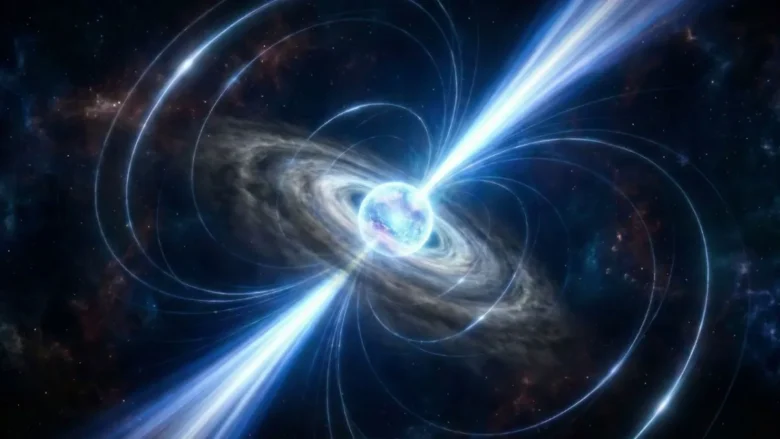
A 10-millisecond pulsar named PSR J0900-3144, about 3,500 light-years from Earth, suddenly sped up in September 2022. This is only the third time a glitch has been seen in a millisecond pulsar. Astronomers found the change after studying more than 14 years of data from several observatories. The event challenges the idea that these fast, old stars are perfect cosmic clocks and may affect how scientists search for gravitational waves.
The small speed change appeared in timing data from telescopes, including MeerKAT, Parkes, Nançay, and Jodrell Bank. The shift in spin was only about 1.15 × 10⁻¹², but over long periods it shows up as a clear step in the star’s normal rhythm. When scientists compared this signal to normal background noise, the data strongly supported the glitch explanation.
Glitches are common in young pulsars. These stars slow down and change speed when material inside them shifts and transfers spin to the outer layer. Millisecond pulsars are much older and were thought to be too stable for this to happen. The new finding shows that even these fast, long-lived stars can still experience sudden changes, even if the size of the change is far smaller than in younger pulsars.
The discovery also changes how often researchers expect such events. Before this, only two glitches had been confirmed in millisecond pulsars over fifty years. With this new case, the estimated rate becomes about one glitch every 400 years per pulsar. Since major groups now track around 120 of these objects for many years at a time, more glitches may appear in the near future.
This matters for projects that use pulsars to search for low-frequency gravitational waves. If a small glitch goes unnoticed, it can look like red noise in the data. That can make a pulsar seem less reliable than it really is and reduce the strength of the overall signal scientists are trying to find.
To test this problem, the team added fake glitches into simulated data. They found that glitches similar in size to this one usually need 10 to 15 years of strong data to be clearly identified. Shorter data sets can easily mistake the change for normal noise, which is a concern for newer observing programs in countries still building long-term records.
Even though the glitch is tiny, it tells scientists more about what lies inside a millisecond pulsar. It suggests that part of the star’s inner structure can still shift and affect its rotation. This event confirms that these stars are not as perfectly stable as once believed and that their small changes must be taken seriously in future research.
Source: A glitch in the millisecond pulsar J0900-3144