Tag: Pulsar

  • Millisecond pulsar PSR J0900โˆ’3144 glitches for first time in decades

    Millisecond pulsar PSR J0900โˆ’3144 glitches for first time in decades

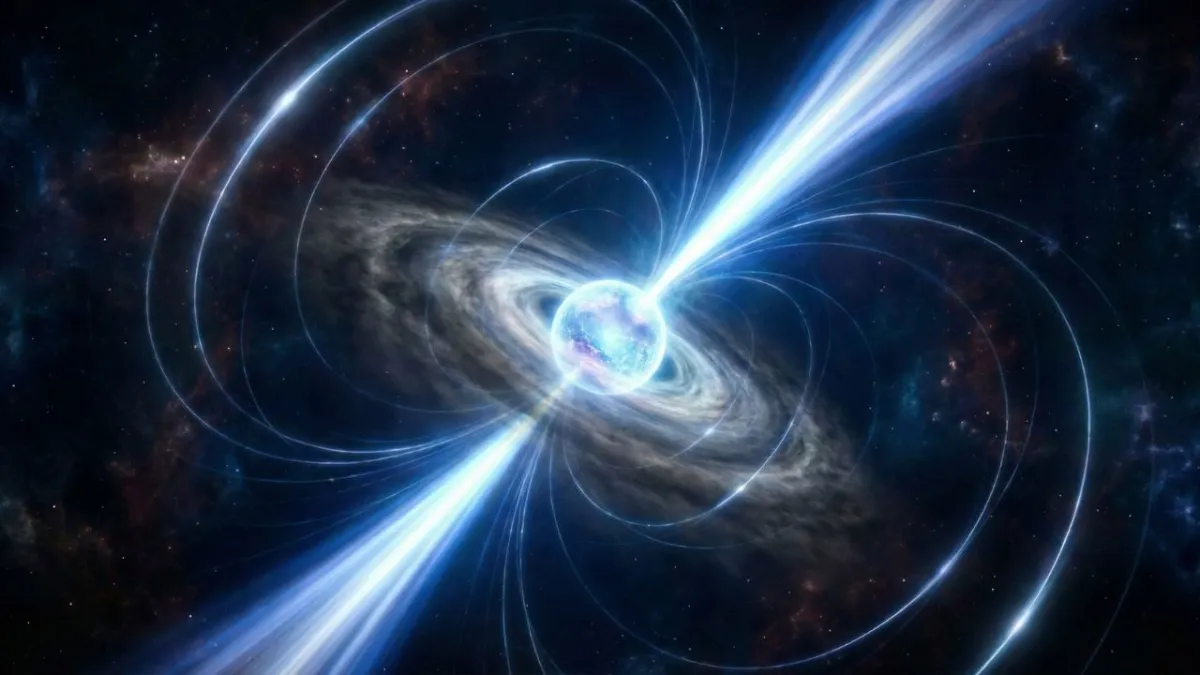
    A 10-millisecond pulsar named PSR J0900-3144, about 3,500 light-years from Earth, suddenly sped up in September 2022. This is only the third time a glitch has been seen in a millisecond pulsar. Astronomers found the change after studying more than 14 years of data from several observatories. The event challenges the idea that these fast, old stars are perfect cosmic clocks and may affect how scientists search for gravitational waves.

    The small speed change appeared in timing data from telescopes, including MeerKAT, Parkes, Nançay, and Jodrell Bank. The shift in spin was only about 1.15 × 10⁻¹², but over long periods it shows up as a clear step in the star’s normal rhythm. When scientists compared this signal to normal background noise, the data strongly supported the glitch explanation.

    Glitches are common in young pulsars. These stars slow down and change speed when material inside them shifts and transfers spin to the outer layer. Millisecond pulsars are much older and were thought to be too stable for this to happen. The new finding shows that even these fast, long-lived stars can still experience sudden changes, even if the size of the change is far smaller than in younger pulsars.

    The discovery also changes how often researchers expect such events. Before this, only two glitches had been confirmed in millisecond pulsars over fifty years. With this new case, the estimated rate becomes about one glitch every 400 years per pulsar. Since major groups now track around 120 of these objects for many years at a time, more glitches may appear in the near future.

    This matters for projects that use pulsars to search for low-frequency gravitational waves. If a small glitch goes unnoticed, it can look like red noise in the data. That can make a pulsar seem less reliable than it really is and reduce the strength of the overall signal scientists are trying to find.

    To test this problem, the team added fake glitches into simulated data. They found that glitches similar in size to this one usually need 10 to 15 years of strong data to be clearly identified. Shorter data sets can easily mistake the change for normal noise, which is a concern for newer observing programs in countries still building long-term records.

    Even though the glitch is tiny, it tells scientists more about what lies inside a millisecond pulsar. It suggests that part of the star’s inner structure can still shift and affect its rotation. This event confirms that these stars are not as perfectly stable as once believed and that their small changes must be taken seriously in future research.

    Source: A glitch in the millisecond pulsar J0900-3144

  • Pulsar Races From Rare Supernova Far Above Milky Wayโ€™s Disk, Surprising Astronomers

    Pulsar Races From Rare Supernova Far Above Milky Wayโ€™s Disk, Surprising Astronomers

    Astronomers have confirmed that a pulsar named Calvera is speeding away from the remains of a supernova in one of the galaxy’s most unlikely regions. Located more than 6,000 light-years above the Milky Way’s crowded disk, Calvera challenges long-held ideas about where massive stars form and explode.

    The discovery comes from combined radio and X-ray observations, which traced the pulsar’s path back to its birth site 10,000 to 20,000 years ago.

    Calvera lies between 13,000 and 16,500 light-years from Earth, positioned in a thin region where very few stars exist. The galactic disk usually produces most of the stars heavier than eight times the Sun, the kind that end their lives in supernovae.

    Above the disk, conditions are far less favorable for star formation. Calvera’s presence proves that at least one massive star did exist there and exploded to form the pulsar we see today.

    Pulsars are the neutron stars that are collapsed remnants of supernovae. They are extremely dense, with more mass than the Sun packed into a sphere only 20 kilometers across.

    Calvera was first identified in 2007 using data from the ROSAT X-ray satellite. It belongs to a rare group of neutron stars known as the Magnificent Seven, which glow strongly in X-rays but do not emit radio pulses. These stars are isolated and slowly cooling, making them useful for studying neutron star surfaces.

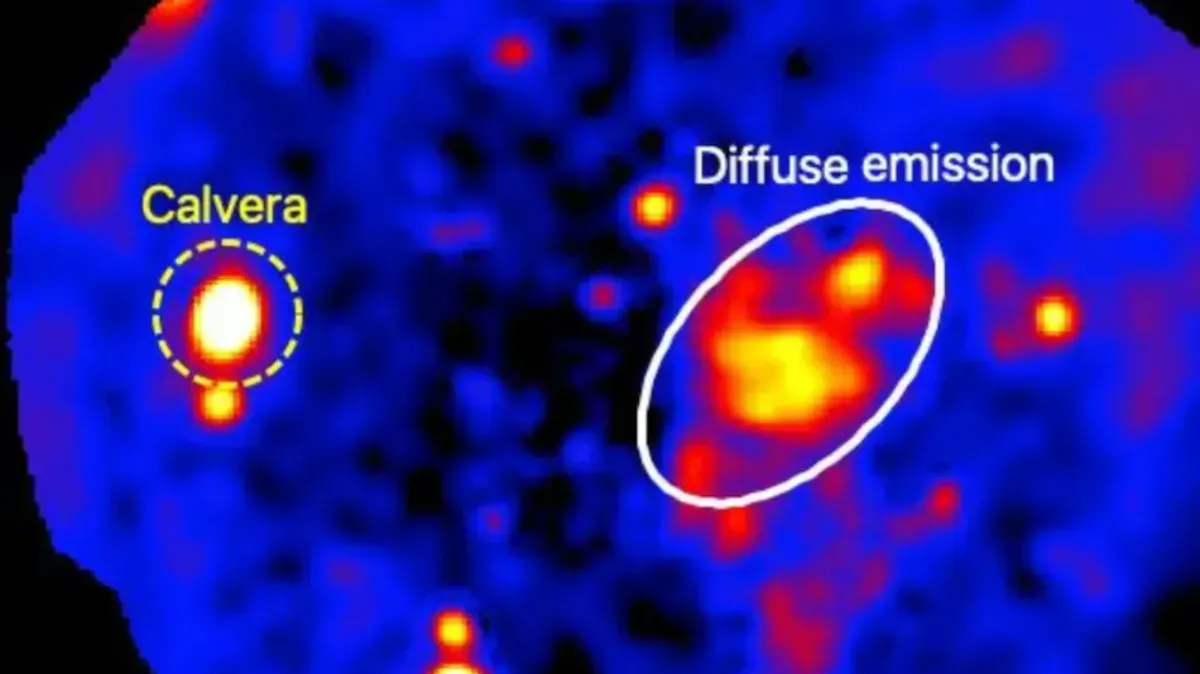
    In 2022, the LOFAR radio telescope in Europe detected a faint ring of radio emission around Calvera. This hinted at the presence of a supernova remnant.

    A team led by Emanuele Greco at Italy’s National Institute for Astrophysics then used XMM-Newton and other telescopes to examine the region in X-rays and other wavelengths. They confirmed that the pulsar’s motion aligns directly with the remnant’s center, pointing to its origin in the explosion.

    When a massive star explodes, the blast is often uneven. That imbalance can fling the remaining neutron star outward at great speed, an effect known as a natal kick. Calvera appears to have received such a kick, sending it flying through the galaxy while the shell of hot gas and debris expanded behind it.

    Even in this thin region of space, clumps of material around the remnant glowed in X-rays and gamma rays, offering clues about the original star.

    Analysis suggests the progenitor star weighed around 15 times the mass of the Sun. Stars of this size live only a few million years before collapsing. Finding such a star far from the galactic plane raises questions about its origin.

    It may have been a runaway star ejected from a cluster closer to the plane, or it could have formed in place under unusual conditions. Similar cases have been seen in the Gum Nebula, another region with rare off-plane massive stars.

    Calvera shows that the outer regions of the galaxy are not as quiet as once thought. If one massive star formed and exploded there, more may be waiting to be discovered. For astronomers studying supernova remnants and pulsars, this means updating maps of where these objects are likely to appear. It also demonstrates that high-energy emissions can remain bright even in sparse environments.

    Future facilities such as the Square Kilometre Array will help detect more unusual neutron stars and remnants in unexpected locations. Calvera, named after a movie villain for its solitary and fast-moving nature, serves as a reminder that the Milky Way still holds surprises. Careful work across radio, X-ray, and gamma-ray astronomy continues to reveal how stars live, die, and shape the galaxy.

    Source: Multi-wavelength study of the high Galactic latitude supernova remnant candidate G118.4+37.0 associated with the Calvera pulsar