

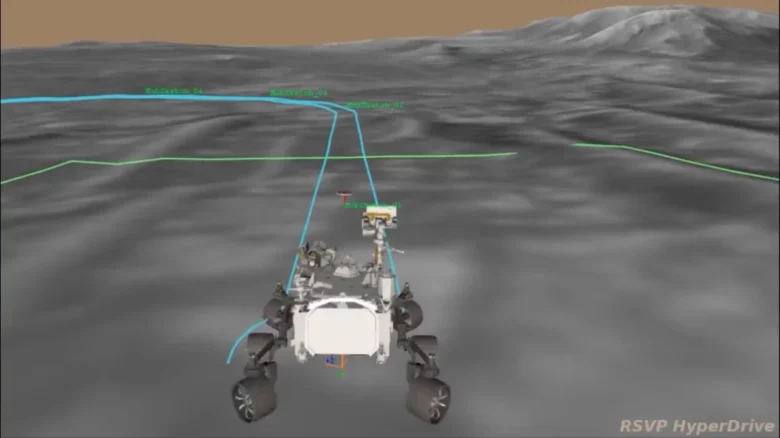
NASA has carried out the first Mars rover drive planned with help from an artificial intelligence system, marking a new phase in how space missions may operate in the future. In December 2025, engineers at NASA’s Jet Propulsion Laboratory worked with Anthropic’s AI model, Claude, to plan a roughly 400 meter drive for the Perseverance rover inside Jezero Crater.
Operating a rover on Mars comes with strict limits. Signals from Earth take about 20 minutes to reach the planet, leaving no room for live steering. Teams must send a full driving plan in advance and review the results later. For years, human rover drivers have handled this task by manually setting waypoints based on satellite images and rover camera data.
For this test, JPL engineers turned to Claude. They supplied the AI with years of driving experience, mission rules, and safety constraints. Claude analyzed overhead images of the route and generated a sequence of waypoints using Rover Markup Language, the same command format used in daily rover operations. The AI planned the drive in short segments, reviewed its own output, and refined the route through multiple passes.
Before transmission, engineers ran the AI-generated plan through the rover’s standard simulation system. The software modeled more than 500,000 variables to predict wheel behavior, slope limits, and hazard risks. Engineers made a few small changes based on ground-level camera images that were not included in Claude’s input. The updated plan was then sent to Mars, where Perseverance completed the drive without issue.
The distance covered was modest, about the length of a running track, but the result carries weight. Engineers estimate that using Claude for route planning could reduce preparation time by about 50 percent. That would allow more frequent drives and greater scientific output without expanding mission teams.
The test also signals what may come next. NASA’s Artemis program and future deep-space missions will face longer communication delays and tighter operational windows. AI systems capable of planning, coding commands, and responding to changing conditions could play a larger role in keeping missions efficient.
For now, Claude’s Mars drive stands as a controlled demonstration. It shows that AI can support real planetary operations under human supervision, opening the door to missions that rely less on constant input from Earth and more on autonomous decision-making beyond it.
