

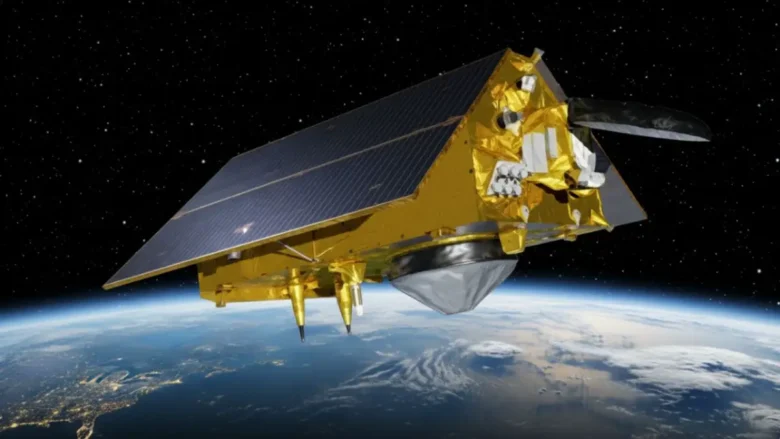
A new satellite built to track rising oceans is now in orbit after a night launch from California. Sentinel 6B rode a SpaceX Falcon 9 from Vandenberg Space Force Base on November 16, 2025, lifting off at 9:21 p.m. local time. The mission aims to deliver the most detailed sea level data yet as coastal cities face higher tides and more frequent flooding.
The Falcon 9 returned its booster to a landing site a few minutes after liftoff, marking the company’s 500th flight with a reused stage, and the satellite sent its first signal home less than an hour after separating from the rocket.
Sentinel 6B carries a radar instrument that sends pulses toward the ocean and measures the time it takes for the signal to return. This lets scientists track sea height across most of the planet with accuracy to a few centimeters.
The readings work through clouds and at night, which keeps the record steady even in storms. The satellite also measures wave heights, wind speeds over the ocean, and temperature layers in the atmosphere, details that feed into weather models used for daily forecasts and hurricane tracking.
The mission comes as sea levels continue to rise. Global averages have climbed about 10 centimeters in the last 25 years, and the pace has increased as oceans warm and ice sheets add more water. Some regions see faster change than others because of shifting currents.
Cities including Miami, Shanghai, and Dhaka already face higher tides and stronger storm surges. Governments use sea level data to plan coastal barriers, guide new construction, and decide when to move people out of high-risk areas.
Sentinel 6B will operate with its twin, Sentinel 6 Michael Freilich, which launched in 2020. Both satellites will fly in the same orbit for about a year so teams can compare readings and check for calibration errors. After that period, the older satellite will shift to a new orbit where it will help map features on the seafloor by tracking tiny changes in the ocean surface caused by underwater mountains. Sentinel 6B will then take over as the primary source for global records.
The launch continues a record of sea level measurement that began in 1992 with the joint NASA and French space agency mission TOPEX/Poseidon. Jason 1, Jason 2, and Jason 3 followed. Together, these satellites produced a continuous dataset that now spans more than three decades.
With Sentinel 6B active, the record is expected to extend close to 40 years by the end of the decade. Long records allow scientists to separate natural shifts, such as temporary dips from cooler ocean cycles, from long-term change driven by warming.
The project involves NASA, the European Space Agency (ESA), NOAA, EUMETSAT, and the Copernicus program. Airbus in Germany built the satellite and prepared it for storage before launch. The French space agency supplied instruments and technical support. Data from the mission will be shared openly with researchers and governments.
Sentinel 6B now circles Earth at about 1,336 kilometers and completes one orbit in 112 minutes. Engineers will spend the next few months testing every system. Routine sea level measurements are expected to begin in early 2026. Once active, the satellite will be one of the main tools used by scientists and coastal planners as communities face rising water and more frequent flooding.