

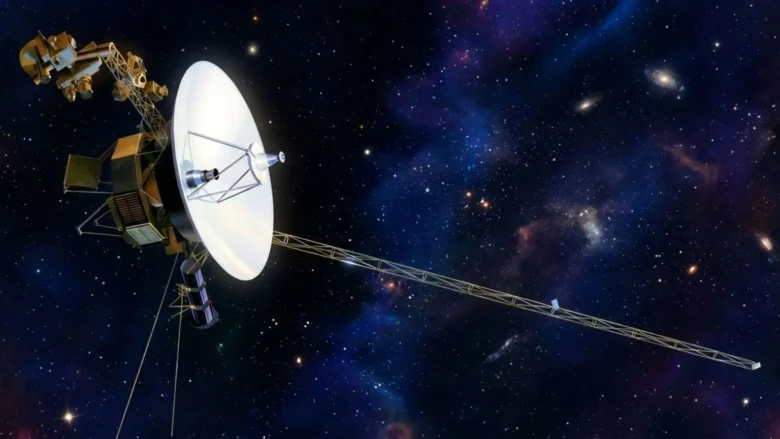
Voyager 1, NASA’s longest-running spacecraft, will reach a distance of one light-day from Earth in November 2026, breaking its own record of the farthest human-made object ever! At that range, a radio signal from Earth will take a full 24 hours to reach the probe. Every command will require patience, planning, and trust in hardware launched nearly five decades ago.
A light-day is the distance light travels in 24 hours, about 26 billion kilometers. The Moon sits just over one light-second away, while sunlight reaches Earth in eight minutes. Voyager 1 will become the first spacecraft to cross this threshold, placing it far beyond the planets and deep into interstellar space.
NASA launched Voyager 1 in 1977 to study the outer solar system. The mission delivered close-up views of Jupiter and Saturn, revealed active volcanoes on Jupiter’s moon Io, and documented Saturn’s rings in sharp detail. After finishing its planned flybys, the spacecraft continued outward. In 2012, scientists confirmed it had exited the Sun’s domain and entered interstellar space.
By early 2026, Voyager 1 is about 170 astronomical units from Earth, or roughly 25.4 billion kilometers away. It travels at nearly 61,000 kilometers per hour and increases its distance by more than 500 million kilometers each year. Communication delays already stretch close to a full day for a round trip.
Power is the mission’s main constraint. Voyager 1 relies on a plutonium-based generator that now produces about half the energy it did at launch. Even so, engineers at NASA’s Jet Propulsion Laboratory (JPL) keep the spacecraft operating. In 2024, the team resolved a computer problem that briefly threatened the mission.
From its remote location, Voyager 1 studies cosmic radiation and magnetic fields between stars. The data shows the boundary around our solar system allows more outside particles to pass through than expected. This work helps scientists better judge how the Sun interacts with the wider galaxy.
Voyager 1 also carries the Golden Record, a gold-plated disc filled with sounds, images, and greetings from Earth. Long after its instruments fall silent, the spacecraft will continue drifting through space, carrying a small snapshot of human life far from home.