

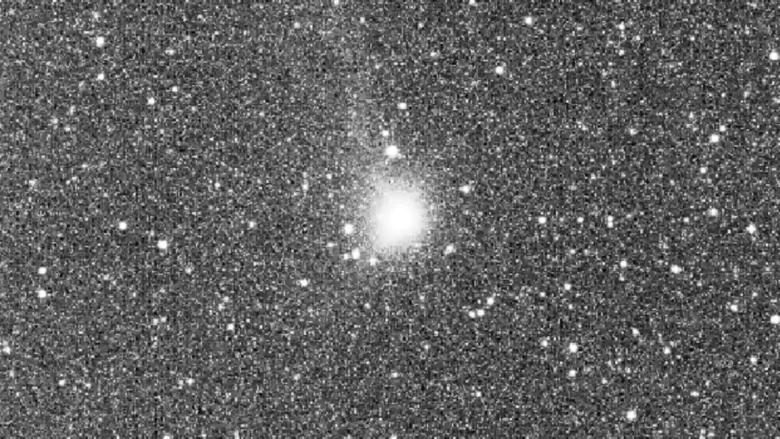
The interstellar comet 3I/ATLAS made its closest pass to Earth on December 19. The comet passed at a safe distance of about 270 million kilometers and posed no threat, according to space agencies tracking its path.
The object was first spotted in July by the ATLAS survey in Chile. Follow-up observations showed it was moving far too fast to be bound to the Sun, confirming it came from outside the solar system. At roughly 60 kilometers per second, 3I/ATLAS is only the third known visitor of its kind, following the 2017 object ʻOumuamua and the comet 2I/Borisov in 2019.
Unlike ʻOumuamua, which showed little activity, 3I/ATLAS behaves like a classic comet. As it approached the Sun earlier this year, it released gas and dust that formed a visible tail. Observatories later reported a faint green glow around the comet, a color commonly seen when certain carbon compounds interact with sunlight. Researchers estimate the comet’s solid core may span up to 20 kilometers, making it larger than many comets seen in our own system.
Around the time of the flyby, some monitoring stations recorded a brief spike in Earth’s natural low-frequency electromagnetic background at about 25 hertz. The signal appeared hours before the comet’s closest approach and lasted for a short period. Scientists who study these signals say such spikes can occur due to natural atmospheric activity or space weather and do not indicate any direct link to the comet.
Experts stressed that 3I/ATLAS was far too distant to affect Earth’s atmosphere or magnetic environment. Studies show that material released by comets disperses quickly and weakens long before it could reach Earth. Radio scans of the comet also found no unusual emissions.
The comet will continue its journey through the solar system and is expected to pass near Jupiter in early 2026. Astronomers plan to keep watching, as the planet’s strong gravity may alter the comet’s activity.