

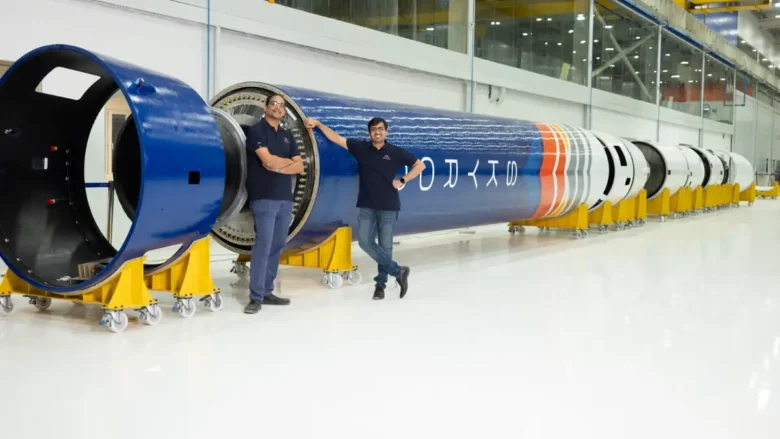
India’s space story entered a new chapter on November 27, 2025, when Skyroot Aerospace opened its Infinity Campus in Hyderabad and unveiled Vikram-I, the country’s first privately developed orbital-class rocket. For those of us who study the universe, moments like this are rare and important. They mark the point where curiosity meets capability, and science gains a new way to reach the sky.
The Infinity Campus is more than a factory. Spread across about 200,000 square feet, it is built to take a rocket from blueprint to finished vehicle under one roof. Clean rooms protect sensitive components from dust. Test bays allow engines and structures to be checked repeatedly. Advanced 3D printers shape complex engine parts that once took weeks to build by machine. This kind of in-house production shortens timelines and reduces cost, which is exactly what a modern space program needs if it plans to fly often.
Vikram-I stands around 22 meters tall and is designed for small satellite missions. It can carry roughly 300 kilograms into low-Earth orbit, a region about 400 to 600 kilometers above the planet where satellites travel at nearly 28,000 kilometers per hour. Rockets aiming for this orbit must reach speeds close to 7.8 kilometers per second, which means the engineering involved is far more demanding than a suborbital hop.
The vehicle uses a combination of solid and liquid propulsion stages. Solid fuel provides strong, reliable thrust during the early phase of flight, while the liquid upper stage allows for finer control during orbital insertion. Carbon-composite materials keep the structure light without sacrificing strength. These choices reflect a careful balance between power, precision, and cost.
Skyroot’s earlier launch in 2022, the Vikram-S mission, proved that the company could build and fly rocket systems safely. That short suborbital mission reached the edge of space and returned valuable data. Vikram-I takes the next big step by aiming not just to touch space but to stay there, placing real payloads into orbit around Earth.
India’s private space sector has grown quickly since reforms in the early 2020s allowed companies to participate more freely in launches and satellite work. Dozens of startups now focus on propulsion, imaging, data analysis, and materials science. Skyroot is part of a larger ecosystem that complements the work of ISRO rather than replacing it. Together, they create a more flexible and capable national space program.