
Tag: JWST

  • James Webb Telescope spots massive Milky Wayโ€“like galaxy just 600M years after Big Bang

    James Webb Telescope spots massive Milky Wayโ€“like galaxy just 600M years after Big Bang

    NASAโ€™s James Webb Space Telescope (JWST) has uncovered a massive galaxy that existed just 600 million years after the Big Bang, weighing nearly as much as the Milky Way. The discovery was made in the galaxy cluster MACS J1423, and the object has been designated WEIC2429, nicknamed the โ€œFirefly Sparkle Galaxyโ€ for its glittering appearance.

    The finding was led by co-author Lamiya Mowla, assistant professor at Wellesley College, who identified the galaxy in JWSTโ€™s image. NASA described the discovery in a poetic post on X: โ€œSomeone struck a match against the nightโ€ฆโ€ The dazzling image left viewers amazed, with users marveling at how Webb continues to reshape our view of the cosmos.

    The Firefly Sparkle Galaxy contains 10 distinct star clusters, emitting light in pink, purple, and blue hues. This color variety indicates that star formation occurred in staggered phases, not all at once. JWSTโ€™s detailed view was made possible by its advanced technology and gravitational lensing, which magnified the galaxyโ€™s faint light through the massive cluster MACS J1423.

    In the image, the galaxy appears stretched into a long arc. Researchers later modeled its true form, suggesting an elongated raindrop shapeโ€”a sign that the stars have yet to settle into a bulge or disc. Its evolution remains uncertain, influenced by two companion galaxies located 6,500 and 42,000 light-years away.

    The study, published in Nature, marks the first identification of an actively forming galaxy with a mass comparable to a young Milky Way so early in cosmic history. It provides key insights into how galaxies like ours began assembling soon after the Big Bang.
  • James Webb Spots Possible First Brown Dwarfs Beyond the Milky Way in Star Cluster NGC 602

    James Webb Spots Possible First Brown Dwarfs Beyond the Milky Way in Star Cluster NGC 602

    Astronomers using the James Webb Space Telescope (JWST) have identified what may be the first young brown dwarfs ever found outside the Milky Way. The discovery was announced by the European Space Agency (ESA) on October 23.

    The observations targeted NGC 602, a rich young star cluster on the outskirts of the Small Magellanic Cloud, a satellite galaxy about 200,000 light-years away. Webb’s Near-Infrared Camera (NIRCam) captured the detailed data in April 2023 as part of its General Observer program.

    An international team including Peter Zeidler, Elena Sabbi, Elena Manjavacas, and Antonella Nota analyzed the data. Their findings revealed several candidates for brown dwarfs (objects that are too massive to be considered planets but not massive enough to sustain nuclear fusion like stars).

    Brown dwarfs typically range between 13 and 80 times the mass of Jupiter. Until now, all confirmed examples had been found inside the Milky Way. If confirmed, these candidates would mark the first detection of such objects in another galaxy.

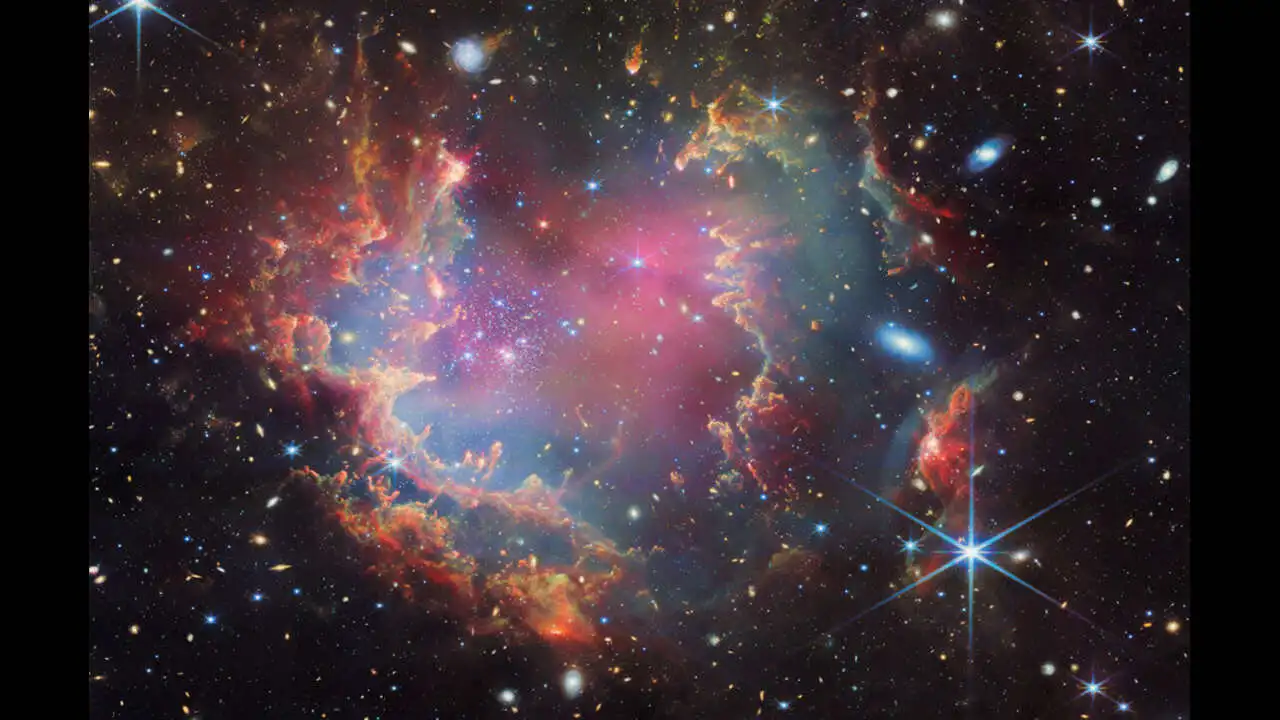
    NGC 602 provides a rare environment for study because its chemical composition resembles that of the early universe. Webb’s imagery shows dark, dense dust clouds, ridges of gas, and signs of active star formation, offering astronomers a chance to trace how stars and substellar objects emerge in different galactic conditions.

    NASA shared Webb’s new image of NGC 602 on X, calling it “rainbows and unicorns, like a middle school binder.” The colorful view shows a crowded region of stars, young stellar objects, and intricate structures of dust and gas, highlighting Webb’s ability to resolve distant clusters in unprecedented detail.

    The telescope has previously delivered sharp images of massive clusters such as Westerlund 1, but NGC 602 stands out for its location beyond our galaxy and the potential breakthrough in identifying brown dwarfs there.

  • James Webb Telescope Captures Rare Image of Super Star Cluster Westerlund-1 Inside Our Galaxy

    James Webb Telescope Captures Rare Image of Super Star Cluster Westerlund-1 Inside Our Galaxy

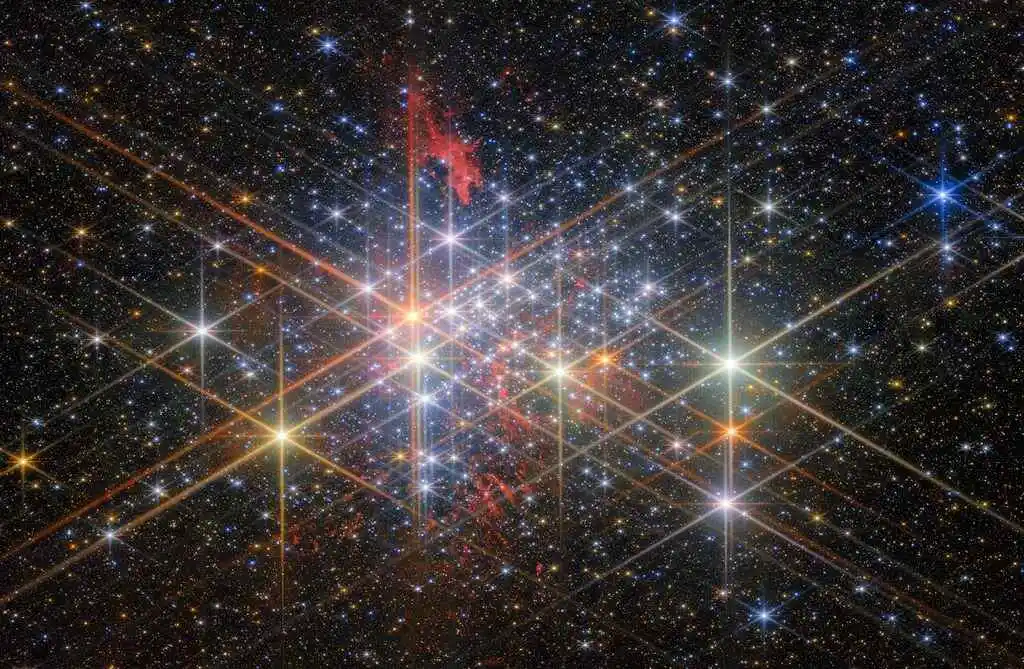
    NASA’s James Webb Space Telescope has captured a striking image of Westerlund-1, one of the most massive and compact star clusters in the Milky Way. Located about 12,000 light-years from Earth, the cluster contains more than 10,000 times the mass of the Sun packed into a relatively small region of space.

    Super Star clusters like Westerlund-1 are among the most extreme places in the universe for star and planet formation. While they are common in younger galaxies where stars are still being born rapidly, they are rare in the Milky Way, which is far older and past its most active period of star formation.

    NASA says Westerlund-1 has a remarkably diverse mix of massive stars. All of them are in advanced stages of their lives, including Wolf-Rayet stars, OB supergiants, yellow hypergiants, which can shine almost a million times brighter than the Sun, and luminous blue variables. This variety gives astronomers a unique chance to study how such stars evolve and interact in dense environments.

    The image was taken as part of the Westerlund 1 and 2 Open Clusters Survey, known as EWOCS, using Webb’s Near-Infrared Camera (NIRCam). The program is focused on studying how stars and planets form and how stars evolve in regions where many of them are born close together.

    Westerlund-1 is not only a rare example within our galaxy but also an important laboratory for astronomers. Observing it with Webb allows scientists to see details that were previously impossible with earlier telescopes. Because the cluster is still relatively close in cosmic terms, it provides a much clearer view of how extreme star-forming regions work.

    The James Webb Space Telescope itself was launched on December 25, 2021. Unlike the Hubble Space Telescope, which orbits Earth, Webb circles the Sun about 1.5 million kilometers away at a stable point known as L2. From this position, it has been able to send back some of the sharpest and deepest images ever seen of the universe, including galaxies in collision and the earliest stages of star birth.

    Astronomers say Westerlund-1 is another reminder of Webb’s power. By observing clusters like this, the telescope is helping scientists better understand how stars live and die and how galaxies like our own came to be.

  • NASA reveals detailed image of merging galaxies the Penguin, the Egg, captured by JWST

    NASA reveals detailed image of merging galaxies the Penguin, the Egg, captured by JWST

    NASA has released a striking new image from the James Webb Space Telescope (JWST), marking the observatory’s second anniversary. Taken on July 12, 2024, the photograph shows two galaxies in the process of merging, officially known as ARP 142 and nicknamed “the Penguin” and “the Egg” for their shapes.

    Captured in unprecedented detail, the image reveals how gravity is slowly pulling the galaxies together, setting the stage for them to combine into a single, larger galaxy.

    The Penguin, cataloged as NGC 2936, is a warped former spiral galaxy now stretched into an arc-like form. The Egg, NGC 2937, is a rounder, compact galaxy seen to the left of the frame. JWST’s infrared observations show the pair locked in a slow gravitational interaction about 100,000 light-years apart. Over time, their mutual pull is drawing them closer, compressing clouds of dust and gas, and igniting bursts of new star formation.

    The image was shared by NASA on X as part of celebrations marking two years since JWST began delivering scientific data. The telescope, launched in December 2021, is the largest and most powerful space observatory in operation. While the Hubble Space Telescope observes mainly in visible and ultraviolet light, JWST specializes in the infrared spectrum. This allows it to see through thick clouds of cosmic dust, revealing objects that are too faint or obscured for other instruments.

    According to NASA, this capability is key to studying galaxy mergers like ARP 142. Infrared imaging can expose the dense, dust-covered regions where stars are forming, helping astronomers understand how such interactions shape galaxies over billions of years. The Penguin and Egg are currently in an early stage of their merger, but simulations suggest they will eventually combine into one elliptical galaxy.

    JWST’s anniversary image not only highlights its scientific power but also underscores its mission: to deliver sharper, deeper, and more revealing views of the universe than ever before. More images from its second year of operation are expected to be released in the coming months, offering further insight into the origins and evolution of galaxies.