Tag: JWST

  • JWST Spots Perfect Spiral Galaxy That Formed Just 1.5 Billion Years After the Big Bang

    JWST Spots Perfect Spiral Galaxy That Formed Just 1.5 Billion Years After the Big Bang

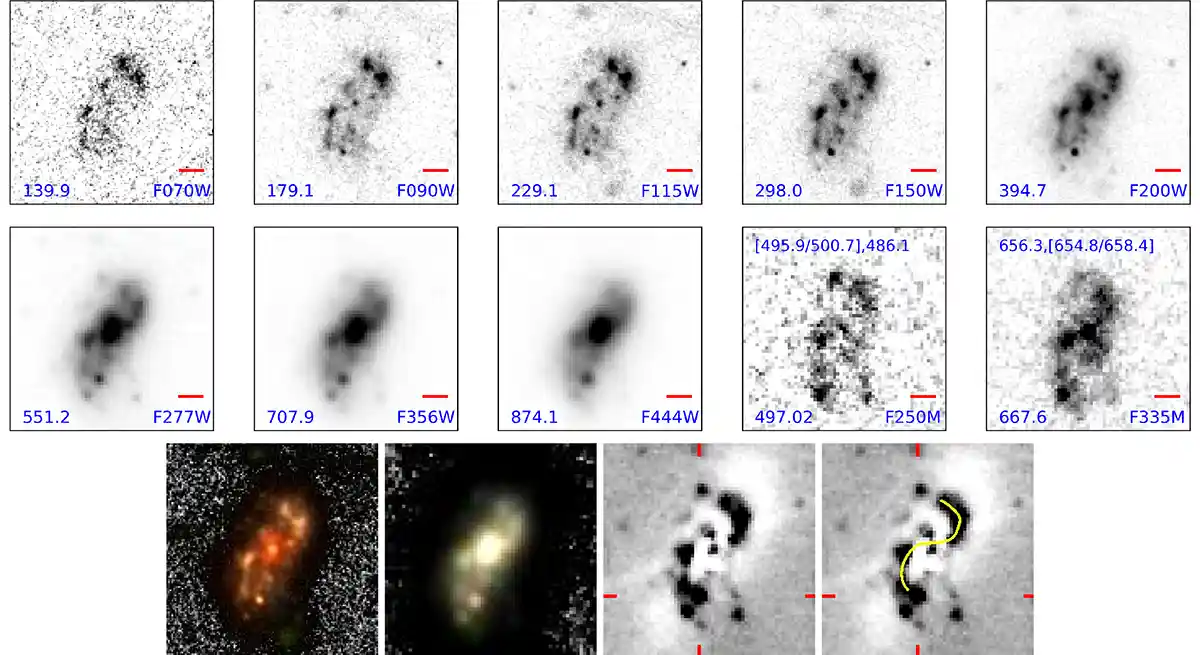
    Astronomers have found a fully formed spiral galaxy from a time when the universe was only 1.5 billion years old. The galaxy, named Alaknanda, sits behind the massive cluster Abell 2744 and was spotted with help from the James Webb Space Telescope (JWST). Its clear spiral arms, bright center, and wide disk challenge ideas about when large, organized galaxies could first appear.

    Researchers saw the galaxy through the natural magnifying effect of the Abell 2744 cluster. The clusterโ€™s gravity made the distant light brighter and easier to study. Without this help, the spiral structure would have been hard to see. The light from Alaknanda began its journey when the universe was less than 12 percent of its current age. This places the galaxy at a time long before galaxies like the Milky Way were thought to have stable spiral forms.

    Most galaxies from this early period look uneven and broken, with scattered regions of star birth. Many are still forming and lack clear structure. Alaknanda does not match that picture. It shows a smooth disk, a small central bulge, and two clear spiral arms.

    In ultraviolet light, the arms show bright spots where stars are forming. In visible light, those areas blend into clean and continuous arms. These patterns match what astronomers usually see in nearby spiral galaxies today. The disk spans about 10 kiloparsecs, which is about 32,000 light-years across. Around 85 percent of its light comes from this flat disk, not from the center. That means the galaxy is already dominated by an organized structure rather than a growing core.

    Alaknanda contains roughly 16 billion times the mass of the Sun in stars. That is around 15 percent of the current mass of the Milky Way. It is forming stars at a rate of about 63 suns per year, far faster than our galaxy does today.

    Scientists estimate that most of its stars formed in the 200 million years before the light we now see was released. This shows that the galaxy built up its mass very quickly, yet still kept a clear and stable shape. A smaller nearby galaxy sits close to the edge of Alaknandaโ€™s disk. Measurements show it lies at nearly the same distance. Researchers think it may be a satellite galaxy that is starting to interact with the larger one.

    This nearby object could have affected the shape of the spiral arms. Gravitational pull between galaxies can change their structure and trigger star formation. It may have helped give Alaknanda its clean, detailed pattern.

    For years, models suggested that spiral shapes take a long time to develop. They were thought to need calm conditions or special events that the early universe did not often provide. Alaknanda shows that this may not always be true.

    Recent surveys using the JWST have found more disk-shaped galaxies at great distances. These new discoveries suggest that organized galaxies appeared much earlier than expected, not just in rare cases.

    Astronomers now want to measure how the stars and gas within Alaknanda are moving. If the disk is rotating in a smooth way, it would support the idea that it is truly stable and settled. Future studies using Webb and radio telescopes on Earth will map how material moves across the spiral arms. These results will help explain whether the structure is long-lasting or still changing.

    Alaknanda offers a clear view of a young universe that was already capable of forming ordered, mature galaxies. It is now a key target for learning how the first large galaxies grew so fast and took on such clean shapes.

    Source: A grand-design spiral galaxy 1.5 billion years after the Big Bang with JWST

  • JWST may have captured the earliest known star cluster, offering strongest evidence yet for first-generation stars

    JWST may have captured the earliest known star cluster, offering strongest evidence yet for first-generation stars

    Using the James Webb Space Telescope (JWST), astronomers have identified a tiny, distant object that may be the strongest evidence yet for the universeโ€™s first stars. The source, called LAP1-B, lies behind the massive galaxy cluster MACS J0416, which magnifies its light by about a factor of one hundred. JWST captured a detailed spectrum of the object this year, revealing almost no elements heavier than helium. That absence of heavier elements is a key sign of the very first generation of stars, known as Population III.

    These stars formed when the universe contained only hydrogen and helium. With no heavier elements to help gas clouds cool, early stars grew extremely large, sometimes hundreds of times more massive than the sun. They lived for only a few million years before exploding and spreading the first carbon, oxygen, and iron.

    None survive today, and any that did would be far too faint or distant for ground telescopes to detect. Their light also shifts deep into the infrared as it travels across the universe, which makes instruments above Earthโ€™s atmosphere essential.

    LAP1-B sits at redshift 6.6, so we see it as it was about nine hundred million years after the Big Bang. The galaxy cluster in front of it bends and boosts its light, making it bright enough for JWST to study. Without that natural lens, the object would be far too dim to detect. JWSTโ€™s observations revealed strong helium emission lines but almost no sign of heavier elements. That pattern matches what scientists expect if LAP1-B is dominated by hot, massive stars formed from untouched primordial gas.

    A team led by Eli Visbal tested the data against the expected conditions for a Population III system. Their model suggests that LAP1-B formed inside a small dark matter halo with the right temperature for early star formation. The stars seem to follow a pattern in which many are very massive, and the entire cluster contains only a few thousand solar masses of material. Earlier candidates were rejected because they showed too many heavy elements or were far larger than theory allows.

    The result is promising but not confirmed. The exact amount of magnification from the lensing cluster can shift, and those changes affect estimates of LAP1-Bโ€™s size and mass. Future JWST observations may help measure the metal content more accurately or detect signs of supernovae from massive early stars. JWST cannot isolate individual stars in the cluster; it can only record the combined light.

    These first stars played an important role in shaping the young universe. Their explosions seeded space with the elements needed to form later stars, planets, and eventually life. They also contributed to reionization, the period when the earliest bright objects cleared the fog of neutral hydrogen and allowed light to travel more freely. Understanding when and how they formed helps explain how the first galaxies grew.

    JWST is continuing to scan lensing clusters for faint, distant objects, and many of its targeted fields are ideal for this search. The upcoming Nancy Grace Roman Space Telescope will survey much larger areas and could uncover more candidates. If LAP1-B is confirmed, it could be the first solid glimpse of the universeโ€™s earliest stellar generation and likely not the last.

    Source: LAP1-B is the First Observed System Consistent with Theoretical Predictions for Population III Stars

  • JWST spots four dust spirals and a hidden third star in the strange Apep system

    JWST spots four dust spirals and a hidden third star in the strange Apep system

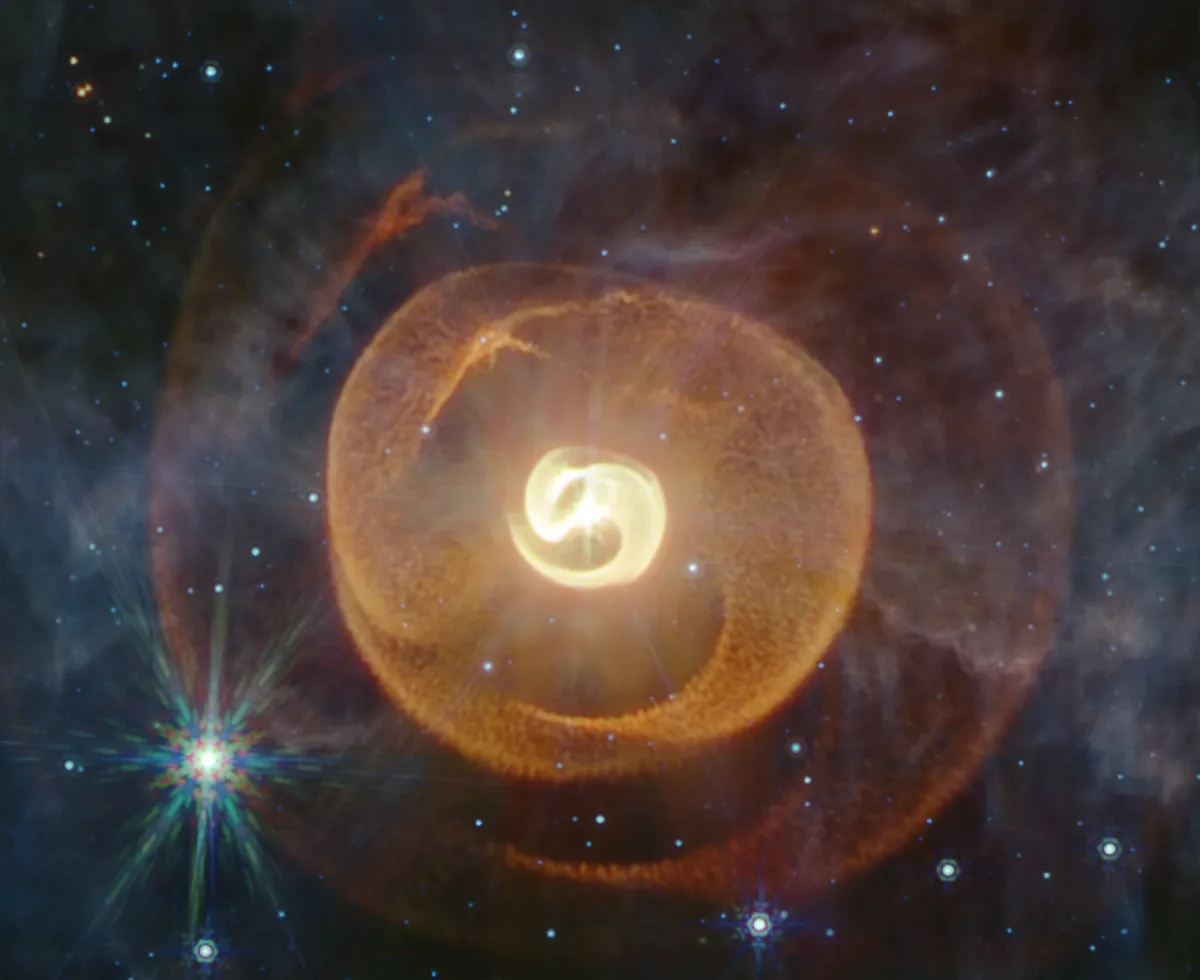
    NASA’s James Webb Space Telescope (JWST) has revealed that the Apep star system, located in our galaxy, is made up of three massive stars forming four repeating dust spirals over a 190-year cycle, a pattern created by violent stellar winds and a sneaky third star that cuts a path through the dust each time it swings past.

    Webb’s Mid-Infrared Instrument captured the clearest image ever taken of Apep. For the first time, scientists could see four thin, evenly spaced spiral shells wrapped around the center of the system. Each shell marks a period when two large, aging stars moved close enough for their winds to crash into each other and create thick clouds of carbon dust.

    Those two stars are known as Wolf-Rayet stars. They are hot, heavy, and in the final stage of their lives. They orbit each other once every 190 years. During about 25 of those years, their winds collide hard enough to produce large amounts of dust. That dust expands and forms a new spiral. Webb’s image shows shells formed from events going back around 700 years.

    In the center of the image is a bright point that earlier telescopes could not clearly explain. Webb confirmed that this point is actually three stars, not two. The third one is a large supergiant that circles the pair from far away. When it passes by, its wind cuts a clear V-shaped gap through the dust being released by the other two stars.

    That same gap appears in every shell. This shows the third star has been taking the same path for centuries. This detail helped scientists confirm that the supergiant is truly part of the system and not just passing through space by chance.

    Apep’s dust is made mostly of carbon. These tiny grains stay warm and glow in mid-infrared light. That is why Webb, which is built to see this type of light, could detect the faint outer shells that ground-based telescopes missed.

    Apep stands out because of its long cycle. Most similar systems create dust every few years or few decades. Apep’s 190-year period is the longest of its kind known in our galaxy, which gives scientists a rare chance to study how powerful winds behave over long periods of time.

    Over the next few hundred thousand years, both Wolf-Rayet stars are expected to explode as supernovae. Because of how fast they spin and how they lose material, one of those explosions could send out a narrow, powerful burst of energy through space.

    Source: The Serpent Eating Its Own Tail: Dust Destruction in the Apep Colliding Wind Nebula

  • JWST detects rare Phosphine gas in distant Brown Dwarf, solving a long unsolved mystery

    JWST detects rare Phosphine gas in distant Brown Dwarf, solving a long unsolved mystery

    Astronomers have found phosphine gas in the atmosphere of a brown dwarf named Wolf 1130C, about 55 light-years away. The signal comes from new James Webb Space Telescope (JWST) data and matches predicted levels for the first time. The find helps explain why other cool objects in space appear to lack this gas, even though models say it should be present.

    Brown dwarfs sit between planets and stars. They are too small to shine through steady hydrogen fusion but too large to count as planets. Wolf 1130C is one of the cooler examples, with a temperature of around 600 Kelvin. It has a mass about 40 times greater than Jupiter and a similar size.

    The system that hosts it is unusual. Wolf 1130 includes a close pair: a small red dwarf star and a white dwarf formed from an older star. Wolf 1130C moves far from that pair, at a distance thousands of times greater than the space between Earth and the Sun. The entire system belongs to an old region of the Milky Way known as the thick disk. Stars in this region contain fewer heavy elements than younger stars closer to us.

    That low metal level turns out to be key. Heavy elements like iron and phosphorus formed in earlier stellar explosions. Many older stars have less iron, but some show higher phosphorus than expected. Wolf 1130C appears to be one of them.

    JWST used two instruments to study the object. First, the NIRSpec spectrograph recorded infrared light between 0.6 and 5.2 microns. Then, MIRI mapped longer wavelengths. Together, they produced clean signals with high clarity, letting scientists separate Wolf 1130C’s light from the bright pair nearby.

    In that data, researchers saw a small dip at a wavelength around 4.3 microns. That dip matches a pattern caused by phosphine gas. It includes several narrow features that rule out carbon dioxide, which can mimic this signal. Models that assume still, unchanging layers in the atmosphere fail to produce phosphine. But when mixing is added, the match becomes clear.

    The levels detected reach about 0.1 parts per million. That is 100 times higher than readings for another cold brown dwarf called WISE 0855-0714. It also lines up closely with predictions made before the observation.

    On Jupiter and Saturn, phosphine rises from deeper, hotter layers. Under calm conditions it would break apart, so its presence points to strong mixing. Until now, brown dwarfs and giant planets outside our solar system only showed upper limits, far below predicted levels. In many cases, carbon dioxide blocks the signal scientists look for.

    Wolf 1130C appears different. Its low metal level cuts carbon dioxide to tiny amounts. That opens a clear window where phosphine can be seen. Low metals change other chemistry too. A salt that normally removes phosphine forms deeper in the atmosphere, letting some phosphine reach higher layers instead of disappearing.

    The data also suggest that water, methane, and hydrogen sulfide match simple expectations. Carbon monoxide and phosphine do not, which again supports strong mixing. Carbon dioxide comes in far below one part per billion.

    The phosphorus level matches what astronomers see in other thick-disk stars, where it can be higher than iron. It could come from ancient supernova explosions that enriched some parts of the galaxy or past activity from the white dwarf in the system.

    The result matters for studies of distant planets. Phosphine once raised excitement on Venus as a possible sign of life, until later work showed non-biological ways to make it. Wolf 1130C is a clear example of a lifeless world that produces it through normal chemistry and motion in its atmosphere.

    Researchers plan to examine more cold objects using JWST. Early results have already found clear carbon dioxide on a hot planet called WASP-39b. With more data, astronomers hope to learn how common phosphine is and what that says about weather and chemistry on planets and brown dwarfs across our galaxy.

  • NASA’s JWST May Have Detected a Galaxy From 90 Million Years After the Big Bang

    NASA’s JWST May Have Detected a Galaxy From 90 Million Years After the Big Bang

    Astronomers say the James Webb Space Telescope (JWST) may have captured the most distant galaxy ever seen, an object nicknamed Capotauro. The discovery, led by Giovanni Gandolfi of the University of Padua, comes from JWST’s CEERS survey, which searches deep space for early galaxies.

    The team shared its findings in a preprint posted to arXiv. If confirmed, the object would push cosmic history back to a time when the universe was only 90 million years old.

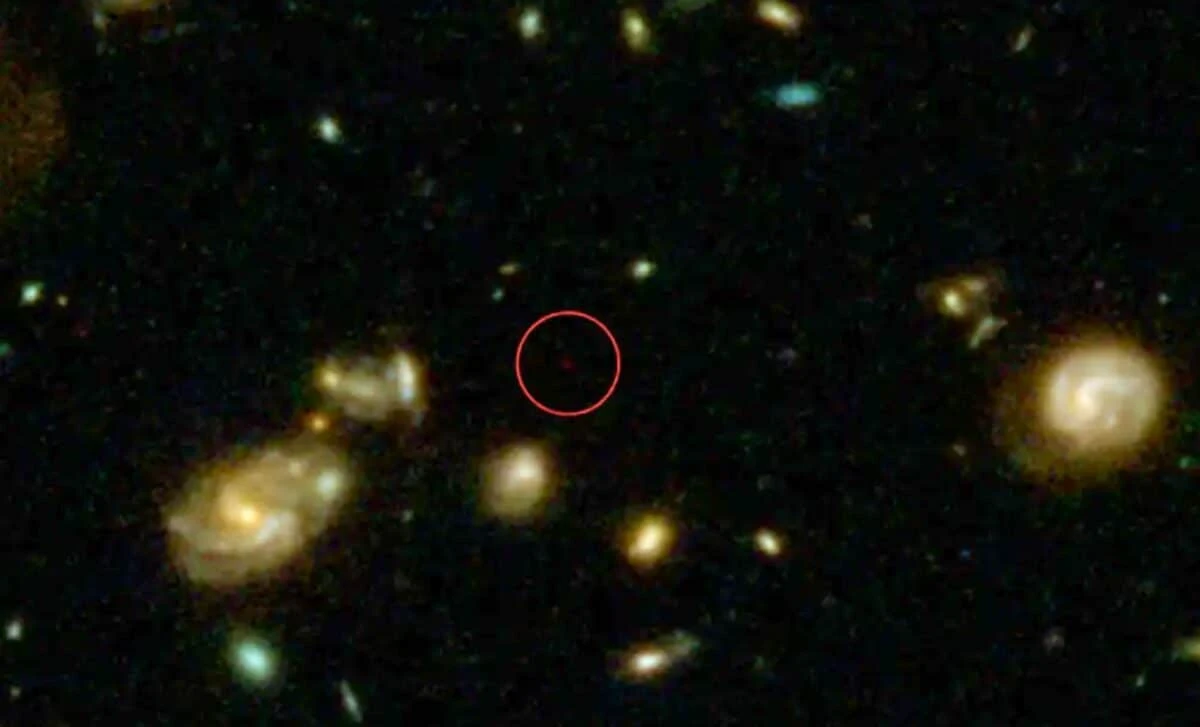
    Capotauro shows up in JWST’s infrared data as a faint red speck. It is absent in shorter wavelengths but appears bright in longer ones, with a sharp drop in brightness between 3.5 and 4.5 microns. Astronomers say this drop, called a Lyman break, is a clear sign of light stretched by the universe’s expansion over billions of years.

    The team used JWST’s NIRSpec instrument to study the object. Their analysis points to a redshift of about 32. That means the light left Capotauro when the universe was still in its first 100 million years of existence.

    The current record-holder for distance is a galaxy called JADES-GS-z14-0, found at redshift 14.3, dating back to about 290 million years after the Big Bang. If Capotauro truly sits at redshift 32, it would extend the timeline of galaxy formation by 200 million years. That period is thought to be when the first stars, known as Population III stars, came into being.

    These stars were massive and made only of hydrogen and helium. They later produced the heavier elements that formed later generations of stars and planets. A galaxy forming during this time would challenge existing models of how quickly cosmic structures could form.

    Not all astronomers agree that Capotauro is a galaxy. The data could also fit a much closer object, such as a dusty galaxy at a redshift below 10. Another possibility is that it is not a galaxy at all but a cold brown dwarf star inside our own Milky Way, with a surface temperature below 300 Kelvin.

    JWST’s early surveys have already produced several candidates for very early galaxies that later turned out to be either closer objects or noise in the data. While the evidence for redshift 32 is strong, the team estimates there is still a small chance (less than 1 percent) that the true redshift is under 25.

    If Capotauro is confirmed as a galaxy, it would reshape ideas of how quickly the first galaxies formed. Current models assume it would take hundreds of millions of years for matter to clump into stars and galaxies after the Big Bang. A galaxy at 90 million years suggests matter collapsed much faster, possibly because of how dark matter influenced early structure.

    The timing also overlaps with the so-called cosmic dawn, when ultraviolet light from the first stars cleared away the neutral hydrogen that filled the universe, making it transparent.

    The team behind the discovery is calling for more observations. Deeper spectroscopy from JWST could confirm the object’s distance and composition. Only then can astronomers know whether Capotauro is a galaxy from the earliest days of the universe or something closer to home.

    Whatever the result, Capotauro is now a target for further study. Whether it proves to be a faint brown dwarf or a galaxy from the dawn of time, it adds to the questions Webb was built to answer.

    Source: Mysteries of Capotauro – investigating the puzzling nature of an extreme F356W-dropout

  • Astronomers connect rare โ€˜little red dotsโ€™ galaxies to slow-spinning dark matter halos in early universe

    Astronomers connect rare โ€˜little red dotsโ€™ galaxies to slow-spinning dark matter halos in early universe

    Astronomers

    using the James Webb Space Telescope (JWST) have identified a rare class of compact, red galaxies in the early universe, nicknamed “little red dots.” A new study suggests these galaxies formed inside dark matter halos that spin unusually slowly, causing gas and stars to collapse into dense cores rather than spreading into larger disks.

    Little red dots, or LRDs, appear between redshifts 4 and 8, meaning we see them as they were when the universe was 1 to 2 billion years old. They are smaller than most galaxies, measuring only about 80 to 300 parsecs across, but denser than typical star-forming regions.

    Researchers Fabio Pacucci and Abraham Loeb propose that LRDs form in the slowest-spinning 1% of dark matter halos. Most halos rotate at a moderate rate, allowing galaxies to form with wide, extended disks. In low-spin halos, gravity pulls material inward, producing compact shapes. This rarity matches LRD numbers, which are about 1% of normal galaxies at similar brightness.

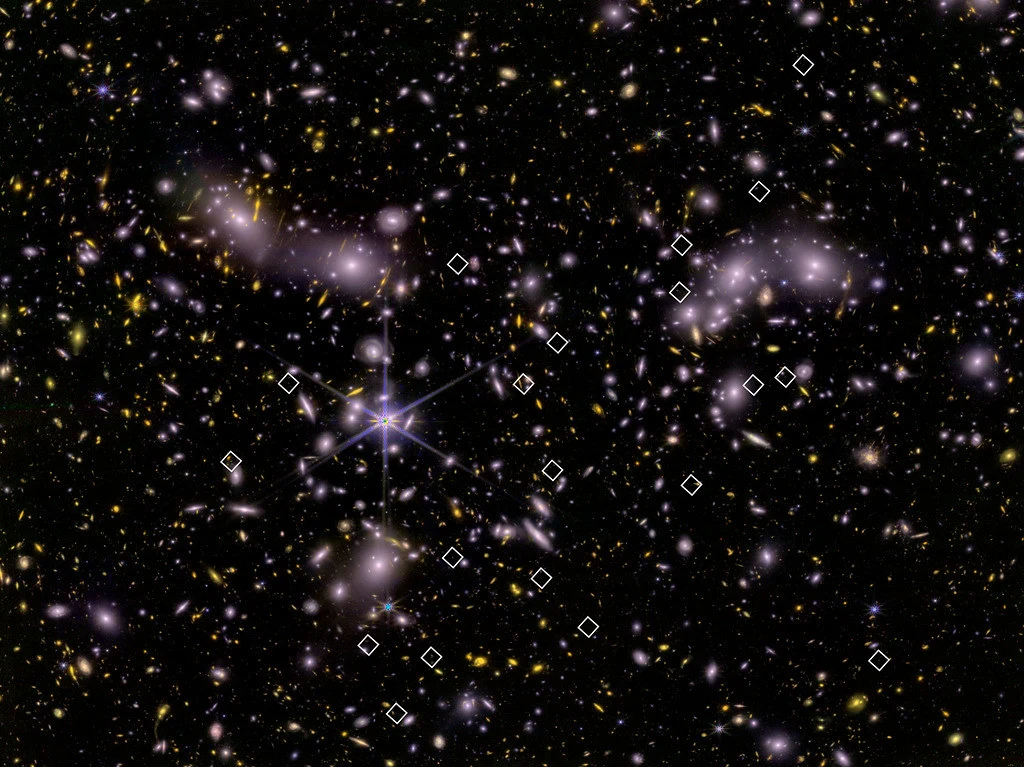
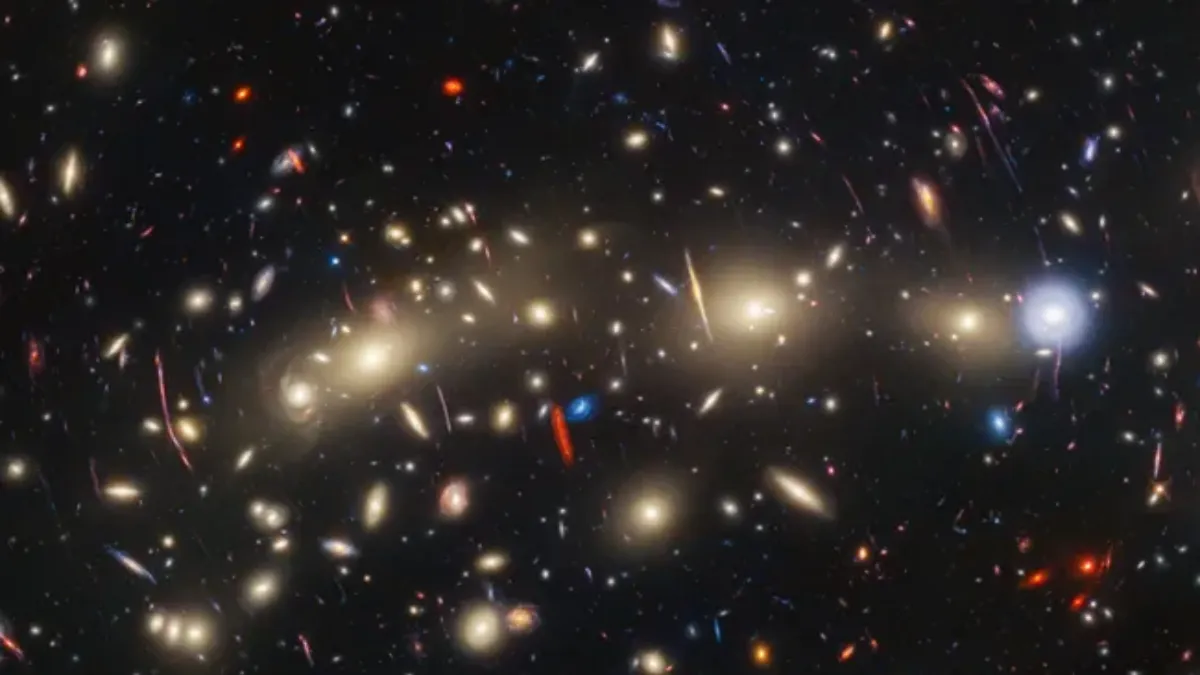
    This deep field image from the James Webb Space Telescope shows distant galaxies scattered across the night sky.
    In this deep-field view from the James Webb Space Telescope, countless distant galaxies fill the scene. The farthest galaxies appear as the “little red dots.” Image credit: NASA, ESA, CSA, STScI, Brant Robertson (UC Santa Cruz), Ben Johnson (CfA), Sandro Tacchella (Cambridge), Marcia Rieke (University of Arizona), Daniel Eisenstein (CfA)

    Modeling shows that a halo at redshift 5 with a mass of 100 billion Suns and a spin of just 0.0153 would host a galaxy smaller than 300 parsecs. Their abundance also matches predictions: rarer than ordinary galaxies but more common than bright quasars.

    The pattern changes over time. At lower redshifts, larger halos would need even slower spins to stay compact, which is uncommon. At higher redshifts, more low-spin halos exist, but their galaxies are too faint for JWST to detect. This explains why LRDs peak around redshift 5 and are scarce at both earlier and later times.

    Observations also show LRDs cluster more than expected, suggesting they form in quieter regions of space. Their dense cores could account for the broad emission lines seen in their light, whether powered by black holes or intense star formation.

    The study concludes that LRDs are not a strange new galaxy type but an extreme outcome of familiar processes. Future JWST observations could test the theory by checking whether these galaxies lack rotation, a hallmark of low-spin origins.

    The study was originally published in Astrophysical Journal Letters.

  • NASA’s Webb spots ‘Sleeping Beauty’ galaxies in the early Universe

    NASA’s Webb spots ‘Sleeping Beauty’ galaxies in the early Universe

    Using the James Webb Space Telescope (JWST), astronomers have uncovered a surprising group of 14 galaxies that paused their star-forming activity within the first billion years after the Big Bang. These “dormant” galaxies, found in a range of sizes, offer fresh clues about how galaxies grow and evolve in the universeโ€™s infancy.

    Galaxies form stars from cold gas clouds, but sometimes this process stalls. One cause is the intense radiation from supermassive black holes at a galaxyโ€™s core, which can heat or deplete the gas needed for stars. Nearby larger galaxies can also strip away this gas or warm it, halting star formation.

    Another factor is stellar feedback. When stars, through explosions like supernovas or powerful winds, push out or heat the gas, leaving the galaxy in a temporary quiet phase. โ€œThis pause usually lasts around 10 to 25 million years,โ€ said Alba Covelo-Paz, a doctoral student at the University of Geneva and lead author of the study, in an email. Over time, the gas can cool and fall back, allowing star formation to restart.

    Until recently, astronomers had only identified four dormant galaxies from this early period, with masses either below a billion times the Sunโ€™s or above 10 billion. This small sample left gaps in understanding how common these pauses were across different galaxy sizes.

    But JWSTโ€™s powerful Near-Infrared Spectrograph (NIRSpec) changed that. By analyzing light from about 1,600 galaxies in the DAWN JWST Archive, Covelo-Pazโ€™s team found 14 dormant galaxies with masses ranging from 40 million to 30 billion solar masses. The findings, posted on the preprint server arXiv on June 27, 2025, are awaiting peer review.

    These galaxies werenโ€™t expected to be dormant so early in the universeโ€™s history. Young galaxies are typically thought to form stars rapidly. A 2024 study had already surprised researchers by spotting one such galaxy, previously observed by the Hubble Space Telescope but only confirmed as dormant with JWSTโ€™s advanced capabilities. Unlike Hubble, JWST can detect the redshifted light from these distant galaxies and analyze its spectrum to reveal details about their stars.

    The team focused on galaxies showing signs of older or middle-aged stars but no new star formation. They used a tool called Bagpipes to model the galaxiesโ€™ star-forming histories, finding that these 14 galaxies had paused star formation 10 to 25 million years ago.

    This suggests a โ€œburstyโ€ pattern, where galaxies alternate between active star-forming periods and quiet phases, likely driven by stellar feedback. โ€œWe see these galaxies taking a breather,โ€ Covelo-Paz said. โ€œTheyโ€™ve likely paused due to processes like supernovas pushing gas out, but they could restart star formation later.โ€

    Still, questions remain. If these galaxies stay dormant for 50 million years or more, it might point to a permanent shutdown, possibly caused by black holes or other factors. For now, their properties support the idea of a temporary pause.

    To learn more, astronomers are planning a JWST program called โ€œSleeping Beautiesโ€ to hunt for more dormant galaxies and study how long these quiet phases last.

  • Astronomers capture earliest stages of Planet formation around a baby star HOPS-315

    Astronomers capture earliest stages of Planet formation around a baby star HOPS-315

    Astronomers have detected the earliest stages of planet formation around a young star named HOPS-315, located 1,370 light-years away. Using NASAโ€™s James Webb Space Telescope (JWST) and the European Southern Observatoryโ€™s ALMA telescopes in Chile, scientists observed solid particles forming in the gas disk surrounding this star, which is only 100,000 to 200,000 years old. The findings were published in Nature on July 16, 2025.

    โ€œWeโ€™ve captured the moment when rocky planets like Earth start to take shape,โ€ said Melissa McClure, who led the research team from Leiden Observatory in the Netherlands. The team identified silicon monoxide gas and crystalline silicate minerals (materials that were key to forming our own solar system over 4.5 billion years ago) in a region similar to the asteroid belt between Mars and Jupiter.

    A gap in the starโ€™s gas disk, combined with its tilt toward Earth, allowed astronomers to study this process closely. Images from ALMA show the system glowing brightly against the dark backdrop of space. โ€œThis is a major step in understanding how planets form,โ€ said Fred Ciesla, a University of Chicago scientist not involved in the study. โ€œWeโ€™re seeing evidence of processes weโ€™ve long theorized about.โ€

    The gas disk around HOPS-315 is massive, suggesting it could eventually form multiple planets, possibly as many as eight, over the next million years. McClure noted that this discovery indicates planet formation may be a common process around young stars. โ€œWe didnโ€™t know if this was unique to our solar system or something that happens often,โ€ she said.

    Researchers, including Purdue Universityโ€™s Merel van โ€™t Hoff, plan to study more young stars to compare their findings. โ€œWe want to learn if this process is typical and what it means for the chances of finding Earth-like planets elsewhere,โ€ van โ€™t Hoff said. This discovery offers a new perspective on the origins of planets and our place in the universe.

  • NASA’s JWST captures the first direct images of an Exoplanet

    NASA’s JWST captures the first direct images of an Exoplanet

    An international team of astronomers has captured the first-ever direct image of an exoplanet with a mass similar to Saturn, using NASA’s James Webb Space Telescope. The newly discovered planet, designated TWA 7 b, is orbiting a young red dwarf star called TWA 7, located about 34 light-years away in the TW Hydrae association.

    The team spotted a faint heat source inside the dusty disk that surrounds TWA 7. They used Webbโ€™s Mid-Infrared Instrument (MIRI) data to block the starโ€™s bright light and reveal hidden objects nearby. The source lies about 50 times farther from its star than Earth is from the Sun.

    The first-ever image of an Exoplanet captured by JWST MIRI instrument
    A composite image combining data from ESOโ€™s SPHERE (blue) and JWSTโ€™s MIRI (orange) reveals the candidate exoplanet TWA 7 b as a bright orange spot near the top. The central star TWA 7, marked with a dotted circle and a star symbol, has been masked to highlight nearby features. Credit: Anne-Marie Lagrange (CNRS, UGA), Mahdi Zamani (ESA/Webb) / NASA, ESA, CSA

    TWA 7 b fits theoretical models for a young, cool planet with a mass similar to Saturn and a temperature around 47 degrees Celsius. Its position lines up with a gap in one of the three rings within the surrounding disk, suggesting it may be shaping the disk’s structure through gravitational influence.

    โ€œOur observations reveal a strong candidate for a planet shaping the structure of the TWA 7 debris disk, and its position is exactly where we expected to find a planet of this mass,โ€ lead author Anne-Marie Lagrange from CNRS and Universitรฉ Grenoble Alpes in France told NASA.

    Astronomers have long been studying such rings and gaps in dusty disks as signs of hidden planets, but they have never imaged such a planet directly.

    These observations were part of JWST’s program 3662, which focuses on early-stage planetary systems. Using a coronagraph on JWST’s MIRI instrument, the team blocked the glare from the star, removed leftover starlight through image processing, and revealed a small heat source near the inner part of the disk.

    While there is a small chance the source is a distant galaxy, the objectโ€™s size and distance from its star match what scientists expect from a young Saturn-mass planet. Its place in the disk also raises the chance it may hold a โ€œtrojan diskโ€ (a rare dust structure in the same orbit as the planet).

    Follow-up work will now focus on confirming that the object is a planet and studying its air and motion to better understand how planets grow in young star systems.

    The research was published on June 25 in the journal Nature.

  • Breakthrough! James Webb Space Telescope confirms presence of crystalline water ice in a nearby Star System
    Breakthrough! James Webb Space Telescope confirms presence of crystalline water ice in a nearby Star System
    Researchers have confirmed the presence of crystalline water in space for the first time in human history! The James Webb Space Telescope (JWST) has discovered crystalline water ice in a dusty debris disk orbiting the Sun-like star HD 181327, located 155 light-years away. Researchers used NIRSpec (Near-Infrared Spectrograph) (a super-sensitive instrument designed to detect faint dust particles from space) for this discovery.

    NASA’s retired Spitzer Space Telescope hinted at the possibility of frozen water in the same system back in 2008; however, it lacked the sensitivity to confirm the discovery. Now, Webb has not only confirmed the presence of water ice but also revealed that it is mixed with fine dust particles throughout the debris disk, forming what scientists describe as tiny โ€œdirty snowballs.โ€

    The Webb Telescope revealed that water ice is most abundant in the cold outer regions of the disk, where over 20% of the material is ice. Webb detected about 8% water ice in the middle region of the disk. Almost no water ice was found in the inner region of the disk, likely due to ultraviolet radiation from the star vaporizing the ice or its entrapment within planetesimals.

    The star HD 181327 is relatively young at 23 million years old and is slightly more massive and hotter than our Sun, resulting in a larger surrounding system. The discovery of crystalline water ice around this young star can help scientists better understand how planets form and how water might be delivered to rocky worlds.

    Crystalline water ice has also been found in Saturnโ€™s rings and the Kuiper Belt in our solar system and is considered a key ingredient in the formation of giant planets. Thus, the large gaps between the star HD 181327 and its debris disk suggest that the system may be shaped by an emerging planet or is still in the early stages of its evolution.

    These findings were originally published in a recent article by NASA.