Tag: Nova

  • New research suggests black holes can trigger unique supernovae, challenging past theories

    New research suggests black holes can trigger unique supernovae, challenging past theories

    Astronomers have spotted a supernova that’s unlike any they’ve seen before, and they think it’s a star that exploded while being consumed by a black hole. This rare event, named SN 2023zkd, was first seen in July 2023, about 730 million light-years away in a low-mass host galaxy with little star formation.

    Classified as a Type IIn supernova, it stands out because of narrow hydrogen lines in its spectrum, along with strong helium features that make it helium-rich. These traits point to the explosion happening inside a dense cloud of gas the star lost earlier.

    A special AI tool, called LAISS, designed to find strange space events, flagged it for immediate attention. This allowed astronomers to get crucial data from the beginning of the explosion, giving them a full picture of what happened.

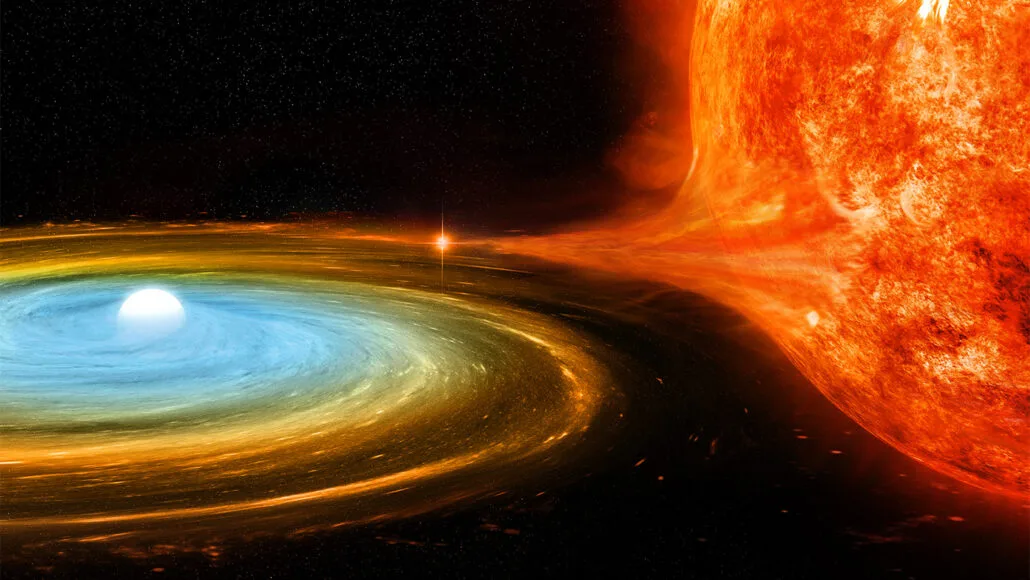
    Scientists from Harvard, MIT, and other universities believe a massive star, starting with at least 30 solar masses and partially stripped of its outer layers, was in a tight orbit with a black hole. As the star got closer, the black hole’s immense gravity began to pull off gas and dust, forming a swirling disk around it.

    Before the black hole could fully swallow the star, the intense pressure and gravitational stress caused the star to detonate. The blast ejected about 10 solar masses of material at high speeds, with an energy around 2 × 10^51 ergs.

    The light curve showed two peaks: the first reached an absolute magnitude of about -18.7 in the r-band, then it faded, only to brighten again to -18.4 magnitude roughly 240 days later. This second flash came from the shock wave hitting denser material the star had ejected earlier.

    Spectra revealed asymmetric lines from hydrogen and helium, with velocities ranging from 400 km/s in slow-moving equatorial hydrogen to 1,000-2,000 km/s in faster polar helium. These suggest an uneven distribution of material around the system.

    Looking at old data, scientists found that the system had been glowing more brightly for four years before the big explosion, with a persistent brightness around -15 magnitude in the the r-band. This precursor split into two parts: a long steady phase and a ramp-up in the final year.

    The total circumstellar material involved was about 5-6 solar masses, lost in bursts 3-4 years and 1-2 years before the explosion. Such high mass-loss rates, up to 1 solar mass per year, are hard to explain with a single star.

    An alternative view is a tidal disruption where the black hole rips the star apart without a true supernova, but the long precursor and spectral details favor the merger scenario. “This is strong evidence for black holes triggering these special explosions,” said Alexander Gagliano, the lead author of the study. It points to a process where orbital instability leads to a common envelope phase, ending in a blast.

    V. Ashley Villar, a co-author, believes this could be a new kind of supernova that scientists haven’t recognized before. Most massive stars live in pairs, so binary ends like this might be more common than thought.

    This discovery shows how binary systems can produce odd supernovae and perhaps lead to pairs of black holes that merge later, detectable by gravity waves.

    As new, powerful telescopes like the Vera C. Rubin Observatory become fully operational, they will scan the entire sky for transient events. Scientists believe that AI tools will be key in sifting through the vast amounts of data to find similar, hidden classes of supernovae.

    The findings were published in the Astrophysical Journal.

    References

  • A ‘New Star’ has Exploded in the Night Sky! Hereโ€™s Where to See It

    A ‘New Star’ has Exploded in the Night Sky! Hereโ€™s Where to See It

    Astronomers have discovered a new star in the night sky. This new star is not a normal star but a nova. On June 12, 2025, the All-Sky Automated Survey for Supernovae detected a sudden bright spot in the constellation Lupus. Over the coming days, that spot brightened enough to become visible without a telescope. This supernova is named V462 Lupi.

    As of June 18, it had reached an apparent magnitude of +5.7, just inside the range our eyes can see under dark skies. The explosion made the star 4 million times brighter than it was before, thanks to a thermonuclear burst on the surface of a white dwarf in a binary system.

    Where is the Nova V462 Lupi visible?

    The nova is visible in the constellation Lupus, low in the southern sky after sunset. It’s best seen from the Southern Hemisphere, but people in North America can also catch a glimpse. Sightings have been reported as far north as Lake Superior, as well as in California and Arizona, particularly just after sunset near the southern horizon. The nova can be viewed with the naked eye in dark sky areas; however, using a telescope or binoculars can increase your chances of spotting it.

    What is a nova?

    A young boy pointing to a bright new star in the night sky
    (Artist’s Concept). Credit: Nihal sayyad / Wonders in Space

    A nova is a transient astronomical event that causes the sudden appearance of a bright, apparently newย star that slowly fades over weeks or months.

    What Makes This Event Rare?

    Novae like this one do happen, but they rarely reach a brightness level we can see without tools. On average, just one or two novae a year become visible to the naked eye worldwideโ€”and often, they appear in hard-to-see parts of the sky or go unnoticed due to moonlight, clouds, or city lights.

    What makes V462 Lupi stand out is that it was unexpected; it got bright enough for backyard stargazers to notice. It’s in a southern constellation but still visible from parts of the Northern Hemisphere.

    Don’t miss this incredible opportunity to witness a nova explosion. Use a sky-watching app like Stellarium to find the constellation and the nova, and enjoy the experience!

  • Rare nova explosion; T Coronae Borealis Star System to Go Nova

    Rare nova explosion; T Coronae Borealis Star System to Go Nova

    Stargazers are waiting for a once-in-a-lifetime show. The binary star system T Coronae Borealis, or TCrB, is expected to go nova, or explode, anytime between now and September. This event will cause the star system, which is normally too faint to see, to brighten dramatically to a magnitude of +2—about the same brightness as the North Star, Polaris. When it brightens, it will be visible to the naked eye.

    The TCrB system is located 3,000 light-years from Earth in the Northern Crown constellation. Its last explosion happened in 1946, and these events occur roughly every 80 years. This rare opportunity gives scientists and the public a chance to witness a nova explosion without a telescope.

    What is a Nova Explosion?

    A nova is not the complete death of a star. It happens in a binary system, where a large, unstable red giant star transfers its outer layers of material to a much smaller, denser white dwarf star. As the white dwarf collects this material, the pressure and heat on its surface build up until a massive thermonuclear reaction occurs. This causes a sudden, bright explosion.

    Unlike a supernova, which marks the total destruction of a star, a nova only involves about 5% of the star’s material. The stars in the TCrB system will survive the blast and begin the cycle again, leading to another nova in about 80 years.

    Ten such events are expected to happen in the Milky Way galaxy, and the TCrB explosion is one of them.

    How to Spot the Nova

    When it occurs, the “new star” will be visible in the semicircular constellation Corona Borealis, which is situated between the Hercules and Boötes constellations. The nova is expected to be visible for about five days at this location, offering a viewing window for observers around the world.

    Image of the constellation Coronae Borealis where the Nova explosion will be visible in 2024.
    The constellation Corona Borealis, where the nova will appear. Image credit: IAU and Sky & Telescope magazine (Roger Sinnott & Rick Fienberg). Source: Wikimedia Commons
    • Timing and Location: Since the exact date is unknown, keep an eye on NASA’s updates. When the nova happens, find a spot with a clear view of the sky and away from city lights.
    • Equipment: The nova will be bright enough to see with your eyes, but binoculars or a telescope will provide a better view.
    • Photography: If you’re a photographer, use a DSLR camera with manual settings and a stable tripod to capture the moment.

    Will Our Sun Go Nova or Supernova?

    Some people wonder if our own Sun could experience a similar fate. The answer is no. A nova requires a binary star system, a condition our Sun does not meet. A supernova, which is the complete explosion of a star, only happens to stars that are at least eight times more massive than our Sun.

    Our Sun will follow a different, quieter path. It will expand into a red giant and then shed its outer layers, becoming a planetary nebula before finally settling into a white dwarf.

    The TCrB nova is a special event that gives scientists valuable insights into the dynamics of binary star systems and the processes that power these explosions. Don’t miss this opportunity to see a cosmic event that has been building for 80 years.