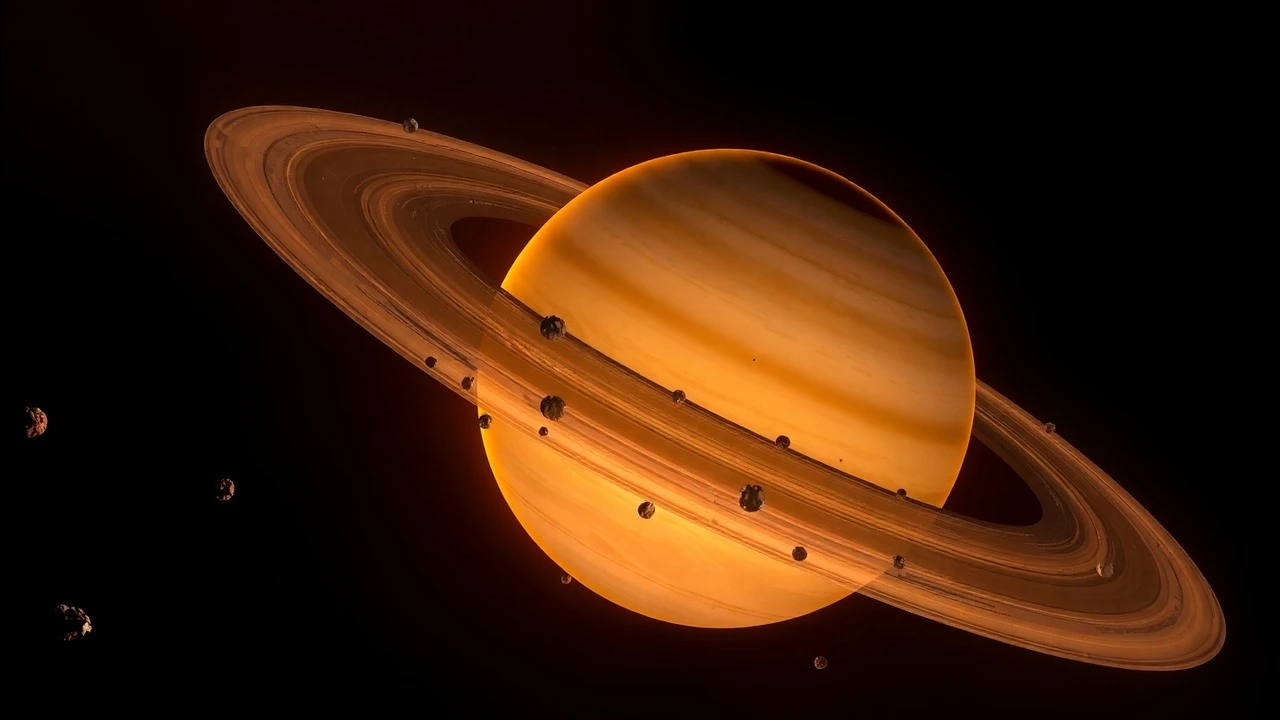
Tag: Saturn

  • Saturnโ€™s Rings have vanished from view, and the next opportunity wonโ€™t come for over a Decade!

    Saturnโ€™s Rings have vanished from view, and the next opportunity wonโ€™t come for over a Decade!

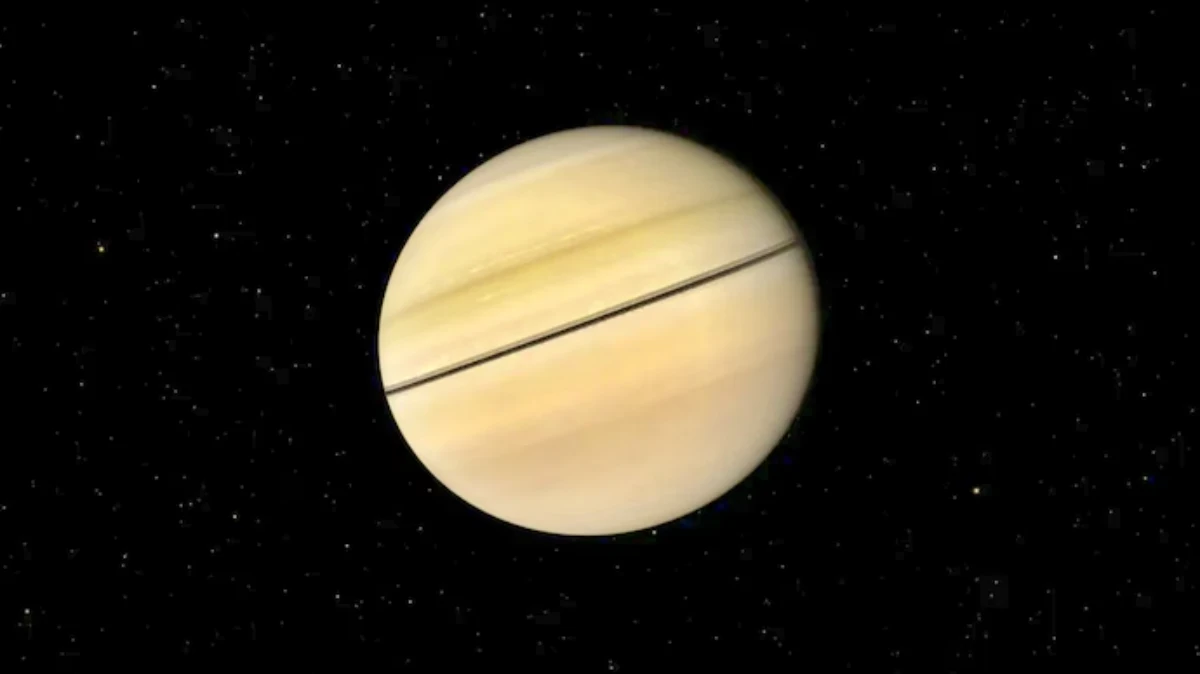
    Saturnโ€™s rings briefly disappeared from Earthโ€™s view when the planet reached a rare edge-on alignment with our line of sight. NASA confirmed the event with new Hubble Space Telescope images released a few days earlier, showing the rings reduced to a narrow line. The alignment happens because of how Earth and Saturn move around the Sun. The rings will begin to tilt back into view in early 2026.

    NASAโ€™s image from November 23 shows Saturn as a pale yellow globe with a thin streak across its middle. Even Hubble struggles to detect the rings when they are viewed edge-on, as their thickness is tiny compared to their overall width. Hubble documented a similar alignment in 1995.

    The rings look like they vanish because they are extremely thin. Although they stretch about 282,000 kilometers across, most of the material is packed into a layer only a few dozen meters thick. Saturn is tilted by about 27 degrees relative to Earthโ€™s orbital plane, which causes the rings to swing in and out of view every 13 to 15 years.

    This change in appearance confused early astronomers. Galileo first saw what he described as โ€œhandlesโ€ on Saturn in 1610. Two years later, he found that the features had disappeared. The actual structure of the rings was not understood until Christian Huygens studied Saturn in the mid-1600s.

    The 2025 alignment happened twice. The first crossing occurred on March 23, but Saturn was too close to the Sun to observe. The second crossing in November offered a clearer view as the planet moved higher in the evening sky. Small telescopes now show Saturn as a round disk with only a faint line marking the ring plane. Saturnโ€™s largest moon, Titan, remains easy to spot.

    The rings will begin opening again in the first months of 2026. They will continue to widen throughout the year and reach their next full tilt toward Earth in 2032. When fully open, the rings show well-known gaps created by the gravitational pull of Saturnโ€™s moons.

    These periodic alignments also help scientists study how the ring system changes over time. Data from NASAโ€™s Cassini mission indicate that particles from the rings slowly fall into Saturn. If that process continues at the same rate, the rings could disappear entirely within 100 to 300 million years.

    People hoping to see Saturn during the alignment can look toward Aquarius after sunset. Binoculars will show a bright point, and small telescopes will reveal the thin appearance of the rings. Those who cannot observe directly can use NASAโ€™s Eyes on the Solar System tool to simulate the event from home.

    The temporary disappearance of the rings is a normal part of Saturnโ€™s orbit, but it remains an uncommon event for observers. The next chance to see the rings edge-on will not arrive again for more than a decade!

  • “Iโ€™m thrilled!” Astrophotographer Captures the Rare ISS-Saturn Transit

    “Iโ€™m thrilled!” Astrophotographer Captures the Rare ISS-Saturn Transit

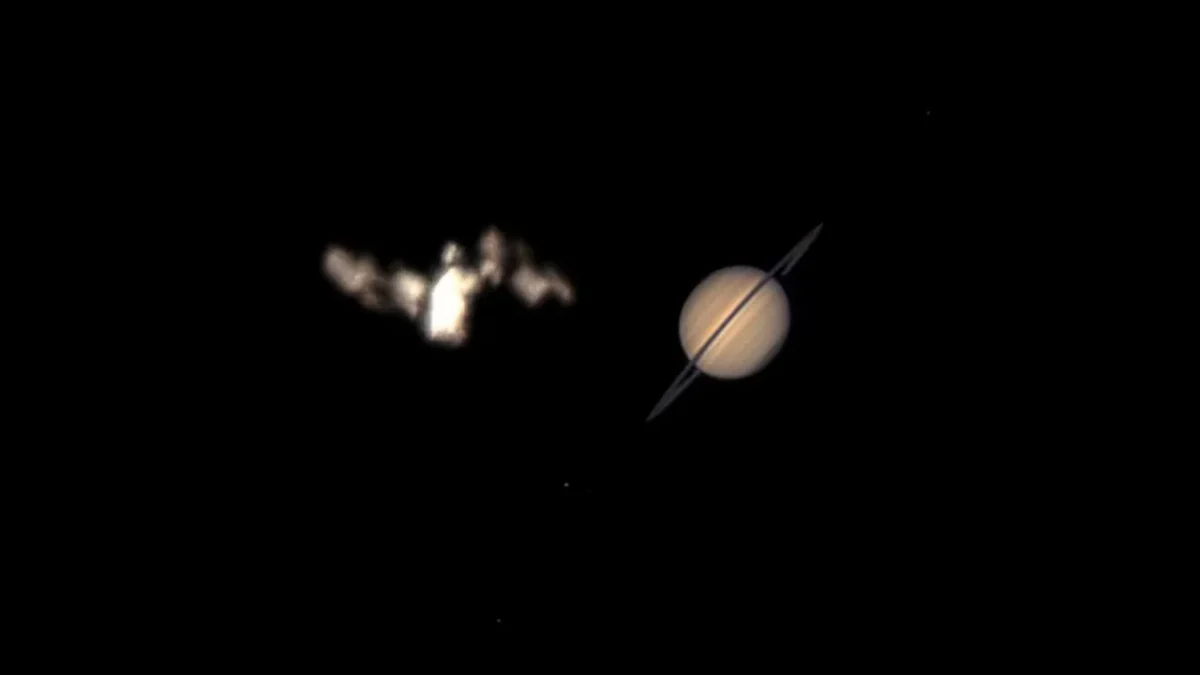
    Adam Smadi, a 20-year-old astrophotographer from Shoreline, Washington, captured a rare image of the International Space Station (ISS) passing in front of Saturn on the morning of July 6 (Eastern time), achieving a stunning visual alignment of two celestial objects 1.39 billion kilometers apart.

    After two days of meticulous planning and a 50-mile journey to a precise location, Smadi used the Stellarium app and coordinate calculations to pinpoint the exact spot where the ISS and Saturn would briefly appear to overlap from Earthโ€™s perspective. This fleeting event, known as a transit, marks a feat accomplished by only a handful of people worldwide.

    Single, raw Frame of ISS transiting Saturn.
    Single, raw frame of the ISS-Saturn transit captured on July 6, 2025. Image Credit: Adam Smadi

    Using a Celestron NexStar Evolution 9.25โ€ telescope and a ZWO ASI662MC camera with an IR685 and visible light blend, Smadi documented Saturnโ€™s iconic rings in vivid detail, though the ISS appears less sharp due to its significant distance from Earth at the time.

    Smadi, who previously photographed a rare solar eclipse on Saturn, noted that Saturnโ€™s dimmer appearance compared to the ISS results from the inverse square law of light, which causes surface brightness to drop rapidly with distance from the inner solar system. โ€œThe conditions were great, but the station was quite far, so itโ€™s not the sharpest. Still, Saturn looks amazing, and Iโ€™m stoked with the result,โ€ Smadi shared on Instagram.

    This remarkable image underscores the precision and dedication required in astrophotography, blending advanced technology, careful planning, and a deep understanding of celestial mechanics to capture a moment that bridges the vast distances of our solar system.

  • Must see Astronomical events in July 2025

    Must see Astronomical events in July 2025

    Attention, stargazers! July 2025 offers some exciting stargazing opportunities for both casual observers and professional astronomers around the globe. Starting with the conjunction of Antares and the Moon, the month will end with the peak of the Delta Aquarids meteor shower.

    This article serves as a clear and reliable guide to help you navigate the celestial events of July, offering detailed insights into each event so you can make the most of your stargazing experience.

    Key astronomical events in July 2025

    • July 1-7: Mercury appears bright and easy to see low in the western sky 30 to 45 minutes after sunset. A clear horizon is required for visibility before it sets.
    • July 3: Mercury lies near the Beehive Cluster in the western sky after sunset, visible until around 8:20 p.m. At the same time, Spica appears close to the Moon and remains in view until midnight.
    • July 4: Earth reaches its farthest distance from the Sun (Aphelion): 152 million kilometers. Mercury reaches its greatest eastern elongation, offering its widest separation from the Sun in the evening sky.
    • July 21-22: A crescent moon appears close to Venus and Jupiter in the eastern sky just before sunrise. Several bright stars remain visible in the same region.
    • July 28: A crescent moon appears near Mars in the western sky after sunset.
    • July 30-31: The Delta Aquariids meteor shower peaks, with as many as 25 meteors per hour visible from 9:30 p.m. until dawn. (Check Radiant Point.)

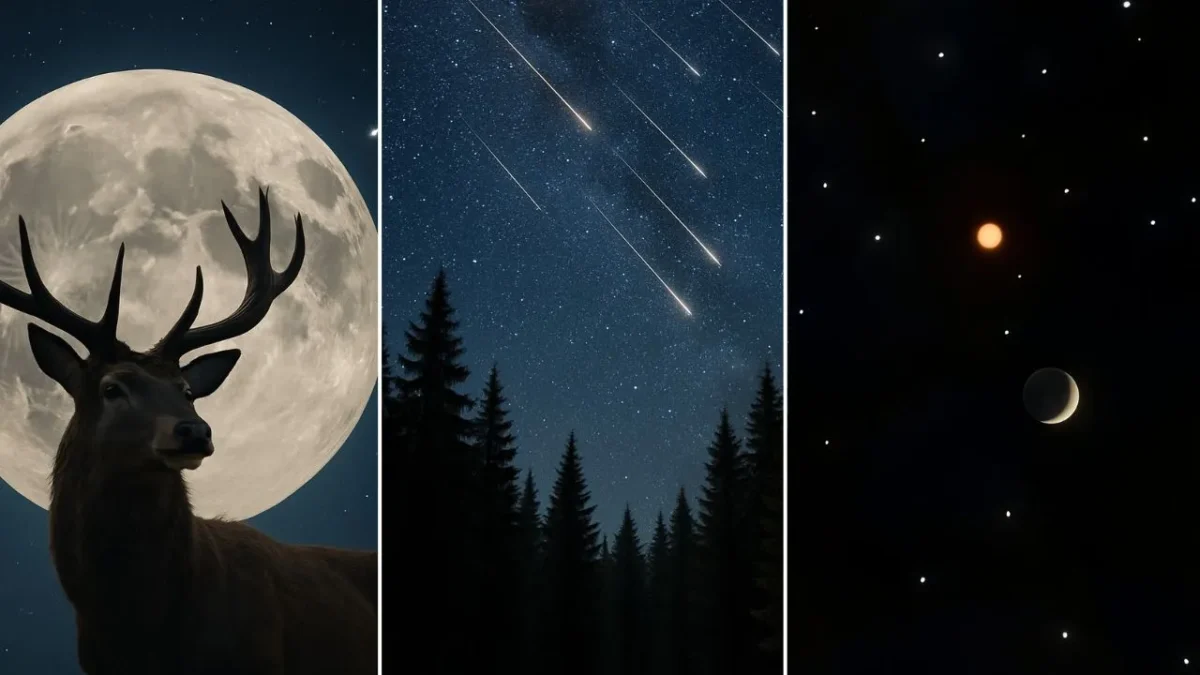
    The Buck Moon

    The Buck Moon/the July full moon.
    (Artists’s Concept)

    According to Forbes, the Buck Moon (Full Moon of July) will reach its full phase at 4:38 p.m. EDT on Thursday, July 10. While it will appear full the night before and after its peak, the most breathtaking view will be during moonrise at dusk on July 10. That is when the full moon will hang low on the horizon, appearing larger, brighter, and more dramatic.

    According to Farmer’s Almanac, the name comes from Native American traditions, referring to the time of year when male deer, or bucks, begin to grow new antlers covered in soft velvet. The term has since become widely recognized in modern lunar calendars.

    This yearโ€™s Buck Moon does not coincide with the Delta Aquariids peak, allowing clearer views of the meteor shower later in the month.

    Planets and constellations visible in July 2025

    • Venus shines brightly in the eastern sky during the two hours before sunrise, appearing near the Pleiades star cluster, Aldebaran, and Capella throughout the month.
    • Mars appears low in the west after sunset and remains visible for a couple of hours. Its brightness gradually fades as the month continues.
    • Jupiter begins rising in the east around an hour before sunrise from mid-July onward, climbing higher each morning.
    • Saturn rises around midnight and stays high in the southern sky through the early morning hours.
    • The Aquila constellation is visible in the eastern sky during the first half of the night. Its brightest star, Altair, forms one corner of the Summer Triangle and remains easy to locate, even from areas with light pollution.

    Space History

    The month of July 2025 marks 60 years since NASAโ€™s Mariner 4 performed the first successful flyby of Mars in July 1965. It was the first mission to send back close-up images of another planet and revealed that Mars has a very thin, cold atmosphere.

    Moon phases for July 2025

    • First quarter: July 2
    • Full Moon: July 10
    • Third quarter: July 17
    • New Moon: July 24

    Darker skies around the new moon offer ideal conditions for viewing faint stars, planets, and meteor showers. Topped with multiple conjunctions, July remains a rewarding month for skywatching.

  • โ€˜Wonโ€™t happen again until 2038โ€™: Astrophotographer captures a rare solar eclipse on Saturn

    โ€˜Wonโ€™t happen again until 2038โ€™: Astrophotographer captures a rare solar eclipse on Saturn

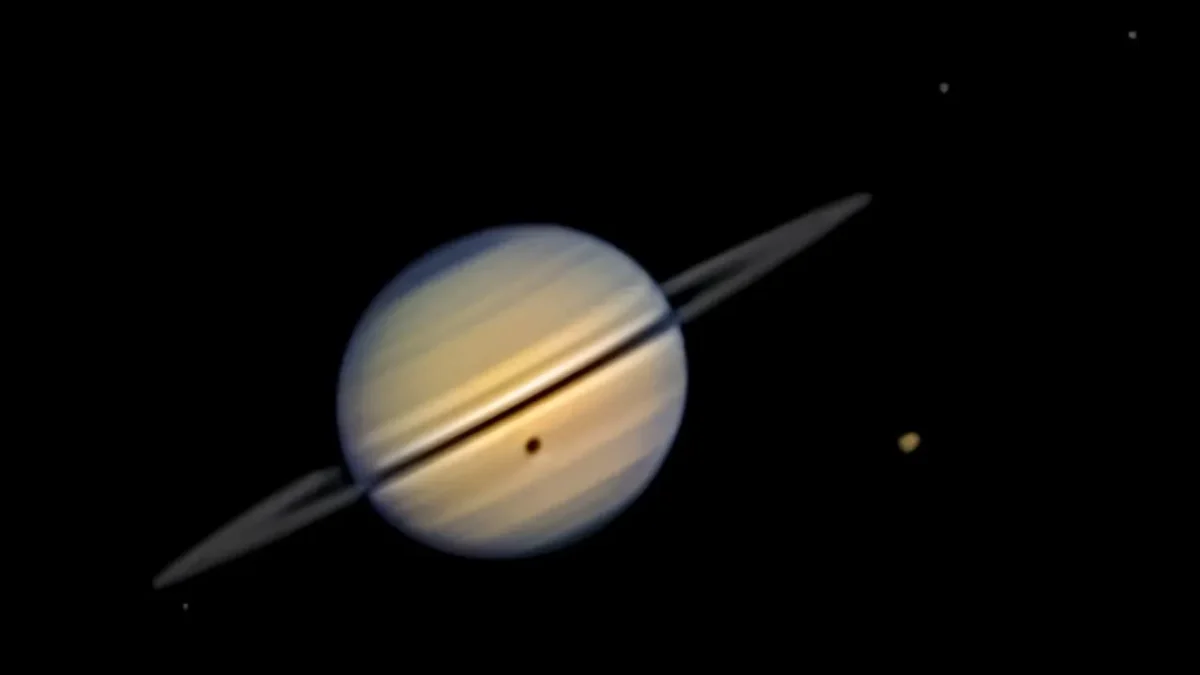
    A 20-year-old astrophotographer from Shoreline, Washington, has captured a rare solar eclipse on Saturn. The event, known as a shadow transit, showed Saturnโ€™s largest moon, Titan, casting a small dark shadow on the planetโ€™s surface. This type of eclipse will not be visible again until 2038.

    Adam Smadi has been practicing astrophotography for about two years. He said that he planned the shot days in advance using the Stellarium software, which helped him find the exact time and location from which the eclipse would be visible.

    โ€œI saw that it was going to be visible during the perfect time from Shoreline,โ€ Smadi told Wonders in Space. โ€œI knew I had to try.โ€

    A rare solar eclipse on Saturn, caused by its largest moon, Titan, with other moonsโ€”Dione, Tethys, and Enceladusโ€”visible in the frame.
    Titan casts its shadow on Saturn, creating a rare solar eclipse, while three of Saturnโ€™s moons, Dione (bottom left), Tethys (far bottom left), and Enceladus (a faint dot just above the tip of Saturnโ€™s ring on the right), join the scene. Credit: Adam Smadi

    He began setting up his 9.25 inch telescope around 1 a.m. to let the equipment cool down and match the outdoor temperature and reduce air currents inside the telescope, helping create sharper images. By 3:30 a.m., Saturn was high enough in the sky to begin imaging. Smadi used a ZWO ASI662MC camera and an infrared filter (685 nm) that helped reveal more detail in Saturnโ€™s atmosphere.

    โ€œI stacked thousands of images using video captures,โ€ he told Wonders in Space. โ€œAnd thereโ€™s the result.โ€

    Shadow transits like this are rare. They only happen when Saturnโ€™s rings are edge-on from Earthโ€™s point of view, allowing moon shadows to cross the planetโ€™s face. These viewing windows last only a few months and return about every 15 years.

    Labeled image of a rare solar eclipse on Saturn.
    (Labeled image) Titan casts its shadow on Saturn, creating a rare solar eclipse, with moons Dione, Tethys, and Enceladus also in view. Features like the Cassini Division, ring shadow, and south polar storms are also visible in this stunning view. Credit: Adam Smadi

    Smadi’s stunning photos have been widely shared across astronomy forums and social media platforms, drawing praise from viewers around the world. On Instagram, his followers and viewers flooded the comments with admiration and excitement. โ€œAward winning,โ€ one user wrote. โ€œFantastic, glad you were able to catch it!โ€ said another.

    While it may look like a small dot on a giant planet, it reflects hours of preparation and a precise understanding of planetary motion.

    Follow Adam Smadi on Instagram to see more of his stunning work.

  • Saturn solidifies its ‘Moon King’ title as astronomers discovered 128 new moons orbiting the planet

    Saturn solidifies its ‘Moon King’ title as astronomers discovered 128 new moons orbiting the planet

    A team of astronomers from Taiwan, Canada, the U.S., and France has confirmed the discovery of 128 new moons orbiting Saturn, cementing the gas giant’s status as the “Moon King” of our solar system. This breakthrough raises Saturn’s total moon count to an impressive 274, far surpassing Jupiter’s 95 moons.

    The discovery of the 128 new moons around Saturn was made in 2023 using the Canada-France-Hawaii Telescope. However, the International Astronomical Union officially recognized these moons on March 11, 2025.

    The team, led by Dr. Edward Ashton from Academia Sinica in Taiwan, revisited earlier observations in 2023 to confirm the presence of these additional moons. The newly discovered moons are all relatively small, with diameters ranging from 1 to 3 kilometers.

    “These aren’t large moons like Titan or Enceladus,” explains Dr. Elena Vasquez, lead astronomer on the project. “They’re more like small rocky bodies captured by Saturn’s gravity over time. But they still count as moons since they orbit the planet in stable patterns.”

    Most of the new moons follow irregular orbits, suggesting they were not formed alongside Saturn but were captured later. They orbit at significant distances from the planet, with some taking more than three Earth years to complete a single orbit around Saturn.

    This discovery highlights how technology continues to enhance our understanding of the solar system. “Twenty years ago, we could only detect the largest moons,” notes Dr. James Chen, planetary scientist at the Pacific Astronomy Institute. “Now our instruments can identify smaller and more distant objects, revealing just how complex Saturn’s system truly is.”

    The finding raises questions about how Saturn managed to capture so many objects. Researchers suggest its position in the solar system and strong gravitational field make it particularly effective at capturing passing objects.

    The research team has begun the process of naming these new moons, following the IAU convention of using names from various mythologies. The public may even be invited to participate in naming some of these newly discovered natural satellites in the coming months.

    FAQ’s

    How many moons does Saturn have?

    Saturn currently has 274 moons officially recognized by the International Astronomical Union (IAU). Previously, the planet had 146 known moons, but a recent discovery of 128 additional moons by a team led by Dr. Edward Ashton from Academia Sinica, Taiwan, has increased the total count. This makes Saturn the ‘Moon King’ of our solar system.

  • Saturn enters opposition: Watch Saturn at its largest and brightestย 

    Saturn enters opposition: Watch Saturn at its largest and brightestย 

    The beautiful ringed planet Saturn entered opposition on September 7 and 8. This was significant, as Saturn appeared the largest and brightest from Earth during that time. On these dates, Earth was positioned right between Saturn and the Sun. This alignment allowed Saturn to shine brighter and larger than usual.

    Using a telescope or binoculars was recommended, as the majestic rings of Saturn werenโ€™t visible to the naked eye. As estimated, Saturn rose around 6 pm local time on September 7, and it set between 5:30 and 6:30 am local time on September 8.

    For those who caught this event, it was a special opportunity, as the next Saturn opposition will occur on September 21, 2025. During this event, Saturn was located in the constellation Aquarius. Skywatching software or a sky chart was recommended to find Saturnโ€™s exact location, and using a telescope enhanced the view. The planet reached its peak around midnight local time, appearing highest in the sky.

    During this once-in-a-year astronomical event, Saturn looked more beautiful than usual, as the bright direct sunlight made its rings more visible and appear brighter. This phenomenon is known as the Seeliger Effect, named after the German astronomer Hugo Seeliger, who first described it.

    On September 7, the moon was a waxing crescent, around 18% full, so moonlight did not interrupt skywatching sessions. Clouds, however, were a concern, as rains were increasing in some parts of India.